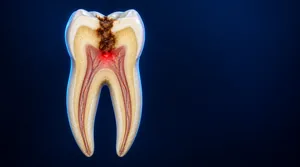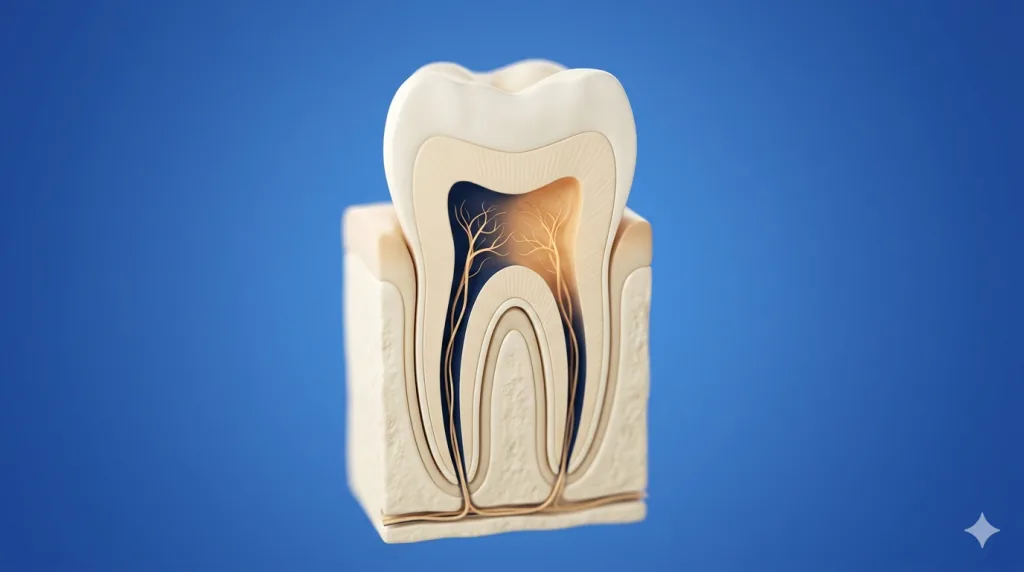
The phrase “nerve pain” means different things depending on where in the tooth the nerve is being affected and why. Understanding the anatomy of tooth sensation helps demystify why toothaches feel so different from one situation to the next, and why the same symptom can have different causes and treatments.
The Anatomy Behind Tooth Nerve Pain
How a Tooth Feels Pain
Dentin tubules
The dentin layer beneath the enamel contains thousands of microscopic fluid-filled channels that lead toward the pulp. When dentin is exposed, through decay, recession, erosion, or a crack, external stimuli (cold, heat, sweet, pressure) cause fluid movement in these tubules that stimulates nerve fibers at the pulp end, producing sharp, brief sensitivity.1 This is the mechanism behind most surface-level tooth pain, and it is why a tooth can feel sharply sensitive while the pulp itself remains healthy.
The dental pulp (the soft living tissue, nerves and blood vessels, inside a tooth)
The pulp chamber (the hollow space inside the crown of the tooth that houses the nerve and blood vessels) and root canals contain a network of nerve fibers, primarily nociceptors (the specialized nerve endings that detect pain and tissue damage) that respond to injury and inflammation.1 When the pulp becomes inflamed (pulpitis), these nerve fibers fire with increasing intensity. At the irreversible stage, they generate spontaneous pain without any external trigger.2 Once the pulp dies (necrosis), these fibers lose function, but the infection continues spreading to the periodontal ligament (the thin layer of fibers connecting the tooth root to the jawbone, which acts as a shock absorber and contains pressure-sensitive nerve fibers) and bone. Those surrounding tissues have their own nerve supply, which is why pain can continue or even intensify after the pulp itself has died.
The periodontal ligament
The thin connective tissue attaching the root to the bone is richly innervated with pressure-sensitive nerve fibers. When infection spreads from a necrotic (dead, referring to tissue that has lost its blood supply and died, most commonly the pulp inside an infected tooth) pulp to the periapical (relating to the area surrounding the very tip of a tooth’s root) tissues, these fibers generate the extreme bite tenderness and throbbing characteristic of acute periapical periodontitis (infection and inflammation at the root tip that has spread into the surrounding bone) and abscess.

Causes of Tooth Nerve Pain. From Surface to Deep
Exposed Dentin (Dentinal Hypersensitivity)
When gum recession, enamel erosion, or tooth wear exposes the dentin layer, the unprotected tubules transmit external stimuli directly toward the pulp nerve.1 The leading explanation for this is the hydrodynamic theory, in which fluid movement inside the exposed tubules activates the nerve fibers at the pulp end and produces the sharp, brief sensation.4 The result is sharp, brief pain with cold, sweet, acidic, or tactile stimuli. The pulp itself is generally healthy, so the nerve pain is a transmission effect rather than true pulp inflammation. Desensitizing treatments, fluoride application, and addressing the underlying cause can manage this type of nerve pain without root canal treatment.
Stomach acid can thin enamel the same way, which is why reflux and GLP-1 medications come up in this conversation.
Tooth Decay Approaching the Pulp
As a cavity progresses through enamel into dentin, the thinning dentin layer becomes less effective at buffering external stimuli. Sensitivity to sweets, cold, and pressure increases. If caught before decay reaches the pulp, a filling can eliminate the pain. Once decay enters the pulp, root canal treatment is required. The progression from painful sensitivity to pulp involvement can happen over weeks to months, and the timeline varies widely from one tooth to the next.
Reversible pulpitis
When the pulp is mildly inflamed, from deep decay, a cracked tooth, or trauma, it generates heightened sensitivity to stimuli, particularly cold. Pain is triggered but resolves fairly quickly after the stimulus is removed.3 The pulp still has the capacity to recover if the irritant is removed. Removing the decay and placing a restoration may allow the pulp to heal without root canal treatment, though close monitoring is required.
Irreversible Pulpitis
When pulp inflammation crosses the threshold of reversibility, the nerve generates spontaneous pain, often throbbing or aching, that occurs without any external trigger.2 Cold sensitivity tends to linger after the stimulus is removed. The pulp cannot recover; root canal treatment is needed to remove the inflamed tissue and relieve the pain.3 This is one of the most common reasons patients are referred to endodontic specialists.
Pulp necrosis and periapical abscess (a pocket of infection at the root tip of a tooth, caused by bacteria spreading from inside the tooth)
When the pulp dies and bacteria spread beyond the root tip, the nerve fibers of the periodontal ligament and surrounding bone generate acute pain. The tooth becomes extremely tender to biting or touching. Throbbing pain often occurs spontaneously and can worsen when lying down. Swelling, fever, and a pimple-like bump on the gum may develop. Root canal treatment or extraction is urgently needed, because this stage can spread beyond the tooth if left untreated. With prompt care, the tooth usually has a strong chance of being saved.

Neuropathic and Referred Pain
Not all tooth nerve pain originates from dental disease. Neuropathic pain, nerve pain from damaged or sensitized nerve pathways, can persist after dental treatment and mimic active tooth pain even when no dental cause is present.3 Referred pain from the jaw muscles, TMJ, or sinuses can also present as tooth nerve pain. Endodontic specialists are trained in diagnosing non-odontogenic (originating from a source other than a tooth) pain to prevent unnecessary dental treatment on healthy teeth.
How the Character of Pain Guides Diagnosis
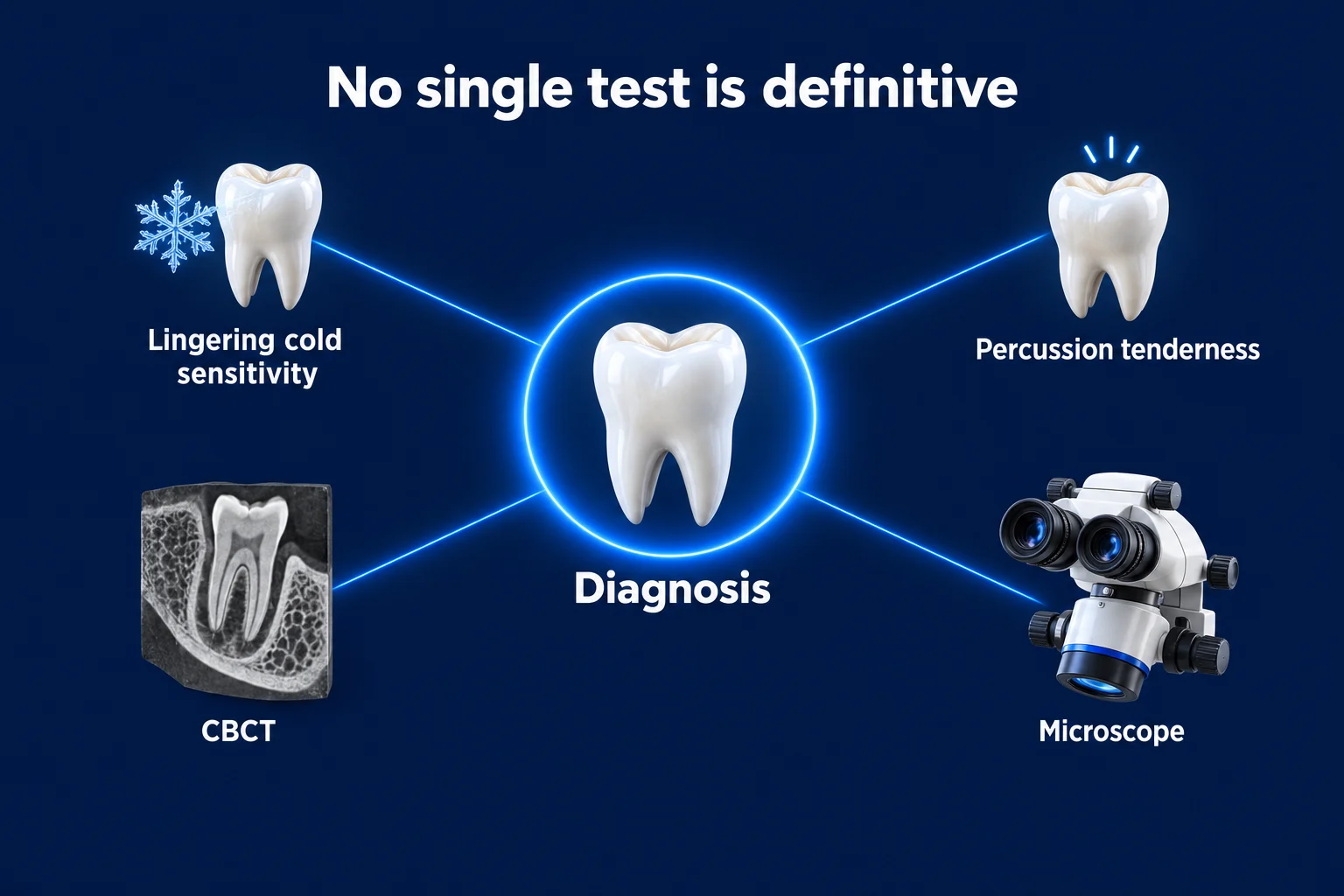
The type of nerve pain you experience is diagnostically meaningful:
- Brief, sharp pain with cold or sweet → surface-level dentin exposure or early reversible pulpitis (early, reversible inflammation of the tooth’s inner nerve tissue)
- Lingering pain after cold → pulp inflamed beyond the reversible stage; needs endodontic evaluation
- Spontaneous, throbbing pain with no trigger → irreversible pulpitis (severe inflammation of the tooth’s inner tissue, too damaged to heal on its own) or abscess; urgent care needed
- Severe bite tenderness, even light touch → periapical involvement; infection has spread beyond the tooth
- Pain that was severe and then stopped → pulp necrosis (death of the living tissue inside the tooth); infection still active, evaluation still urgently needed
- Diffuse, poorly localized pain affecting multiple teeth → consider non-dental origin; specialist evaluation warranted
The neurophysiology of dental pain involves both peripheral sensitization at the pulp nerve level and changes along the trigeminal pathway. Research on dental injury models, reviewed in Critical Reviews in Oral Biology and Medicine, describes how inflammatory mediators (chemical signals released by the body during injury and infection that drive pain, swelling, and heat) released during pulp inflammation lower the activation threshold of pulpal nociceptors.1 That mechanism helps explain why irreversible pulpitis can produce spontaneous pain without an external stimulus, and it supports the use of targeted anti-inflammatory measures and removal of the inflamed pulp in treatment. The consensus diagnostic framework used in endodontics builds on this physiology to separate reversible from irreversible pulpitis and necrosis.3
Works Cited
- Byers MR, Närhi MV. Dental injury models: experimental tools for understanding neuroinflammatory interactions and polymodal nociceptor functions. Crit Rev Oral Biol Med. 1999;10(1):4-39. doi:10.1177/10454411990100010101 Narrative Review
- Trowbridge HO. Intradental sensory units: physiological and clinical aspects. J Endod. 1985;11(11):489-498. doi:10.1016/S0099-2399(85)80222-3 Narrative Review
- Levin LG, Law AS, Holland GR, Abbott PV, Roda RS. Identify and define all diagnostic terms for pulpal health and disease states. J Endod. 2009;35(12):1645-1657. doi:10.1016/j.joen.2009.09.032 Systematic Review
- Aminoshariae A, Kulild JC. Current concepts of dentinal hypersensitivity. J Endod. 2021;47(11):1696-1702. doi:10.1016/j.joen.2021.07.011 Narrative Review