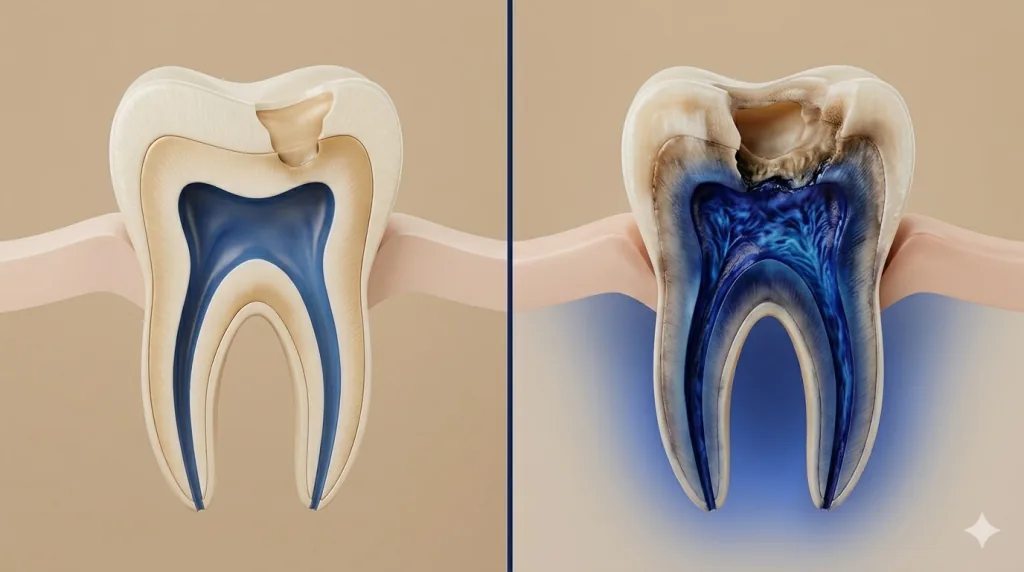
Both tooth sensitivity and tooth infection can produce sharp, uncomfortable sensations, but they are different conditions requiring different responses. Mistaking an infection for simple sensitivity is one of the most common reasons patients delay treatment until a problem becomes serious.
This guide gives you the clinical tools to tell them apart at home, and to know when to call an endodontist. Because no symptom is conclusive on its own, the goal here is to help you recognize warning patterns early, not to self-diagnose.
Key Differences at a Glance
- Brief, sharp pain (seconds)
- Always triggered, cold, heat, sweets, or touch
- Resolves quickly when trigger is removed
- No spontaneous pain
- No swelling, fever, or gum bumps
- Often affects multiple teeth
- May improve with sensitivity toothpaste
- Lingering pain that keeps aching after the cold is removed
- May occur spontaneously with no trigger
- Throbbing, deep, or severe quality
- May worsen at night lying down
- May include swelling, fever, or pimple on gum
- Usually one specific tooth
- Does not improve with sensitivity products
Symptom-by-Symptom Comparison
| Symptom | Sensitivity | Infection / Pulpitis |
|---|---|---|
| Cold sensitivity | Brief, fades fast, may be reversible inflammation | Lingers after the cold is gone, pulp may be too inflamed to heal itself |
| Heat sensitivity | Usually absent or mild | Often severe; in late-stage infection, cold may paradoxically relieve throbbing |
| Spontaneous pain | No, always needs a trigger | Yes, pain appears without any trigger |
| Pain at night | Uncommon; brief if present | Common; often worsens lying down |
| Swelling or gum pimple | No | Possible, indicates active abscess |
| Throbbing quality | No, sharp and brief | Yes, throbbing or aching is common |
| Number of teeth affected | Often several teeth | Usually one specific tooth |
| Pain on biting | Uncommon | Common, tooth is often tender to touch |
| Response to sensitivity toothpaste | Improves over weeks | No improvement |
| Requires root canal? | Usually not | Likely yes if pulp is infected |
Understanding Tooth Sensitivity
Sensitivity occurs when the inner layer of the tooth, the dentin (the layer of tooth beneath the hard enamel (the hard outer shell of the tooth, the hardest substance in the human body), softer and more sensitive, containing microscopic channels that connect to the nerve), becomes exposed or more permeable. Dentin contains microscopic tubules that lead to the nerve. When exposed to temperature changes, sweets, or pressure, fluid movement in these tubules triggers a sharp but brief pain signal, the mechanism first described as the hydrodynamic theory of dentin sensitivity.23 This is inflammation of the pulp at a mild, often reversible level. See the full list of signs you may need root canal therapy. See what causes tooth nerve pain.
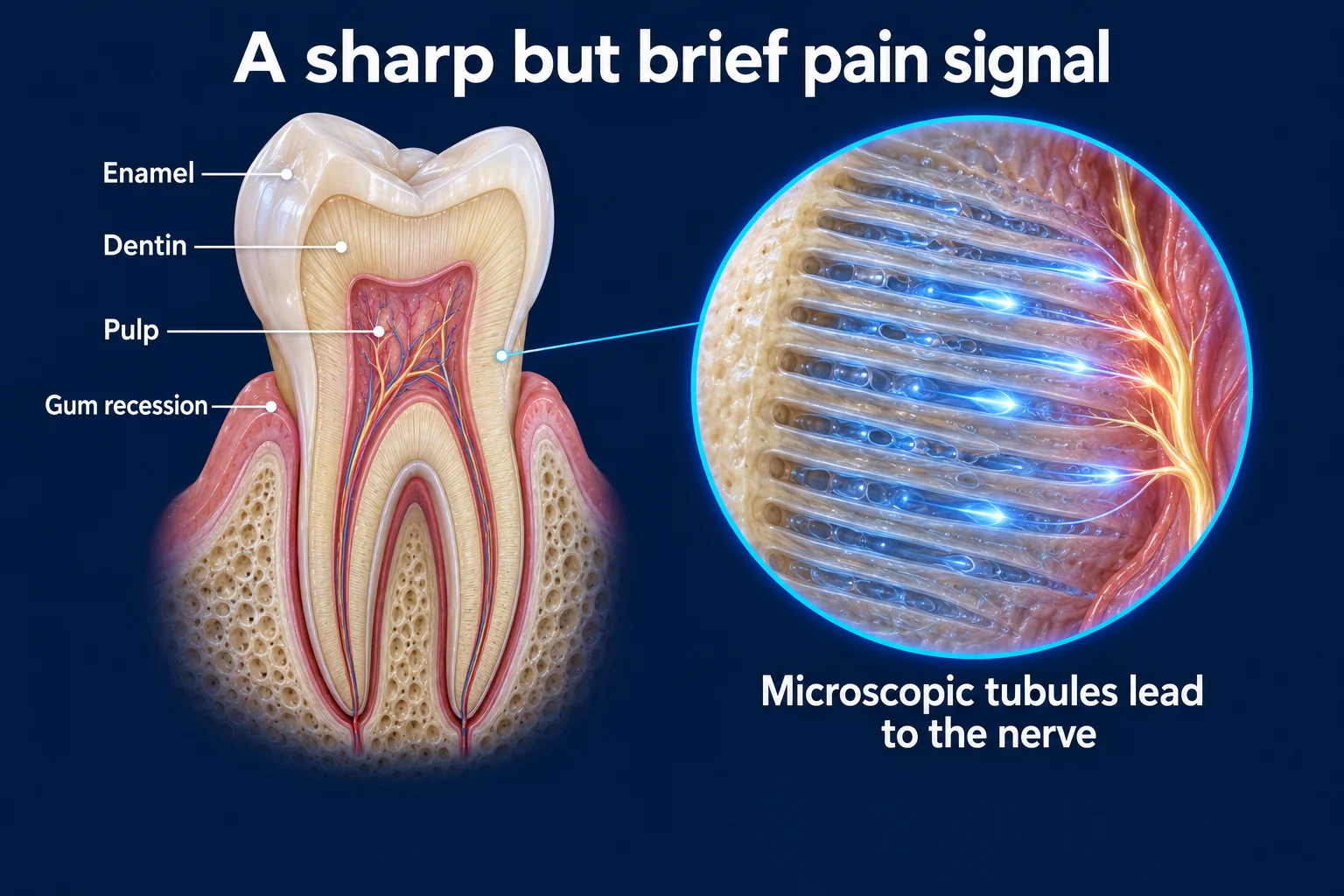
Common causes include: gum recession, enamel erosion from acid reflux or acidic foods, overbrushing with a hard toothbrush, a chipped tooth, teeth whitening, or recent dental work. When cold sensitivity fades within seconds, the pulp is irritated but may still recover, especially if the irritant (like a cavity) is removed promptly. Sensitivity toothpastes can help block dentin tubules for surface-level sensitivity, but they have no effect on inflammation deeper inside the tooth.3
If you take a GLP-1 medication such as Ozempic or Mounjaro, reflux and dry mouth are the two pathways worth knowing about.
Understanding Irreversible Pulpitis (The Middle Stage)
Between simple sensitivity and a full infection lies a critical stage: irreversible pulpitis. Here, the pulp is so severely inflamed, from deep decay, a crack, or prolonged irritation, that it can no longer heal itself, even if the source of irritation is removed. This is not necessarily a bacterial infection yet, but the pulp tissue is on a path toward dying. Endodontic diagnostic guidelines define this as a distinct clinical state that sits between a healthy responsive pulp and a necrotic one.4
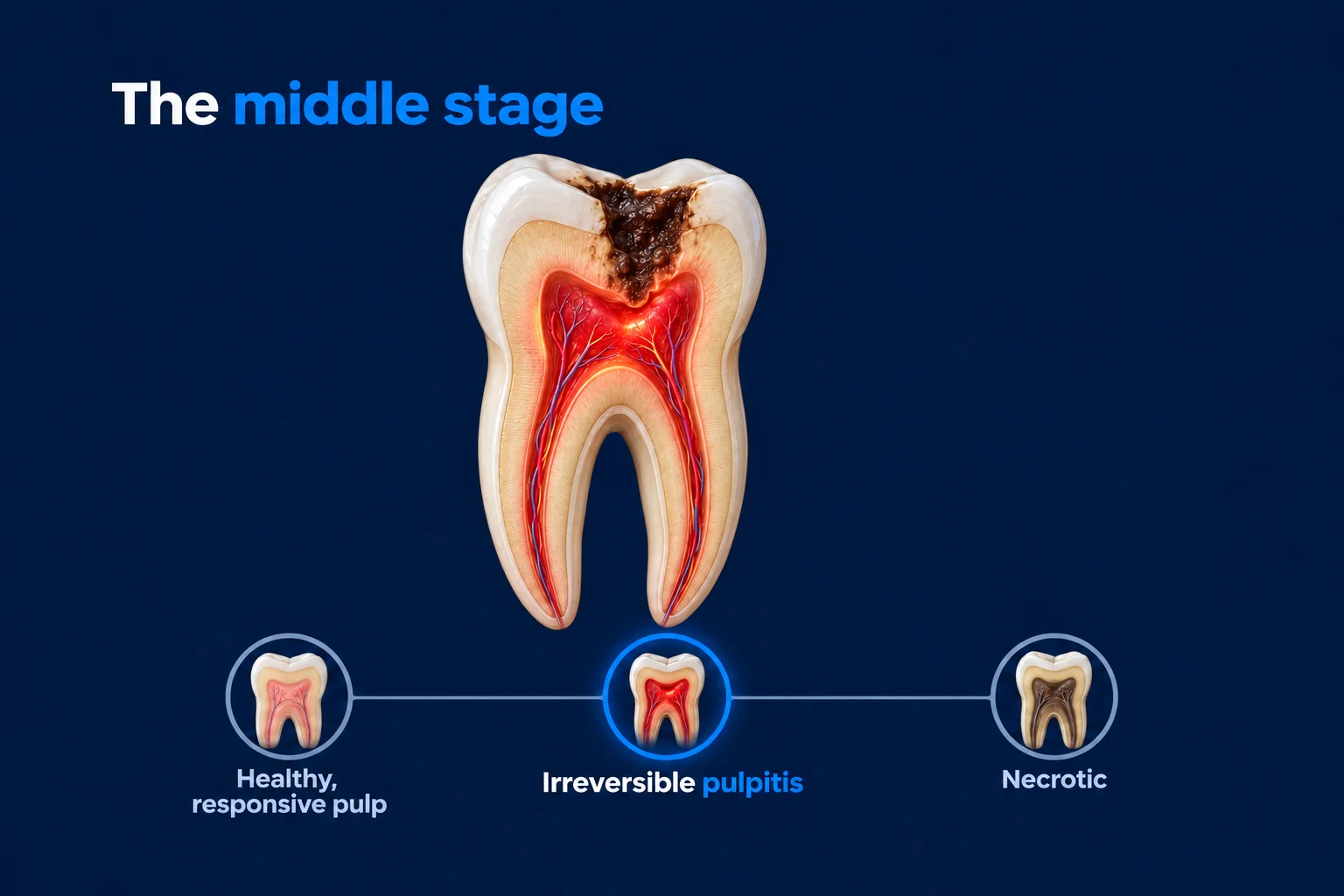
A common warning sign is cold sensitivity that keeps aching after the cold is removed, along with pain that may start to appear on its own. It is important to understand the limits here: the duration of a cold response is a useful clue, but research shows that no single symptom or in-office test reliably confirms the exact condition of the pulp on its own.1 That is why a worsening or lingering pattern is a reason to be evaluated rather than a self-diagnosis. When irreversible pulpitis is confirmed, root canal treatment is recommended, not because the tooth is already infected, but because an inflamed pulp that has passed the point of recovery will eventually become necrotic (dead, referring to tissue that has lost its blood supply and died, most commonly the pulp inside an infected tooth) and infected if left untreated.
Understanding Tooth Infection: Pulp Necrosis and Abscess
When irreversible pulpitis progresses further, the pulp tissue dies (necrosis). Bacteria colonize the dead tissue and spread through the root canals into the surrounding bone, forming a periapical (relating to the area surrounding the very tip of a tooth’s root) abscess (a pocket of infection at the root tip of a tooth, caused by bacteria spreading from inside the tooth). At this point, the condition has evolved from inflammation into active infection, the stage at which root canal treatment or, in some cases, additional procedures become necessary to clear the infection and preserve the tooth.5
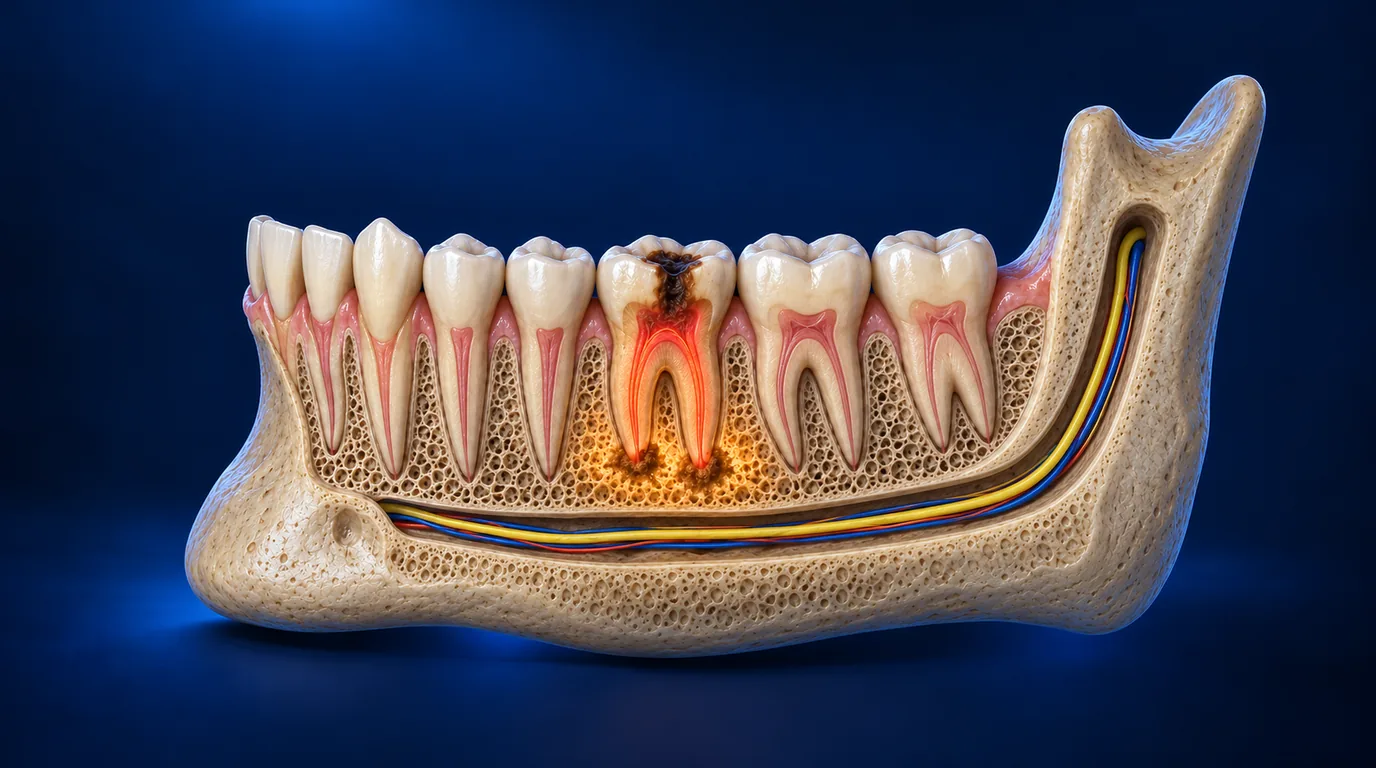
The pain profile changes: spontaneous, throbbing pain dominates, often worsening at night. Swelling, fever, a draining bump on the gum, and extreme heat sensitivity can all appear. Critically, once the pulp is fully necrotic, cold sensitivity often disappears, because there is no longer living pulp tissue to respond. Pain from cold at this stage may actually temporarily relieve throbbing, which is a paradoxical sign endodontists look for in advanced cases.
The Clinical Test: What Cold Sensitivity Actually Tells You
Cold is a tool for reading the state of the pulp, not a direct sign of infection, and it is most reliable in the hands of a clinician who weighs it alongside other findings. Pooled diagnostic-accuracy research confirms that the cold test, while useful, is far from perfect on its own, which is why it is read together with other clinical signs.6 Here is what your response to cold can suggest, and what it means for you: Read how endodontists diagnose tooth pain.
- Cold causes brief pain that disappears within seconds → the pulp is irritated but likely still reversibly inflamed. Monitor it, see your dentist, treat the underlying cause (cavity, crack). The pulp may recover.
- Cold causes pain that keeps lingering after the trigger is gone → a possible warning sign of irreversible pulpitis. The longer and more consistently it lingers, the more meaningful the finding, though it is still only one piece of the picture and not proof on its own.1 If this pattern is present, an endodontist can confirm whether the pulp is too inflamed to heal and whether treatment is needed.
- Cold actually relieves throbbing pain temporarily → this is a paradoxical sign. The pulp is likely necrotic (dead), and an active bacterial infection (abscess) may be present. The cold is temporarily constricting blood vessels near the abscess. This stage needs same-day evaluation.
- No response to cold at all → the pulp may be necrotic. A tooth that used to be cold-sensitive and has stopped responding is not better; it may mean the nerve has died and infection is spreading silently.
The duration of the cold-stimulus response is a widely used clinical clue for telling reversible from irreversible pulpitis, but it is not a stand-alone proof. A systematic review published in the International Endodontic Journal evaluated the signs, symptoms, and tests used to judge the condition of the pulp and found that the overall evidence was insufficient to confirm the pulp’s state from any single finding, including an abnormal reaction to heat or cold or the results of thermal and electric pulp testing.1 The practical takeaway is the opposite of a quick home verdict: a lingering cold response is a meaningful reason to seek evaluation, while the actual diagnosis is made by an endodontist who combines history, testing, and imaging before recommending endodontic treatment (treatment focused on the inside of the tooth, most commonly root canal therapy).14
Not sure which side of the line you are on? An endodontist at your nearest MFE location can run a simple in-office test to find out. Find a location.
Works Cited
- Mejàre IA, Axelsson S, Davidson T, et al. Diagnosis of the condition of the dental pulp: a systematic review. Int Endod J. 2012;45(7):597-613. doi:10.1111/j.1365-2591.2012.02016.x Systematic Review
- Brännström M. Sensitivity of dentine. Oral Surg Oral Med Oral Pathol. 1966;21(4):517-526. doi:10.1016/0030-4220(66)90411-7
- Liu XX, Tenenbaum HC, Wilder RS, Quock R, Hewlett ER, Ren YF. Pathogenesis, diagnosis and management of dentin hypersensitivity: an evidence-based overview for dental practitioners. BMC Oral Health. 2020;20(1):220. doi:10.1186/s12903-020-01199-z
- Levin LG, Law AS, Holland GR, Abbott PV, Roda RS. Identify and define all diagnostic terms for pulpal health and disease states. J Endod. 2009;35(12):1645-1657. doi:10.1016/j.joen.2009.09.032 Systematic Review
- Ng YL, Mann V, Rahbaran S, Lewsey J, Gulabivala K. Outcome of primary root canal treatment: systematic review of the literature. Part 2. Influence of clinical factors. Int Endod J. 2008;41(1):6-31. doi:10.1111/j.1365-2591.2007.01323.x Systematic Review
- Patro S, Meto A, Mohanty A, et al. Diagnostic accuracy of pulp vitality tests and pulp sensibility tests for assessing pulpal health in permanent teeth: a systematic review and meta-analysis. Int J Environ Res Public Health. 2022;19(15):9599. doi:10.3390/ijerph19159599 Systematic Review