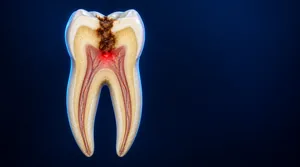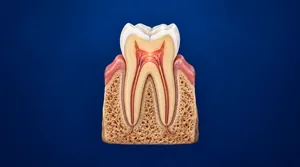
Intermittent tooth pain is easy to dismiss. When the pain is gone, the urgency fades. When it returns, it’s uncomfortable but manageable. This cycle, pain, relief, pain, relief, can repeat for weeks or months while the underlying condition quietly worsens.
At Mid-Florida Endodontics, we regularly see patients whose intermittent pain turned out to be early-stage cracked tooth syndrome, a pulp in its final stages of dying, or a chronic abscess that had been draining silently. Understanding the patterns helps you know when intermittent pain is truly minor and when it deserves prompt attention.
Common Patterns of Intermittent Tooth Pain, and What They Mean
Brief Sensitivity That Comes and Goes With Temperature or Food
Sharp, brief pain triggered by cold, sweet, or acidic foods that fades quickly is consistent with surface-level dentin (the layer of tooth beneath the hard enamel (the hard outer shell of the tooth, the hardest substance in the human body), softer and more sensitive, containing microscopic channels that connect to the nerve) hypersensitivity, from recession, erosion, or a small exposed area. It comes and goes because you don’t eat cold or sweet foods constantly. While lower urgency than spontaneous pain, this pattern still warrants evaluation to identify and address the underlying cause before it progresses. Desensitizing toothpaste manages the symptom but does not treat the cause.
Pain When Biting That Isn’t Consistent
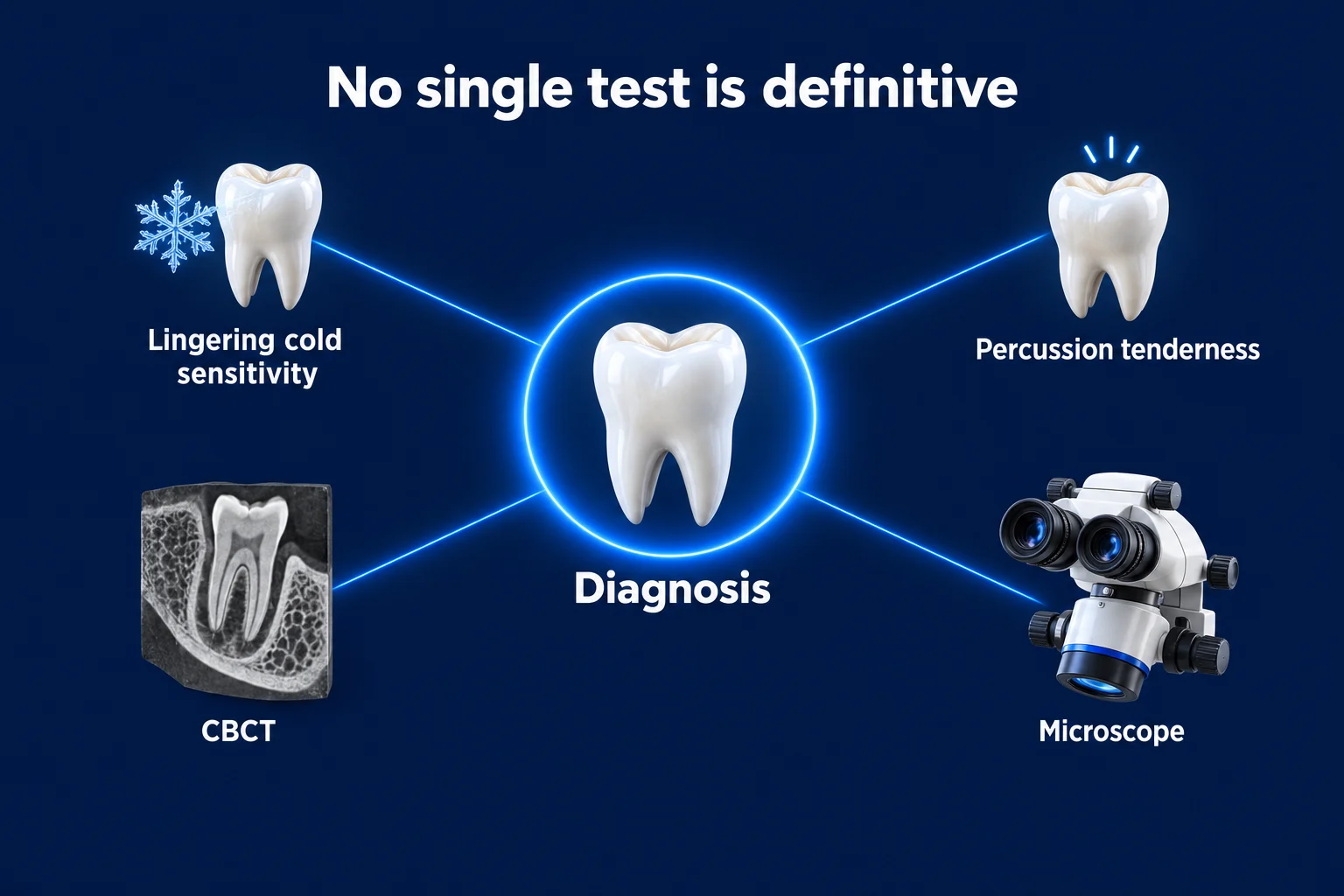
Pain triggered by biting that doesn’t happen every time, or varies depending on what you’re eating or which part of the tooth is loaded, is a hallmark of early cracked tooth syndrome. The crack only hurts when the bite forces flex it in a specific direction or on a specific cusp. Because the pain is inconsistent and X-rays appear normal, patients often wait. Meanwhile, each chewing cycle risks propagating the crack closer to the root. When a crack does reach the pulp, root canal treatment can still preserve many of these teeth, though survival depends on how deep the crack extends.2 This pattern warrants prompt evaluation.
Tooth Pain That Flares for a Few Days Then Disappears
Episodic pain lasting a day or two followed by days or weeks of relief can reflect a pulp cycling between inflammatory states, a tooth in the transition from reversible to irreversible pulpitis (severe inflammation of the tooth’s inner tissue, too damaged to heal on its own). Each flare represents the pulp (the soft living tissue inside the tooth, containing nerves and blood vessels) responding to bacterial or mechanical irritation. The quiet periods don’t mean healing, they often mean the pulp’s inflammatory capacity is diminishing. This pattern frequently precedes the onset of constant spontaneous pain, which signals irreversible pulpitis has arrived. Because intermittent symptoms and pulp tests alone have limited reliability for confirming the pulp’s true condition, clinical examination together with imaging is what establishes the diagnosis.3

Throbbing Pain That Comes and Goes. Worse at Night
Spontaneous throbbing that intensifies in episodes, is worst when lying down, and has been recurring over multiple days or weeks strongly suggests irreversible pulpitis or an early abscess. Even though there are pain-free periods, the underlying condition is advancing. Many patients with this pattern arrive to find a periapical (relating to the area surrounding the very tip of a tooth’s root) lesion (an area of infection and bone damage at the tip of a tooth’s root, visible on X-rays) already forming on imaging, even though they considered their pain “manageable” because it wasn’t constant.
Pain That Was Severe, Disappeared, and Occasionally Returns as a Dull Ache
This pattern is one of the most deceptive in dentistry. Severe pain followed by apparent resolution often marks the death of the pulp, the nerve stops generating pain signals because it has lost viability. A residual dull ache or occasional pressure reflects the periapical infection that continues spreading into surrounding bone. This tooth is not getting better. Apical periodontitis develops as a host response to infection from inside the tooth, and it persists until the infection is cleared by treatment rather than resolving on its own.4 The infection is progressing silently between symptom episodes, and a significant abscess may be present on imaging despite minimal pain.
Pain That Moves Around or Affects Multiple Teeth
Diffuse or shifting pain that is hard to localize, affecting what seems like a different tooth each time, may indicate referred pain from a single source tooth, myofascial pain from grinding, sinus pressure mimicking tooth pain, or TMJ dysfunction. Endodontic specialists are specifically trained in differentiating these sources through systematic clinical testing. Getting an accurate diagnosis prevents unnecessary treatment on healthy teeth.
A tooth that had significant intermittent pain and has now gone completely quiet deserves urgent evaluation, not less attention. Cessation of pain in a previously symptomatic tooth frequently marks pulp death rather than recovery. The infection remains active and is now spreading into surrounding bone without generating symptoms. “It stopped hurting” is not a reason to cancel your appointment.
Why Intermittent Pain Is Hard to Dismiss Safely
The challenge with intermittent tooth pain is the same as with many intermittent symptoms in medicine: its variable nature makes it easy to rationalize away. “It only hurts sometimes.” “I can manage it.” “Maybe it will resolve on its own.”
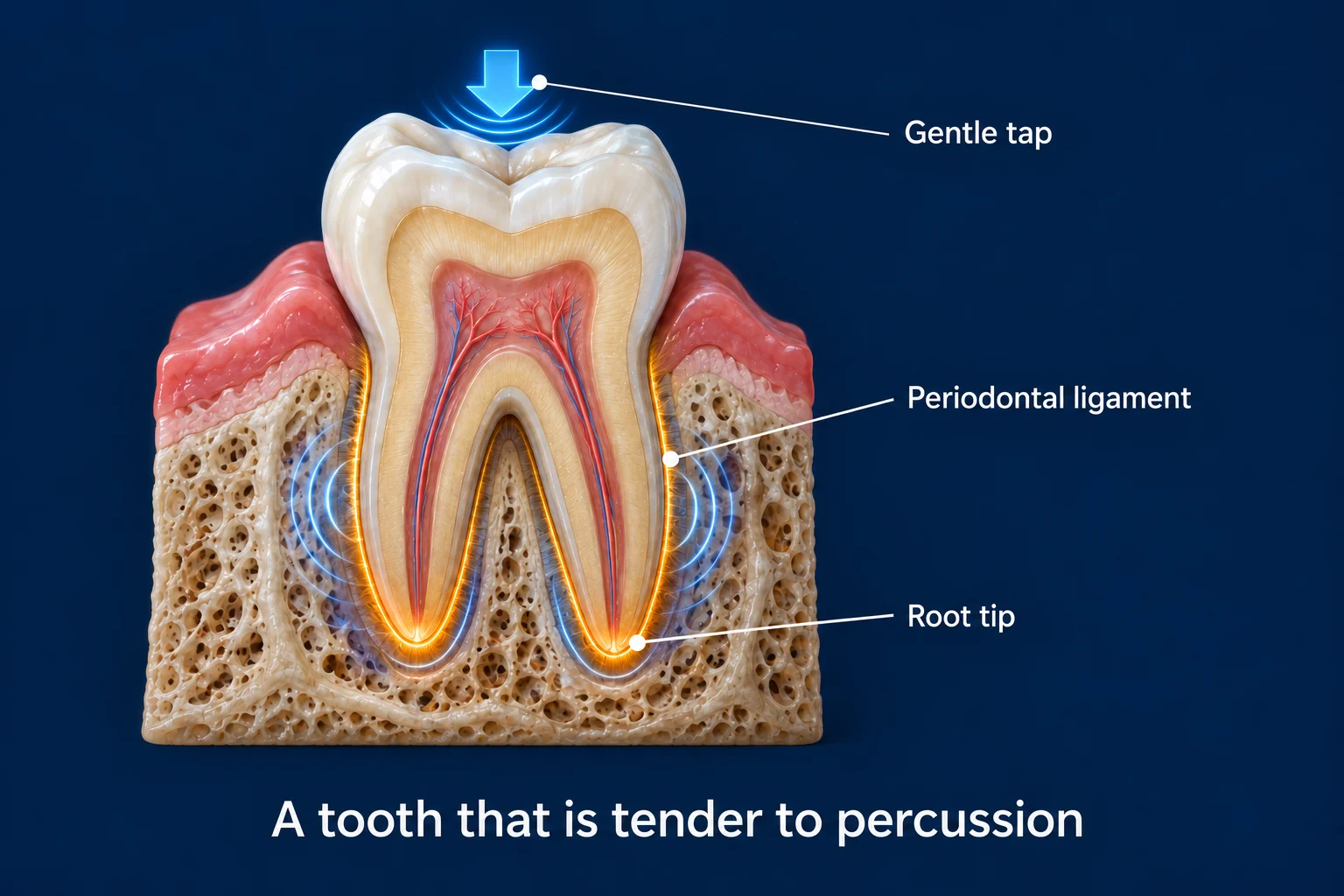
The problem is that dental disease, unlike many other conditions, does not spontaneously resolve. A cracked tooth does not heal. An infected pulp does not clear itself. A periapical abscess (a pocket of infection at the root tip of a tooth, caused by bacteria spreading from inside the tooth) does not disappear without treatment.4 What changes with time is not the disease, it is the complexity and cost of treating it. Timely treatment matters too: the outcome of a tooth is more favorable when it is treated before a periapical lesion has formed and while the surrounding tissues are still healthy.1
The appropriate response to intermittent tooth pain that has been present for more than one to two weeks is a dental evaluation, starting with your general dentist and escalating to an endodontic specialist if findings suggest pulp involvement or if the diagnosis is unclear.
Diagnostic terminology for the pulp recognizes that symptomatic pulpitis can present with episodes of pain rather than constant pain, so the absence of constant pain does not rule out a diagnosis that needs treatment.5 Because intermittent symptoms and individual pulp tests have limited reliability on their own, the evidence supports combining careful clinical examination with imaging to evaluate any tooth that has recurring, unexplained discomfort.3 The practical takeaway for patients is consistent: pain that comes and goes still warrants a professional look, because the quiet periods do not confirm that the tooth is healing.
Works Cited
- Ng YL, Mann V, Rahbaran S, Lewsey J, Gulabivala K. Outcome of primary root canal treatment: systematic review of the literature. Part 2. Influence of clinical factors. Int Endod J. 2008;41(1):6-31. doi:10.1111/j.1365-2591.2007.01323.x Systematic Review
- Kang SH, Kim BS, Kim Y. Cracked teeth: distribution, characteristics, and survival after root canal treatment. J Endod. 2016;42(4):557-562. doi:10.1016/j.joen.2016.01.014 Prospective Study
- Mejàre IA, Axelsson S, Davidson T, et al. Diagnosis of the condition of the dental pulp: a systematic review. Int Endod J. 2012;45(7):597-613. doi:10.1111/j.1365-2591.2012.02016.x Systematic Review
- Nair PN. Pathogenesis of apical periodontitis (infection and inflammation at the root tip spreading into the jawbone) and the causes of endodontic failures. Crit Rev Oral Biol Med. 2004;15(6):348-381. doi:10.1177/154411130401500604
- Levin LG, Law AS, Holland GR, Abbott PV, Roda RS. Identify and define all diagnostic terms for pulpal health and disease states. J Endod. 2009;35(12):1645-1657. doi:10.1016/j.joen.2009.09.032 Systematic Review