
Few dental symptoms are as unmistakable, or as urgent, as a throbbing tooth. The pulsing quality makes it impossible to ignore, and for good reason: it is your body signaling that significant inflammation or infection is underway inside a tooth that has no way to decompress on its own.
Why Does an Infected Tooth Throb?
The throbbing quality of infected tooth pain has a direct physiological explanation. The dental pulp (the soft living tissue, nerves and blood vessels, inside a tooth) sits inside a rigid, enclosed space, the pulp chamber and root canals, with no room to expand.1 When infection or severe inflammation causes tissue swelling and increased vascular pressure inside this confined space, every heartbeat pumps additional blood volume into already-compressed tissue. The dense network of pain-sensing nerve fibers packed into this sealed compartment is what makes the resulting sensation so sharp and pulsatile.2
The result is pain that pulses in synchrony with your heartbeat, the dental equivalent of the throbbing you feel from any inflamed, enclosed tissue (like a deeply infected fingertip). It is worse when lying down because horizontal positioning increases blood pressure to the head, amplifying the pulpal pressure further. This is why throbbing tooth pain is notorious for intensifying at night.
Common Causes of Throbbing Tooth Pain
Dental Abscess (Periapical Infection)
The most common cause of severe throbbing tooth pain. Bacteria have reached the root tip and formed an abscess, a pocket of infection actively destroying surrounding bone.4 The pressure from the abscess, combined with the inflamed periapical (relating to the area surrounding the very tip of a tooth’s root) ligament, creates intense, often unrelenting throbbing. This frequently escalates at night and may be accompanied by swelling, fever, and a foul taste. Root canal treatment is required immediately.
Irreversible pulpitis
When pulp inflammation advances beyond the point of recovery, spontaneous throbbing pain develops, often before a full abscess has formed. The inflamed pulp tissue is under pressure inside the sealed pulp chamber, producing pulsing pain that can come on without any trigger.3 This is the stage immediately preceding necrosis (tissue death, when the living tissue inside a tooth dies due to infection or loss of blood supply) and abscess formation. Root canal treatment relieves the pressure and eliminates the pain. Some people find that cold water briefly eases a throbbing tooth rather than triggering it. That pattern is worth taking seriously, and our guide explains what cold water reveals about tooth pain.
Acute periapical periodontitis
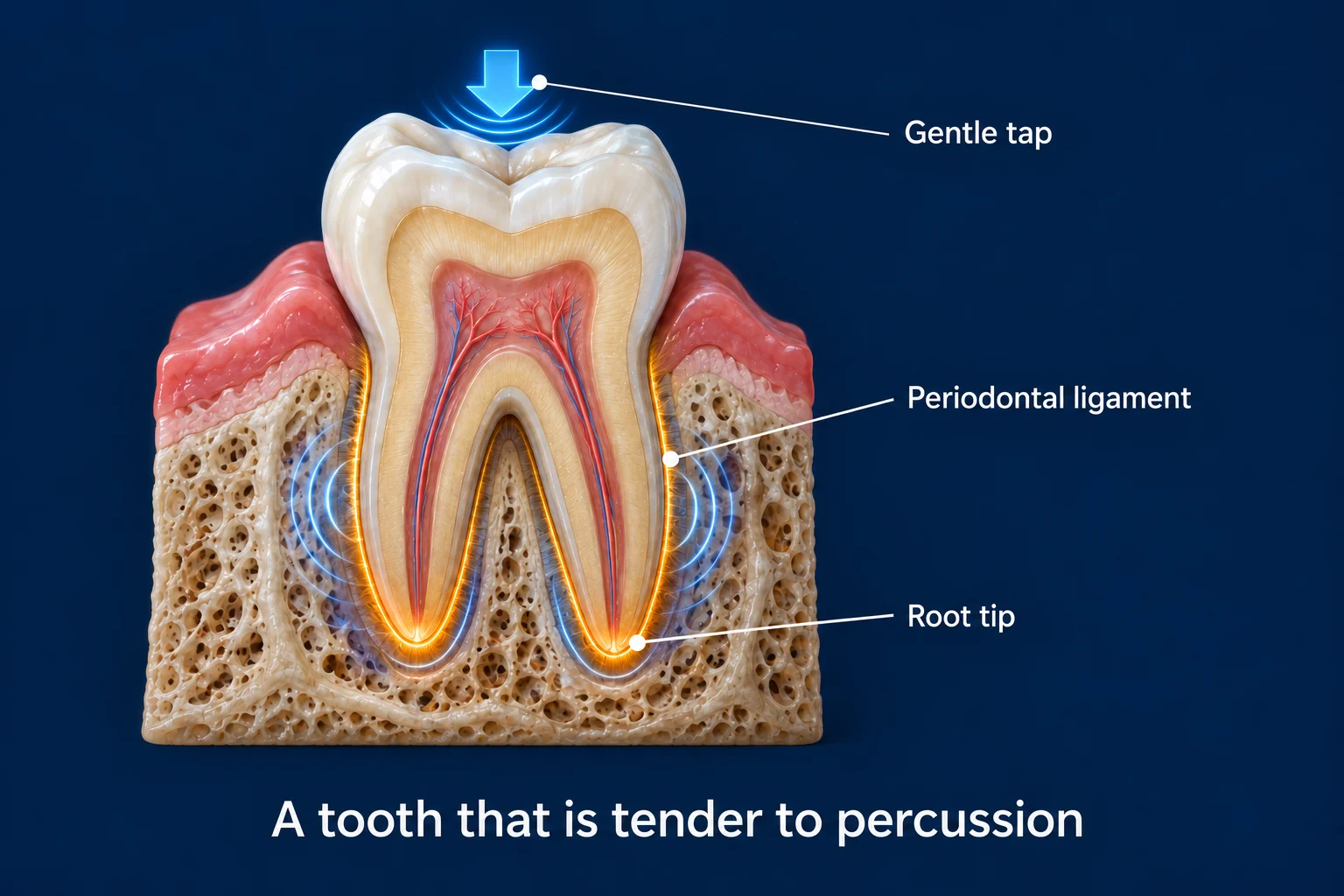
Inflammation and infection spreading from the root tip into the surrounding periodontal ligament (the thin layer of fibers connecting the tooth root to the jawbone, which acts as a shock absorber and contains pressure-sensitive nerve fibers) and bone causes severe bite tenderness and throbbing.4 Even the lightest pressure on the tooth, biting, touching with the tongue, or air from breathing, can be excruciating. The tooth feels “high” in the bite and extremely tender to any pressure.

Cracked Tooth with Pulp Involvement
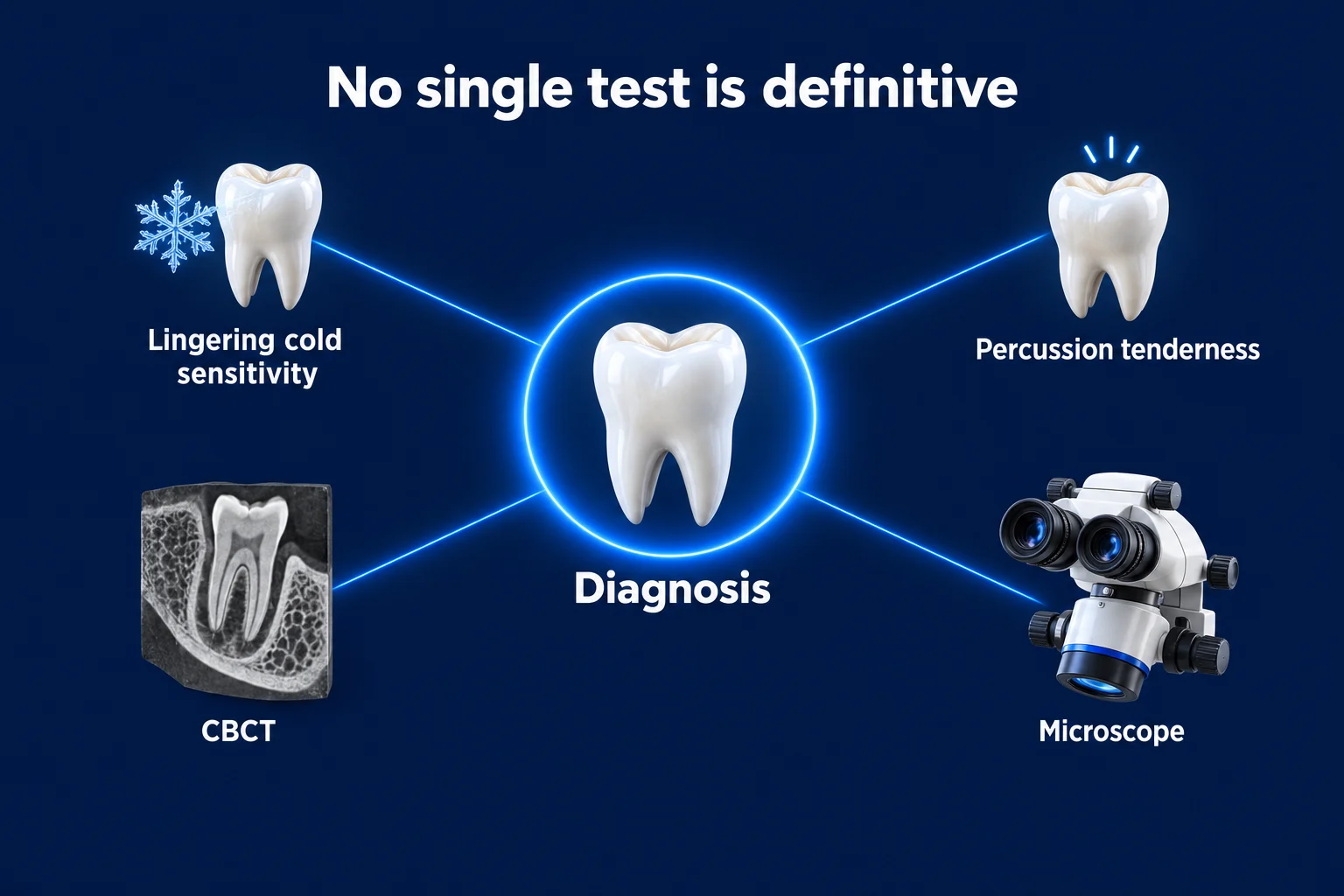
A crack that has extended into the pulp can cause intense, throbbing pain. The pulp becomes inflamed from bacterial infiltration through the crack, and the symptom progression mirrors that of decay-related pulpitis. Diagnosis can be challenging because cracks are largely invisible on standard X-rays, 3D CBCT (cone-beam CT, a low-dose 3D X-ray that lets us see the tooth and bone from every angle) imaging is often needed to assess the extent.
Post-Procedure Inflammation
Throbbing after a deep filling, crown preparation, or other dental procedure can occur as a normal inflammatory response in the days immediately following treatment. If it improves daily and resolves within a week, it is likely normal healing. If it is worsening or persisting beyond a week, contact your dentist, the pulp may have been irreversibly affected by the procedure.
Throbbing That Stops Suddenly. Not a Good Sign
One of the most dangerous misconceptions about throbbing tooth pain is that when it suddenly stops, the problem has resolved. In many cases, the opposite is true. Throbbing that abruptly ceases may mean the pulp has died, the nerve tissue is no longer producing pain signals because it no longer has viable function. The infection, however, has not gone away. It is now spreading silently from the root tip into surrounding bone, potentially forming a larger abscess without any accompanying pain.4 A tooth that throbbed severely and then suddenly quieted still needs urgent evaluation, because the underlying disease process continues even after the painful warning sign has faded.
Seek Same-Day or Emergency Care If Throbbing Is Accompanied By:
Visible swelling of the cheek or jaw · Swelling spreading toward the neck or floor of the mouth · Difficulty swallowing or breathing · Fever · Inability to open your mouth fully · Throbbing so severe that over-the-counter medication provides no relief. These signs indicate the infection has spread beyond the tooth and requires urgent medical and dental attention.
What to Do About a Throbbing Tooth: What an Endodontist Will Do
When a patient presents with acute throbbing tooth pain, the first priority is accurate diagnosis and pain relief. At Mid-Florida Endodontics, our evaluation includes 3D CBCT imaging, pulp vitality (whether the living tissue inside the tooth is still healthy and functioning) testing, percussion, and palpation (pressing on the gum tissue to check for tenderness or swelling that indicates infection beneath) to confirm the diagnosis and identify the affected tooth precisely. Once the diagnosis is confirmed, root canal treatment can typically begin the same day, removing the infected or inflamed pulp tissue, opening the sealed space so trapped pressure can release, and providing relief. Many patients notice a meaningful reduction in pain after the inflamed pulp tissue and its pressure are removed.5
The physiology of throbbing dental pain is well characterized in the endodontic literature. Reviews of intradental sensory function describe how the dental pulp is innervated by a dense population of pain-sensing nerve fibers confined within the rigid, sealed walls of the tooth, which helps explain why inflammation in this enclosed space produces such intense, pulsatile pain.1 Because the pulp cannot expand or decompress on its own, removing the inflamed tissue through root canal treatment is the definitive way to resolve the source of the pain, while the wider disease process of apical periodontitis explains why infection can persist silently even after the pain itself subsides.4
Works Cited
- Trowbridge HO. Intradental sensory units: physiological and clinical aspects. J Endod. 1985;11(11):489-498. doi:10.1016/S0099-2399(85)80222-3
- Byers MR, Närhi MV. Dental injury models: experimental tools for understanding neuroinflammatory interactions and polymodal nociceptor functions. Crit Rev Oral Biol Med. 1999;10(1):4-39. doi:10.1177/10454411990100010101
- Hargreaves KM, Goodis HE, eds. Pain mechanisms of the pulpo-dentinal complex. In: Seltzer and Bender’s Dental Pulp. Chicago: Quintessence Publishing; 2002.
- Nair PNR. Pathogenesis of apical periodontitis and the causes of endodontic failures. Crit Rev Oral Biol Med. 2004;15(6):348-381. doi:10.1177/154411130401500604
- Pak JG, White SN. Pain prevalence and severity before, during, and after root canal treatment: a systematic review. J Endod. 2011;37(4):429-438. doi:10.1016/j.joen.2010.12.016 Systematic Review