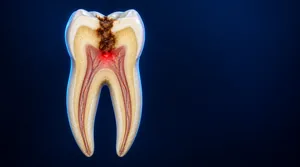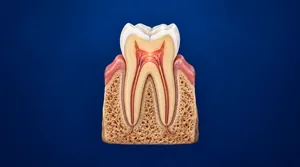
Antibiotics and tooth infections are widely misunderstood, by patients and, sometimes, by providers outside of dentistry. ERs and urgent care centers frequently prescribe antibiotics for dental pain as a short-term measure, and patients often interpret improvement in symptoms as evidence that the infection has been cured. Often it has not been. Understanding why antibiotics are a temporary measure rather than a definitive treatment helps explain why dental follow-through after an antibiotic course is not optional. Clinical guidelines are clear that the first-line treatment for an infected tooth is removal of the source of infection by local, operative measures, with systemic antibiotics reserved for evidence of spreading or systemic involvement.1
Why Antibiotics Cannot Cure a Tooth Infection
The key lies in the biology of a dental abscess. When a tooth’s pulp becomes necrotic, all blood supply to that tissue is lost. Antibiotics work by traveling through the bloodstream to reach infected tissues, but a necrotic pulp has no blood supply. The antibiotic cannot reliably get to where the bacteria are living and multiplying inside the root canal system.4 We break down symptoms of a dental abscess and how it is treated. Here’s how tooth decay reaches the nerve and starts an infection. A crack can also let germs in, so learn whether a cracked tooth can heal.
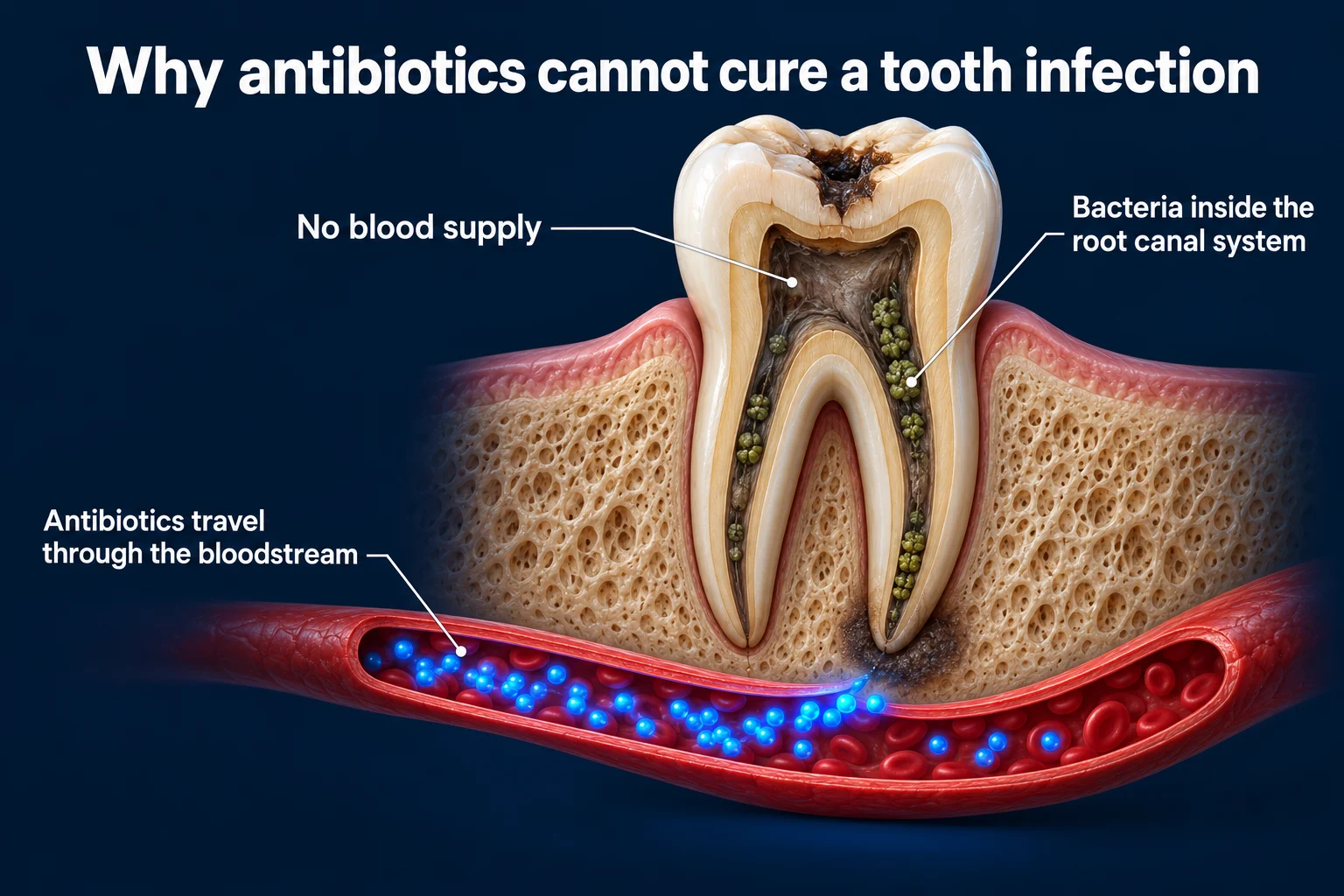
The bacteria inside a dead tooth pulp sit in a protected reservoir, shielded from both the immune system’s white blood cells and from systemic antibiotics. This infection is typically polymicrobial, a mix of many bacterial species, and it can colonize and maintain a chronic infection that persists, periodically seeding new acute flare-ups into the surrounding bone and soft tissue.4
Think of it this way: antibiotics help control what has escaped from the tooth. Root canal treatment removes what is inside it.5
What Antibiotics Can and Cannot Do for a Tooth Infection
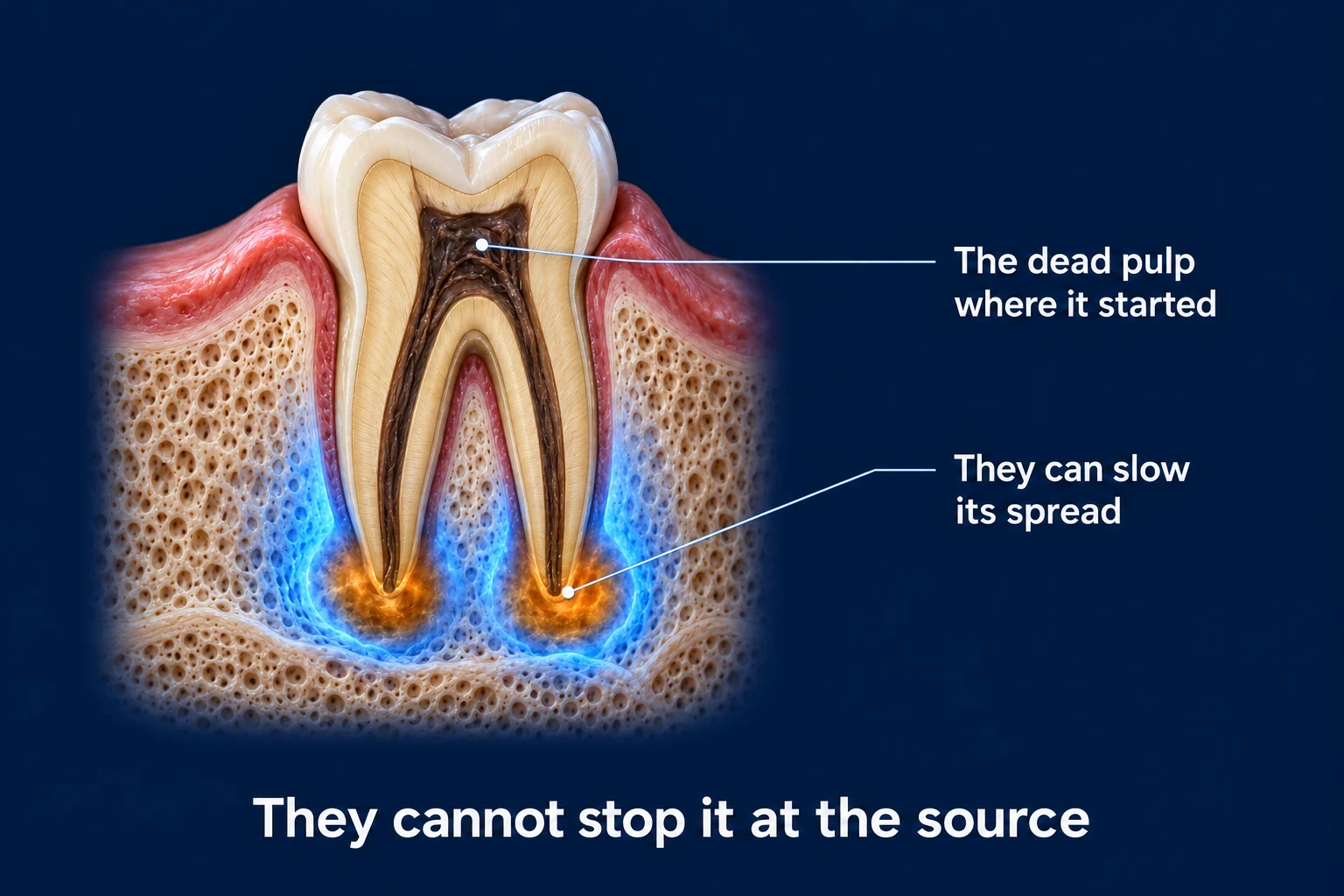
Can antibiotics stop a tooth infection? They can slow its spread, but they cannot stop it at the source, because they cannot reach the dead pulp where it started.
What Antibiotics Can Do
- Reduce spreading cellulitis (a spreading bacterial infection of the soft tissue, in dental contexts, this means infection has moved from the tooth into the face, jaw, or neck) in surrounding soft tissue
- Manage fever and systemic signs of infection spread
- Reduce acute swelling prior to dental treatment
- Provide temporary symptomatic relief
- Reduce risk of spread in immunocompromised patients
- Bridge the gap to definitive treatment
What Antibiotics Cannot Do
- Reliably penetrate necrotic pulp tissue where bacteria live
- Eliminate the bacterial reservoir inside the tooth
- Prevent the infection from returning after the course ends
- Reverse pulp necrosis (death of the living tissue inside the tooth) or heal infected bone
- Replace root canal treatment or extraction
- Provide a long-term or permanent solution
When Are Antibiotics Prescribed for Dental Infections?
Antibiotics are not routinely prescribed for every tooth infection, and should not be. The American Association of Endodontists and most evidence-based dental guidelines recommend antibiotics for dental infections only when there are signs of systemic spread:6
Appropriate Indications for Dental Antibiotics
- Fever accompanying tooth pain, indicates systemic involvement
- Swelling spreading beyond the immediate tooth area into the face, cheek, or neck
- Cellulitis, diffuse, spreading soft tissue infection
- Patient is immunocompromised (diabetes, chemotherapy, immunosuppressive medications)
- Significant trismus (restricted jaw opening) from spreading infection
- As a bridge to treatment when definitive dental care cannot be performed immediately
For a localized abscess that has not spread, a periapical (relating to the area surrounding the very tip of a tooth’s root) lesion (an area of infection and bone damage at the tip of a tooth’s root, visible on X-rays) without fever or significant swelling, root canal treatment alone is typically sufficient. The evidence suggests that adjunctive antibiotics add little to no benefit when the infection is confined to the periapical tissues and definitive treatment is being performed.2 Antibiotics also work only when paired with the appropriate dental procedure, never as a stand-alone fix.5
The Danger of Relying on Antibiotics Alone
Why “The Antibiotics Worked” Can Be Misleading
Patients commonly finish an antibiotic course, feel significantly better, and conclude the infection is resolved. Swelling has decreased. Pain has diminished. It is reasonable to interpret this as improvement, but clinically, what has often happened is that the bacterial spread has been suppressed, not the source eliminated. The necrotic pulp can remain infected. As the antibiotic’s effects wane and bacterial populations rebuild, the infection commonly returns, sometimes as a worse acute episode than before.3 Each cycle of antibiotic-treat-and-relapse also adds to the broader problem of antibiotic-resistant bacterial strains, a key reason guidelines urge restraint.6
What Should Happen After Antibiotics for a Tooth Infection
If you have been prescribed antibiotics for a tooth infection, whether by a dentist, an ER physician, or an urgent care provider, completing the antibiotic course is important to manage any spread. But it is the beginning of the treatment pathway, not the end. Definitive, conservative dental treatment should be prioritized in every case.3
After the antibiotic course, you need to see a dentist or endodontic specialist for definitive treatment of the source tooth. This means either root canal treatment (to save the tooth) or extraction (if the tooth cannot be saved). Without this step, the infection tends to return.1
Referral note: If you have completed antibiotics for a tooth infection, contact your general dentist promptly for evaluation and referral to an endodontic specialist if root canal treatment is indicated. Some insurance plans require a referral for specialist coverage. For emergencies or ongoing pain, contact us directly.
The inability of systemic antibiotics to substitute for definitive dental treatment is well established. A Cochrane systematic review of randomized controlled trials found that for symptomatic apical periodontitis (infection and inflammation at the root tip spreading into the jawbone) and acute apical abscess (a rapidly developing infection at the root tip causing severe pain and often swelling) without systemic signs, adjunctive antibiotics make little to no difference in patient-reported pain or swelling when the source is removed by operative treatment.2 An American Dental Association evidence-based guideline likewise recommends against antibiotics in most of these scenarios, advising that they be used only when systemic involvement is present and that definitive dental treatment be prioritized in all cases, in part because routine prescribing contributes to antibiotic resistance.3
For more information, see how long it is safe to leave an infection untreated.
If you have been given antibiotics for a tooth infection, that is a temporary measure. The next step is treatment of the source. An MFE endodontist at your nearest location can take care of that. Find a location.
Works Cited
- Cope AL, Francis N, Wood F, Thompson W, Chestnutt IG. Systemic antibiotics for symptomatic apical periodontitis and acute apical abscess in adults. Cochrane Database Syst Rev. 2024;5(5):CD010136. doi:10.1002/14651858.CD010136.pub4 Systematic Review
- Cope AL, Francis N, Wood F, Mann MK, Chestnutt IG. Systemic antibiotics for symptomatic apical periodontitis and acute apical abscess in adults. Cochrane Database Syst Rev. 2014;(6):CD010136. doi:10.1002/14651858.CD010136.pub2 Systematic Review
- Lockhart PB, Tampi MP, Abt E, et al. Evidence-based clinical practice guideline on antibiotic use for the urgent management of pulpal- and periapical-related dental pain and intraoral swelling: a report from the American Dental Association. J Am Dent Assoc. 2019;150(11):906-921.e12. doi:10.1016/j.adaj.2019.08.020 Systematic Review
- Robertson D, Smith AJ. The microbiology of the acute dental abscess. J Med Microbiol. 2009;58(Pt 2):155-162. doi:10.1099/jmm.0.003517-0
- Flynn TR. What are the antibiotics of choice for odontogenic infections, and how long should the treatment course last? Oral Maxillofac Surg Clin North Am. 2011;23(4):519-536. doi:10.1016/j.coms.2011.07.005 Systematic Review
- American Association of Endodontists. AAE Position Statement: AAE Guidance on the Use of Systemic Antibiotics in Endodontics. J Endod. 2017;43(9):1409-1413. doi:10.1016/j.joen.2017.08.015