
There you are, not eating, not drinking anything hot or cold, and suddenly your tooth flares with a sharp, stabbing pain. Or a dull throb appears and just won’t go away. Sudden tooth pain with no obvious trigger is unsettling, and for good reason: in many cases, it means the nerve inside the tooth has become involved.
Here are the seven most common causes our endodontists at Mid-Florida Endodontics see, ranked by urgency.
7 Common Causes of Sudden Tooth Pain
1. Dental Abscess (Tooth Infection)
A dental abscess is a pocket of infection that forms at the root tip or in the gum tissue around a tooth. The sudden onset of throbbing, severe pain, often accompanied by swelling, heat sensitivity, and a foul taste, is the hallmark presentation. Without treatment, the infection can spread into the surrounding jaw and soft tissues, so prompt evaluation gives the best chance of saving the tooth. A root canal is the treatment that removes the infection source and preserves the tooth. Understand what a dental abscess looks and feels like.

2. Irreversible Pulpitis
When the dental pulp (the living tissue inside the tooth) becomes severely inflamed, due to deep decay, trauma, or bacteria, it reaches a point of no return called irreversible pulpitis. This produces spontaneous pain that comes on without any stimulus, often described as a throbbing or shooting sensation, and tends to persist after a trigger is gone.2 It frequently worsens at night. Root canal treatment is the only way to relieve this pain and save the tooth. More on why tooth pain sometimes gets worse at night.
3. Cracked Tooth
A crack in the tooth can appear suddenly, often after biting something hard or experiencing a blow to the mouth, and produces sharp, unpredictable pain. Even without trauma, cracks can develop over time from grinding, large fillings, or natural stress fractures. The pain may be intermittent and hard to pinpoint. Depending on the crack’s extent, treatment ranges from a crown to a root canal.
4. Tooth Decay Reaching the Nerve
Cavities are painless until they reach the inner layers of the tooth. Once decay penetrates into the dentin (the layer of tooth beneath the hard enamel (the hard outer shell of the tooth, the hardest substance in the human body), softer and more sensitive, containing microscopic channels that connect to the nerve) or pulp, it can trigger sudden, sharp pain, especially with sweets, temperature changes, or pressure. At this stage, a simple filling is no longer sufficient; root canal treatment is typically needed.
5. Lost or Broken Filling
When a filling falls out or a tooth fractures, the exposed dentin underneath is highly sensitive. Air, saliva, hot, cold, and sweet foods all suddenly have direct access to the nerve-rich dentin tubules, the microscopic channels whose fluid movement stimulates the pulp’s sensory nerves.3 The pain can feel sudden and intense even though the underlying problem developed slowly. Prompt restoration prevents bacteria from reinfecting the tooth.
6. Gum Recession Exposing the Root
Root surfaces don’t have enamel protection, they’re covered only by cementum (the thin, bone-like layer covering the root surface of a tooth beneath the gumline), which is thinner and more permeable. When gums recede (from brushing too hard, periodontal disease, or natural aging), root surfaces become exposed and exquisitely sensitive to cold, sweet, and acidic foods. This pain is sharp and brief rather than throbbing, and typically localized to a specific spot on the gum line.

7. Sinus Pressure
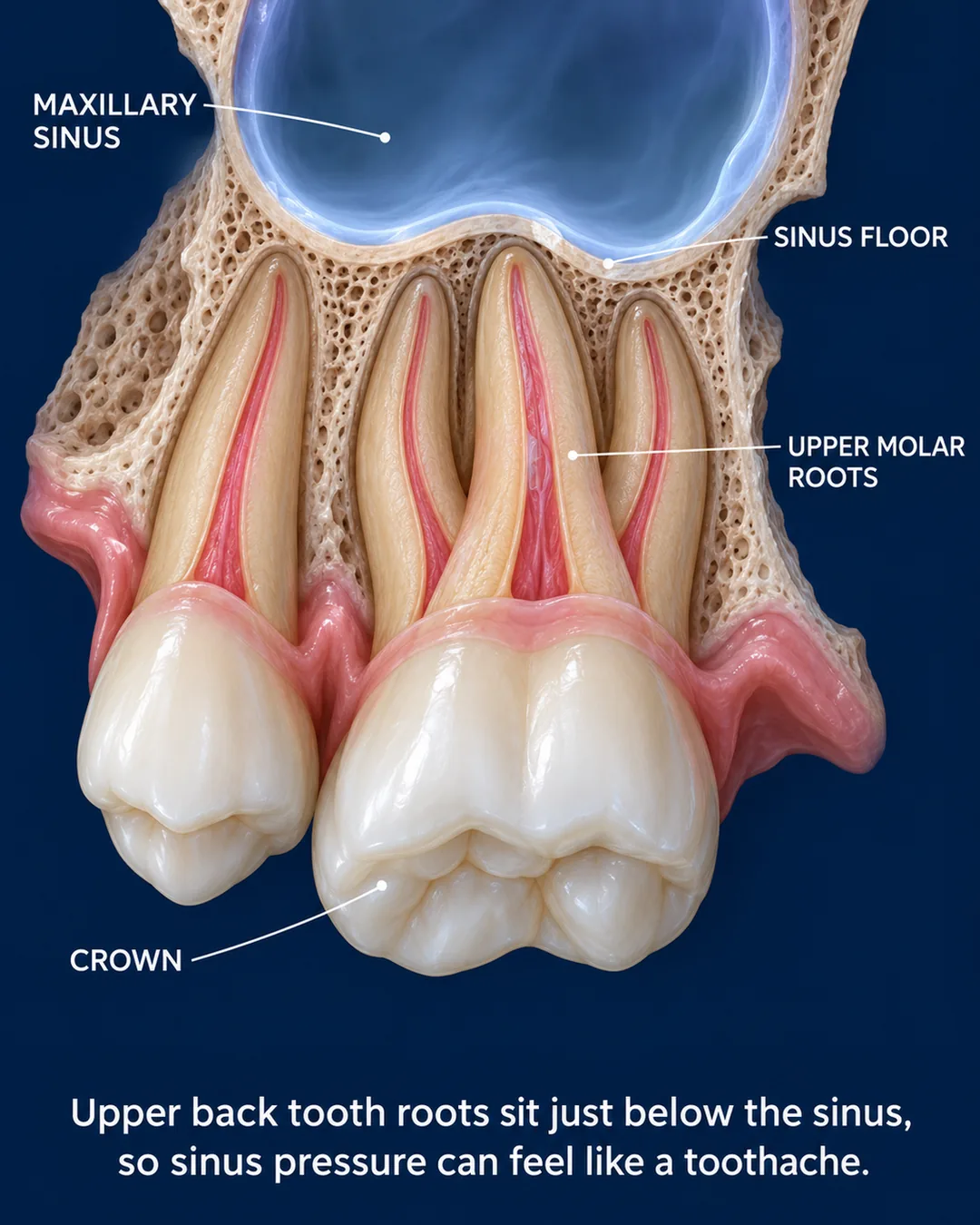
The roots of upper back teeth sit very close to the floor of the maxillary sinuses. During a sinus infection or severe seasonal allergies, sinus pressure can compress these roots and cause bilateral tooth pain, typically affecting multiple upper back teeth simultaneously. This is the one form of “tooth pain” that may resolve as the sinus condition improves. But It should be confirmed by a dental evaluation to rule out a true dental cause.
How Do You Tell the Causes Apart?
Key questions your endodontist will ask:
- Is the pain spontaneous or triggered?. Pain that comes on with no trigger, and persists after any stimulus is removed, is one of the hallmarks dentists associate with pulp infection or irreversible pulpitis.2
- Does it linger or resolve quickly?. Cold sensitivity that fades soon after the cold is removed usually points to reversible inflammation; the pulp (the soft living tissue inside the tooth, containing nerves and blood vessels) may still be able to heal. Pain that keeps going well after the cold trigger is gone is more consistent with irreversible inflammation of the pulp, which generally means the tooth needs root canal treatment whether or not a frank infection is present yet.1
- Is it localized to one tooth or multiple?. Sinus pain typically affects multiple upper back teeth; abscess pain is usually one specific tooth.
- Is there swelling, bad taste, or a bump on the gum?. These indicate active infection requiring urgent treatment.
Spontaneous pain is part of how irreversible pulpitis is defined in the endodontic literature. A systematic review in the Journal of Endodontics that established the standardized diagnostic terms for pulpal health and disease describes pain that arises without a stimulus, and lingers after a stimulus is removed, among the features used to designate an inflamed pulp that cannot recover on its own.1 No single sign confirms the diagnosis; an endodontist weighs the pain history together with pulp testing and periapical (relating to the area surrounding the very tip of a tooth’s root) findings on imaging before recommending endodontic treatment.
Tooth pain that appears without warning rarely resolves on its own. The endodontists at your nearest MFE location can identify the cause and start treatment the same day in most cases. Find a location near you.
Works Cited
- Levin LG, Law AS, Holland GR, Abbott PV, Roda RS. Identify and define all diagnostic terms for pulpal health and disease states. J Endod. 2009;35(12):1645-1657. doi:10.1016/j.joen.2009.09.032 Systematic Review
- Mardani S, Eghbal MJ, Baharvand M. Prevalence of referred pain with pulpal origin in the head, face and neck region. Iran Endod J. 2008;3(2):8-10.
- Byers MR, Närhi MV. Dental injury models: experimental tools for understanding neuroinflammatory interactions and polymodal nociceptor functions. Crit Rev Oral Biol Med. 1999;10(1):4-39. doi:10.1177/10454411990100010101