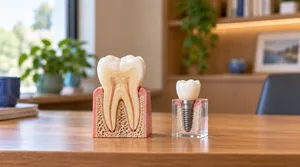
Your tooth has been bothering you for days, maybe weeks. The pain comes and goes, or maybe it never quite stops. You’re wondering if it will go away on its own, or if something serious is happening. Understanding the warning signs of a tooth that needs endodontic treatment (treatment focused on the inside of the tooth, most commonly root canal therapy) can help you act before a manageable problem becomes a dental emergency.
At Mid-Florida Endodontics, our specialists evaluate patients across multiple Florida locations every day for exactly these symptoms. Here’s what we look for, and what you should watch for at home.
Warning Signs That Require Prompt Attention
These symptoms suggest the dental pulp (the soft living tissue, nerves and blood vessels, inside a tooth), the living tissue inside your tooth, may be infected or irreversibly damaged. No single symptom is a definitive test on its own, which is why each sign below is best confirmed by a clinical examination rather than self-diagnosed at home1:
Severe, Persistent, or Throbbing Tooth Pain
Pain that is spontaneous (comes without chewing or biting), throbbing, or keeps you awake at night is one of the more telling indicators of pulp infection or irreversible pulpitis (severe inflammation of the tooth’s inner tissue, too damaged to heal on its own)2. Unlike a cavity, which causes pain primarily when triggered, infected pulp pain can occur at rest and may radiate to the jaw, ear, or neck.4 Because symptoms vary from person to person, the pattern of your pain is one piece of the diagnostic picture rather than the whole answer.
Prolonged Sensitivity to Cold or Heat
Cold sensitivity on its own doesn’t necessarily mean your tooth is infected, it can mean the pulp is inflamed. Brief, sharp cold sensitivity that fades quickly is often reversible pulpitis: the pulp is irritated but may still be able to heal if the source (like a cavity) is removed promptly.

When cold sensitivity instead lingers well after the stimulus is removed, that prolonged response is a warning sign that the pulp may be moving toward irreversible pulpitis, where it can no longer heal itself even if bacteria haven’t fully taken over yet. At that stage, root canal treatment is typically needed to relieve the inflammation and save the tooth2. It is worth knowing that cold and heat testing point toward a likely diagnosis rather than confirming it with certainty, so an endodontist weighs these responses alongside the rest of the examination1. Heat sensitivity that lingers is an additional red flag, often suggesting the pulp is further along toward necrosis (tissue death, when the living tissue inside a tooth dies due to infection or loss of blood supply). Read how to tell the difference between sensitivity and infection.
Swelling, Tenderness, or a Gum Pimple
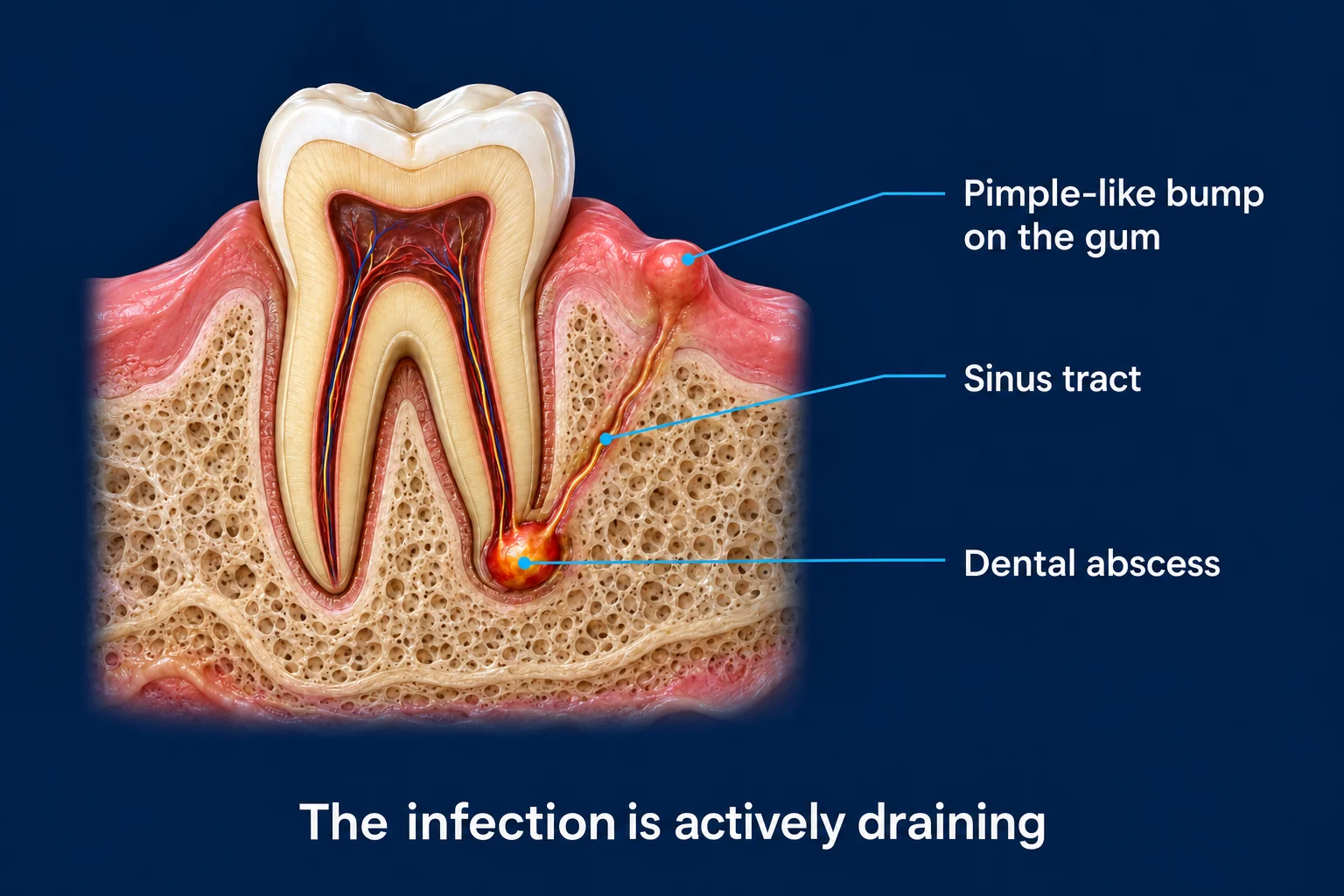
Swelling of the gum, cheek, or jaw near a specific tooth often indicates a dental abscess, a pocket of infection that has spread beyond the tooth root. A small pimple-like bump on the gum (called a sinus tract (a small channel that forms through the gum tissue to drain pus from a tooth abscess, sometimes looks like a pimple on the gum) or fistula) means the infection is actively draining2. Both require immediate evaluation. Untreated abscesses can spread to the jaw, neck, and in severe cases, the airway.
Pain When Biting or Applying Pressure
If a tooth is consistently painful when you bite down or apply pressure, even light pressure with your tongue, the periodontal ligament (the thin layer of fibers connecting the tooth root to the jawbone, which acts as a shock absorber and contains pressure-sensitive nerve fibers) surrounding the root may be inflamed due to infection spreading from inside the tooth. This symptom alone warrants evaluation.
Warning Signs That Should Be Monitored
Tooth Darkening or Discoloration
A tooth that is gradually darkening, turning gray, brown, or black compared to adjacent teeth, may indicate that the pulp has died (necrotic pulp). Dead pulp tissue releases pigments that discolor the tooth from the inside. This can occur without pain, which is why regular dental check-ups are critical.
Deep Decay or a Cracked Tooth
Extensive tooth decay that has reached the pulp chamber (the hollow space inside the crown of the tooth that houses the nerve and blood vessels), or a crack that extends into the pulp, can expose the pulp to bacteria. Your general dentist may refer you to an endodontist after identifying either of these on examination or X-ray, sometimes before symptoms develop. Find out how tooth decay progresses to the point of needing a root canal.
A Previously Treated Tooth That Hurts Again
Teeth that have had root canals can, in rare cases, become reinfected, often years later. New pain, swelling, or a sinus tract near a previously treated tooth may signal that retreatment is needed. This is called root canal retreatment and is a specialized procedure performed by endodontists. Here’s what happens during the procedure.
Can These Symptoms Go Away Without Treatment?
In short, no. An infected dental pulp cannot heal itself. Mild inflammation (reversible pulpitis) can sometimes resolve if the irritant (like a cavity) is removed quickly. But once the pulp is irreversibly inflamed or necrotic (dead, referring to tissue that has lost its blood supply and died, most commonly the pulp inside an infected tooth), the infection will persist and typically worsen over time.
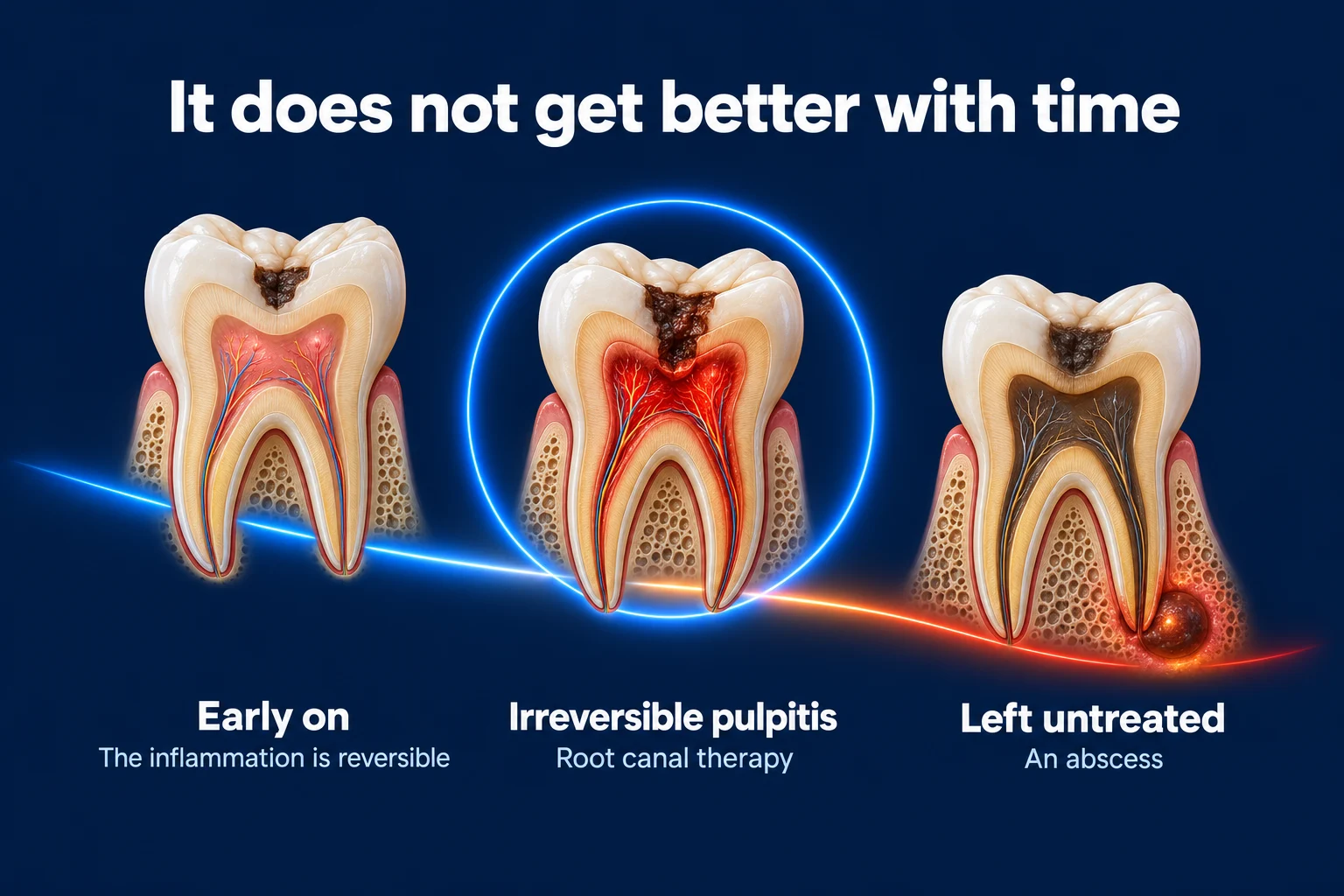
A common scenario is a tooth that was painful for weeks and then suddenly stops hurting. Patients sometimes interpret this as improvement, but it often means the pulp has died completely. The infection hasn’t gone away; it’s now spreading silently beyond the root into the surrounding bone, where it may form an abscess without producing pain. This is one reason a fading symptom should never be read as a sign that the tooth has recovered on its own.
How Does an Endodontist Confirm You Need a Root Canal?
Diagnosis involves more than looking at symptoms. At Mid-Florida Endodontics, our endodontic specialists use a combination of:
- Clinical examination checking for tenderness, swelling, and visible signs of infection
- Pulp vitality testing using cold, heat, or electronic tests to assess whether the pulp is alive, inflamed, or necrotic
- 3D CBCT (cone-beam CT, a low-dose 3D X-ray that lets us see the tooth and bone from every angle) imaging three-dimensional scans that reveal infection around root tips, bone loss, and canal anatomy invisible on standard 2D X-rays
- Percussion testing gently tapping the tooth to assess periodontal involvement
No single one of these tests is conclusive in isolation, so we read them together to build an accurate picture1, an approach reflected in standard endodontic diagnostic references3. This diagnostic process ensures that root canal treatment is only recommended when truly necessary, and that it targets exactly the right tooth.
Diagnosing irreversible pulpitis accurately is central to deciding whether a tooth needs treatment. A systematic review in the International Endodontic Journal appraised the symptoms and tests used to judge the condition of the pulp, including reaction to cold and heat, and concluded that no single sign or test is reliable enough to confirm the diagnosis on its own1. This is why an endodontist combines several findings, symptom pattern, pulp testing, percussion, and imaging, rather than relying on any one result, and uses standardized diagnostic terms to classify pulpal health and disease2.
Worried about cost? See cost and insurance.
If you recognize any of these signs, an endodontist at your nearest MFE location can evaluate your tooth and tell you exactly what is happening inside it. Find a location.
Works Cited
- Mejàre IA, Axelsson S, Davidson T, et al. Diagnosis of the condition of the dental pulp: a systematic review. Int Endod J. 2012;45(7):597-613. doi:10.1111/j.1365-2591.2012.02016.x Systematic Review
- Levin LG, Law AS, Holland GR, Abbott PV, Roda RS. Identify and define all diagnostic terms for pulpal health and disease states. J Endod. 2009;35(12):1645-1657. doi:10.1016/j.joen.2009.09.032 Systematic Review
- Berman LH, Rotstein I. Diagnosis. In: Berman LH, et al., eds. Cohen’s Pathways of the Pulp. 11th ed. St. Louis: Elsevier; 2016:2-39.
- Pak JG, White SN. Pain prevalence and severity before, during, and after root canal treatment: a systematic review. J Endod. 2011;37(4):429-438. doi:10.1016/j.joen.2010.12.016 Systematic Review