
You made it through most of the day managing the dull ache in your tooth. But now it’s 1 a.m., you’re lying in bed, and the pain has gone from annoying to unbearable. This is one of the most common patterns our patients at Mid-Florida Endodontics describe, and there are clear biological reasons it happens. Recognizing those reasons can help you stay calm at 1 a.m. and make a good plan for the morning. More on why tooth pain sometimes comes and goes.
A toothache that gets worse at night when you lie down usually has a clear biological cause. Understanding why tooth pain escalates at night also helps you recognize how serious the underlying cause is likely to be, and how soon you should call for an appointment.
Reasons Tooth Pain Is Worse at Night
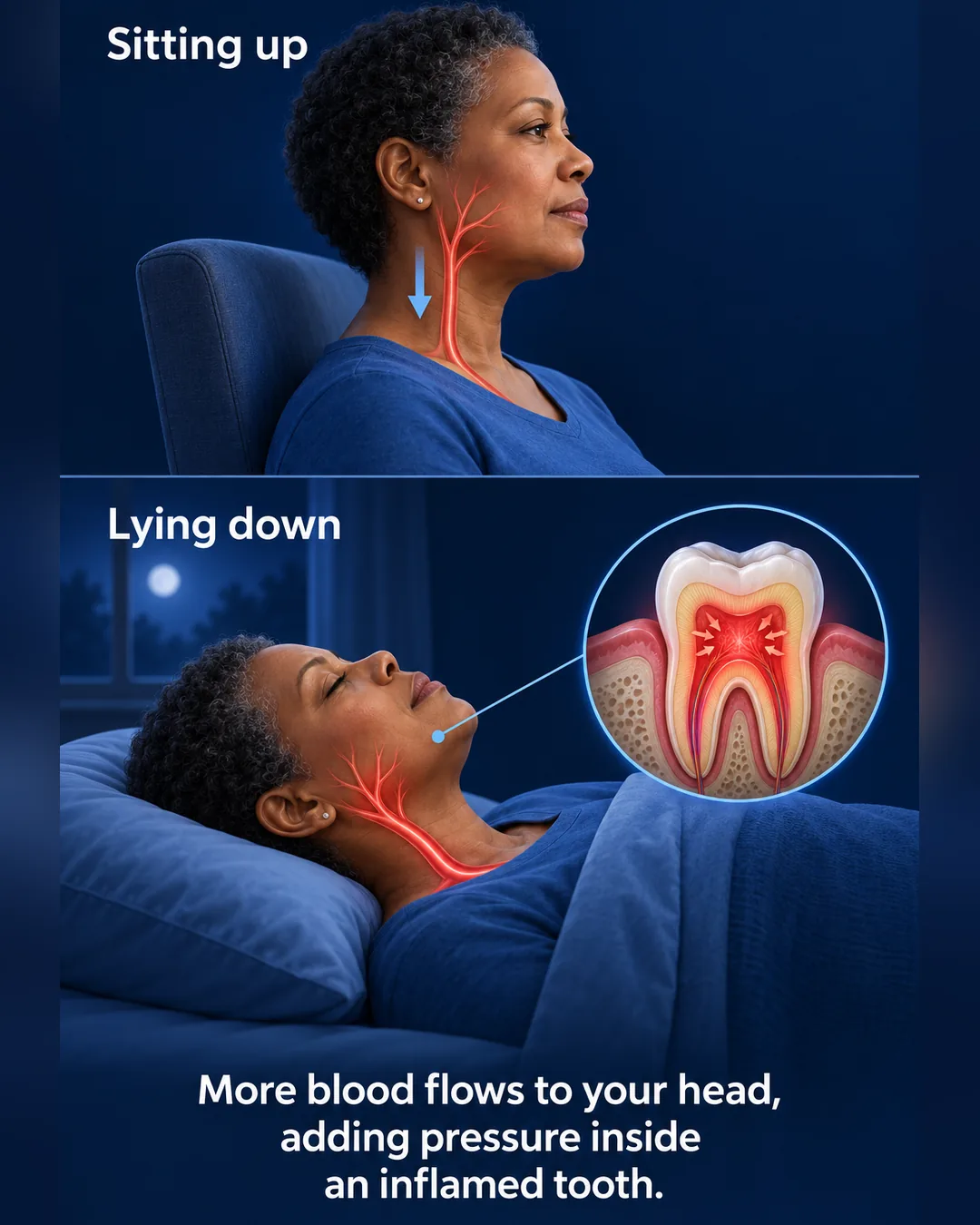
Increased Blood Flow to the Head When Lying Down
When you stand or sit upright, gravity helps moderate blood flow in your head and face. When you lie down, blood flows more freely to your head, which can increase pressure inside inflamed tissue, including an infected or inflamed tooth pulp. This is a normal change in body position and circulation, not a sign that something new has gone wrong. For a tooth that is already inflamed, that added pressure can amplify the throbbing sensation that often accompanies a dental abscess or irreversible pulpitis (severe inflammation of the tooth’s inner tissue, too damaged to heal on its own). Elevating your head with an extra pillow can provide modest temporary relief. We break down what a dental abscess feels like.

Fewer Distractions at Night
During the day, your brain processes dozens of competing sensory inputs: work, conversation, movement. At night, in a quiet, dark room, your nervous system has far less competing information. Pain signals that were partially masked by daytime activity become much more prominent. This isn’t the pain getting objectively worse, it’s your perception of it becoming sharper. Many people find that this is the moment they finally decide to seek care, which is a reasonable response. Understand signs that indicate you may need root canal therapy.
Nighttime Teeth Grinding (Bruxism)
Many people clench or grind their teeth during sleep without realizing it. This repeated muscle activity can load already-sensitive teeth and the surrounding jaw muscles, and it is linked to both tooth wear and morning facial pain.4 If you have a cracked tooth, inflamed pulp, or a new filling, nighttime grinding can intensify the pain signal you feel. Waking up with jaw soreness alongside tooth pain is a common indicator of nighttime grinding, and a custom night guard fitted by your dentist often helps protect the teeth.
Reduced Saliva Flow at Night
Saliva production naturally slows down during sleep. Saliva normally helps neutralize acids in the mouth and provides a protective buffer for tooth surfaces. With less saliva at night, teeth with exposed dentine (the sensitive layer beneath the enamel, often uncovered by gum recession or erosion) may feel more sensitive, and bacterial activity in the mouth can increase, both of which can make dental pain feel more noticeable. Sipping water before bed and keeping up with a steady oral-care routine can help offset this overnight dryness.
Pain Medication Wearing Off
If you took over-the-counter pain relief during the day, it may wear off overnight while you’re asleep, leaving you to wake in significant pain. This cycling is common when people try to manage dental infections with ibuprofen or acetaminophen alone. For pain from an inflamed pulp, anti-inflammatory medication such as ibuprofen tends to be more effective than acetaminophen taken on its own.2 These medications can provide temporary relief, but they do not address the underlying infection, which is why the pain keeps returning.
What Does Nighttime Tooth Pain Tell You About the Cause?
The nature of nighttime tooth pain is diagnostically useful. Endodontists consider:
- Spontaneous throbbing pain that wakes you up → strongly suggests irreversible pulpitis or dental abscess. Spontaneous, persistent pain that lingers after a trigger is removed is a recognized hallmark of irreversible pulpitis.3 This is an urgent sign requiring same-day or next-day evaluation.
- Pain worse when lying flat but better when you sit up → increased pressure from pulp inflammation or abscess, also indicates the need for root canal treatment.
- Generalized jaw soreness with multiple teeth aching → may indicate nighttime bruxism rather than a single infected tooth. A night guard and dental evaluation are warranted.
- Brief sensitivity at night that resolves quickly → may be reversible sensitivity from recession or early decay; less urgent but still worth addressing.
You have facial swelling, difficulty swallowing, a fever alongside tooth pain, or pain so severe you cannot sleep despite over-the-counter medication. These indicate a spreading dental infection requiring emergency care. Mid-Florida Endodontics accommodates same-day emergency appointments, call us first thing when we open.
Temporary Relief for Nighttime Tooth Pain
While You Wait for Your Appointment
- Elevate your head sleeping with an extra pillow reduces blood flow to the area and can lessen throbbing
- Take ibuprofen (if not contraindicated) 400-600mg every 6-8 hours with food, as directed by your provider, reduces inflammation more effectively than acetaminophen for dental pain1
- Avoid hot liquids before bed heat can worsen pain from an inflamed pulp
- Do not apply heat or cold to the outside of your face compresses may seem helpful but can increase swelling, especially when infection is involved. Follow your provider’s medication recommendations instead
- Avoid lying on the affected side reduces direct pressure on the tooth
- Do not put aspirin directly on the tooth or gum this does not help and can cause a chemical burn to the gum tissue
Important: These are temporary measures only. Dental infections do not resolve without professional treatment, and delay typically leads to more extensive treatment being needed. Early evaluation by an endodontic specialist gives you the best chance of saving the tooth and getting comfortable quickly.
Why does an inflamed tooth often hurt more once you put your head down? The most likely explanation is simple physiology: lying flat increases blood flow to the head and face, which can raise pressure inside tissue that is already inflamed, making throbbing more noticeable. That is a general circulatory effect of body position, not a sign of a new problem. What the published evidence does support is how to manage the pain while you wait for care. A systematic review and meta-analysis of endodontic pain found that nonsteroidal anti-inflammatory drugs such as ibuprofen effectively relieve postoperative endodontic pain, with ibuprofen 600 mg outperforming placebo.1 In patients with irreversible pulpitis specifically, a separate systematic review and meta-analysis found anti-inflammatory analgesics more effective than acetaminophen used alone.2 Spontaneous, lingering pain of the kind that wakes people at night is a recognized feature of irreversible pulpitis.3
If tooth pain is interrupting your sleep, that is your body telling you something is wrong. An MFE endodontist at your nearest location can diagnose and treat the cause. Find a location near you.
Works Cited
- Smith EA, Marshall JG, Selph SS, Barker DR, Sedgley CM. Nonsteroidal Anti-inflammatory Drugs for Managing Postoperative Endodontic Pain in Patients Who Present with Preoperative Pain: A Systematic Review and Meta-analysis. J Endod. 2016;43(1):7-15. doi:10.1016/j.joen.2016.09.010 Systematic Review
- Shirvani A, Shamszadeh S, Eghbal MJ, Marvasti LA, Asgary S. Effect of preoperative oral analgesics on pulpal anesthesia in patients with irreversible pulpitis: a systematic review and meta-analysis. Clin Oral Investig. 2016;21(1):43-52. doi:10.1007/s00784-016-1974-1 Systematic Review
- Mardani S, Eghbal MJ, Baharvand M. Prevalence of referred pain with pulpal origin in the head, face and neck region. Iran Endod J. 2008;3(2):8-10. PMID 24171013.
- Jonsgar C, Hordvik PA, Berge ME, Johansson AK, Svensson P, Johansson A. Sleep bruxism in individuals with and without attrition-type tooth wear: An exploratory matched case-control electromyographic study. J Dent. 2015;43(12):1504-10. doi:10.1016/j.jdent.2015.10.002