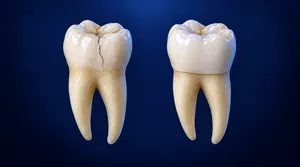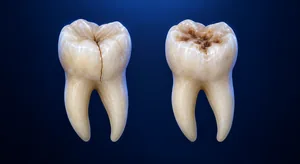
A cracked tooth is one of the most diagnostically challenging conditions in dentistry, and one of the most commonly missed. Unlike a cavity, which produces predictable sensitivity, or an abscess, which causes unmistakable pain, a cracked tooth produces symptoms that are maddeningly inconsistent. The pain comes and goes. It is hard to pinpoint which tooth. Your dentist’s X-ray looks normal. See the difference between a cracked tooth and a cavity.
At Mid-Florida Endodontics, diagnosing and treating cracked teeth is something our endodontic specialists handle regularly. Here is what the symptoms look like, and why early diagnosis matters so much.
Classic Symptoms of a Cracked Tooth
The Cracked Tooth Symptom Checklist
- Sharp pain when biting down often triggered by biting in a specific direction or on a particular area of the tooth
- Pain upon releasing bite pressure the classic “rebound” pain when you lift off a bite; caused by the crack flexing open and closed under load
- Difficulty pinpointing which tooth hurts pain that seems to shift or radiate, making it hard to identify the culprit
- Intermittent pain that comes and goes not constant; may disappear for days then return unpredictably
- Brief sensitivity to cold, sweets, or air from exposed dentin (the layer of tooth beneath the hard enamel (the hard outer shell of the tooth, the hardest substance in the human body), softer and more sensitive, containing microscopic channels that connect to the nerve) at the crack line
- Lingering cold sensitivity if the crack has allowed irritants to reach the pulp (the soft living tissue inside the tooth, containing nerves and blood vessels), the pulp may be inflamed beyond its ability to recover
- No visible damage on X-ray cracks are typically invisible on conventional 2D radiographs, leading to frustrating diagnostic delays
The 5 Types of Cracked Teeth, and What Each Means
Not all cracks are the same. The type and location of the crack determines the treatment, and whether the tooth can be saved. The pattern of cracks is well documented: in a study of posterior teeth, fractures clustered in load-bearing molars and premolars, which carry the highest biting forces.2

Craze Lines
Tiny, superficial cracks in the outer enamel only. Extremely common, especially in adults. They do not penetrate into dentin or pulp and cause no pain or sensitivity. No treatment is needed beyond monitoring.
Fractured Cusp
A piece of the biting surface (cusp) breaks off, usually around a large filling. Often painless since the pulp is rarely involved. Patients may notice a sharp edge or feel a piece break away while eating.
Cracked Tooth (Incomplete Fracture)
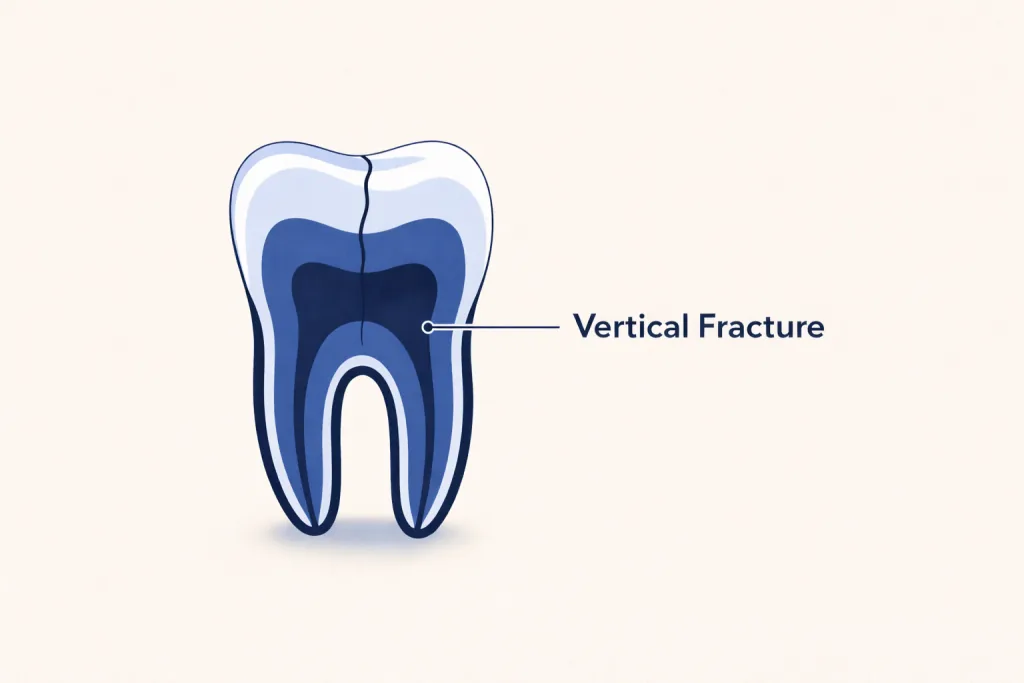
A crack that extends from the chewing surface down toward the root, but has not yet split the tooth completely. This is the most common source of cracked tooth syndrome symptoms. The pulp may or may not be involved depending on crack depth. This is the critical treatment window: early intervention can save the tooth. When the pulp stays healthy, monitoring without immediate restoration can be a reasonable option for an asymptomatic crack, but a tooth that needs a root canal is strongly recommended to receive a full crown afterward to protect it.5

Split Tooth
The crack has propagated completely through the tooth, dividing it into two distinct segments. The tooth cannot be saved as a whole. Depending on the position of the split, one root may sometimes be salvaged with endodontic treatment (treatment focused on the inside of the tooth, most commonly root canal therapy). But Often extraction is required.
Vertical Root Fracture
A crack that starts in the root and extends upward. Often produces minimal symptoms for a long time, making it particularly insidious. Typically diagnosed when bone loss and gum pocketing are found alongside the root. Almost always requires extraction of the affected root or the entire tooth. When a deep periodontal pocket runs along a cracked root, the long-term outlook for keeping the tooth drops sharply, which is why probing depth is one of the most important things we check.1
Why Are Cracked Teeth So Hard to Diagnose?
Standard dental X-rays are two-dimensional and show density changes, but cracks are often hairline fractures that produce no visible density change. A crack can be present for months or years before appearing on any radiograph. When a crack does cause the pulp tissue to die, the diagnosis and prognosis hinge on careful clinical testing rather than the X-ray alone.4
This is where endodontic specialists have a significant diagnostic advantage. At Mid-Florida Endodontics we use:

- 3D CBCT (cone-beam CT, a low-dose 3D X-ray that lets us see the tooth and bone from every angle) imaging three-dimensional scans help us assess bone loss adjacent to cracks and root fractures that are not visible on 2D X-rays
- Bite test with a Tooth Slooth or Burlew disk isolates pain to a specific cusp or area, identifying the crack location
- Transillumination shining a focused light through the tooth makes cracks visible as the crack line interrupts light transmission
- Methylene blue dye staining dye penetrates crack lines and makes them visible during examination
- Surgical microscope examination under high magnification, we see cracks that are not visible to the naked eye
Because the early symptoms overlap with so many other conditions, the additional findings reported in the original descriptions of cracked tooth syndrome remain a useful guide to what we are looking for during the exam.3
What Happens If a Cracked Tooth Is Left Untreated?
Cracks do not heal, they propagate. A crack that today extends only to the crown of the tooth may, over months of normal chewing, extend through the root. Once a crack reaches the root, the prognosis changes: what was a saveable tooth requiring a crown and possibly a root canal can become an unsaveable tooth requiring extraction. The reassuring news is that when a cracked tooth is caught and treated before it splits, the outlook for keeping it is good. See how a cracked tooth is diagnosed under a microscope. Read what happens if you ignore a cracked tooth.
Early treatment, before the crack reaches the pulp and before it extends to the root, gives the tooth the best possible prognosis. Pooled research on cracked teeth that received root canal treatment reports tooth survival of roughly 84 percent at five years, which supports treating a cracked tooth rather than rushing to extract it.6
Cracked tooth syndrome is a recognized diagnostic challenge in clinical endodontics. In a clinical study of cracked teeth published in the Journal of Endodontics, the two-year survival rate after root canal treatment was about 90 percent, and a periodontal probing depth greater than 6 mm alongside the crack was a significant predictor of a worse outcome (survival fell to roughly 74 percent versus about 97 percent for shallower pockets).1 A systematic review and meta-analysis in the Journal of Dentistry reported that cracked teeth keeping a healthy pulp survive at high rates over one to six years, while cracked teeth that need root canal treatment carry a substantially higher extraction risk if they are not protected with a full crown afterward.5 Taken together, the evidence underscores why early diagnosis and timely restoration matter so much for saving a cracked tooth.
Cracked tooth symptoms are notoriously hard to self-diagnose. An endodontist at your nearest MFE location has the tools to find a crack a standard X-ray will miss. Find your nearest location.
Works Cited
- Kang SH, Kim BS, Kim Y. Cracked teeth: distribution, characteristics, and survival after root canal treatment. J Endod. 2016;42(4):557-562. doi:10.1016/j.joen.2016.01.014 Prospective Study
- Ratcliff S, Becker IM, Quinn L. Type and incidence of cracks in posterior teeth. J Prosthet Dent. 2001;86(2):168-172. doi:10.1067/mpr.2001.116578
- Cameron CE. The cracked tooth syndrome: additional findings. J Am Dent Assoc. 1976;93(5):971-975.
- Berman LH, Kuttler S. Fracture necrosis: diagnosis, prognosis assessment, and treatment planning. J Endod. 2010;36(3):442-446. doi:10.1016/j.joen.2009.12.018
- Zhang S, Xu Y, Ma Y, Zhao W, Jin X, Fu B. The treatment outcomes of cracked teeth: a systematic review and meta-analysis. J Dent. 2024;142:104843. doi:10.1016/j.jdent.2024.104843 Systematic Review
- Leong DJX, de Souza NN, Sultana R, Yap AU. Outcomes of endodontically treated cracked teeth: a systematic review and meta-analysis. Clin Oral Investig. 2020;24(1):465-473. doi:10.1007/s00784-019-03139-w Systematic Review