
Tooth pain exists on a spectrum, from the mild sensitivity that has been bothering you for a few days to the acute, crisis-level pain that signals something is medically urgent. Knowing where your situation falls on that spectrum determines whether you need to call us first thing in the morning, head to the ER tonight, or schedule a routine appointment next week.
This guide gives you a clear, honest triage framework so you can read your own symptoms with confidence and act on the level of urgency they actually carry.
Emergency Triage: Where Does Your Tooth Pain Fall?
These Signs Require Immediate Medical Care
- Swelling spreading to the neck, throat, or floor of the mouth
- Difficulty swallowing or breathing alongside dental pain
- Inability to fully open your mouth (trismus)
- Fever above 101°F / 38.3°C with facial swelling
- Rapidly worsening swelling over a period of hours
- Feeling confused, faint, or severely unwell alongside tooth pain
These signs can indicate the infection has spread to the deep spaces of the face, neck, or airway, a potentially life-threatening situation.1 An emergency room can stabilize the infection with intravenous antibiotics and surgical drainage, the standard approach for serious odontogenic (originating from a tooth) infections.1 Antibiotics are reserved for spreading and severe infections rather than routine toothache, so the ER step is about controlling a true systemic threat, not the pain alone.4 Contact your endodontist as soon as possible afterward to treat the dental source.
These Symptoms Need Treatment Today
- Severe throbbing tooth pain that is keeping you awake or preventing normal activity
- Visible swelling of the cheek, jaw, or gum around a specific tooth
- A knocked-out permanent tooth (time is critical, see below)
- A tooth that has been displaced, pushed sideways, or driven into the socket
- Severe pain after a recent dental procedure that is worsening rather than improving
- A pimple-like bump on the gum with accompanying pain, indicating an active draining abscess
- Broken tooth with an exposed nerve causing extreme sensitivity
These Symptoms Are Urgent But Not Immediately Critical
- Persistent tooth pain that has been present for several days without improvement
- Cold sensitivity that lingers after the stimulus is removed
- Tooth pain that is worsening gradually over days
- A cracked or chipped tooth with pain but no swelling or fever
- A lost filling or crown with sensitivity but manageable pain
- Tooth pain that is consistent but not severe enough to prevent sleep or daily function
Cold sensitivity that lingers after the stimulus is removed is one pattern endodontists watch for, because it can point to inflammation inside the pulp rather than ordinary surface sensitivity.3 It is worth a prompt evaluation even when the pain feels manageable.
The Knocked-Out Tooth: A True Time-Critical Emergency
A knocked-out permanent tooth (avulsion) is one of the few dental situations where minutes genuinely matter. The periodontal ligament (the thin layer of fibers connecting the tooth root to the jawbone, which acts as a shock absorber and contains pressure-sensitive nerve fibers) cells on the root surface begin dying shortly after the tooth leaves the socket. The longer a tooth is out of the mouth, the lower the chance of successful reimplantation, which is why getting the tooth back into place quickly gives you the best chance of saving it.
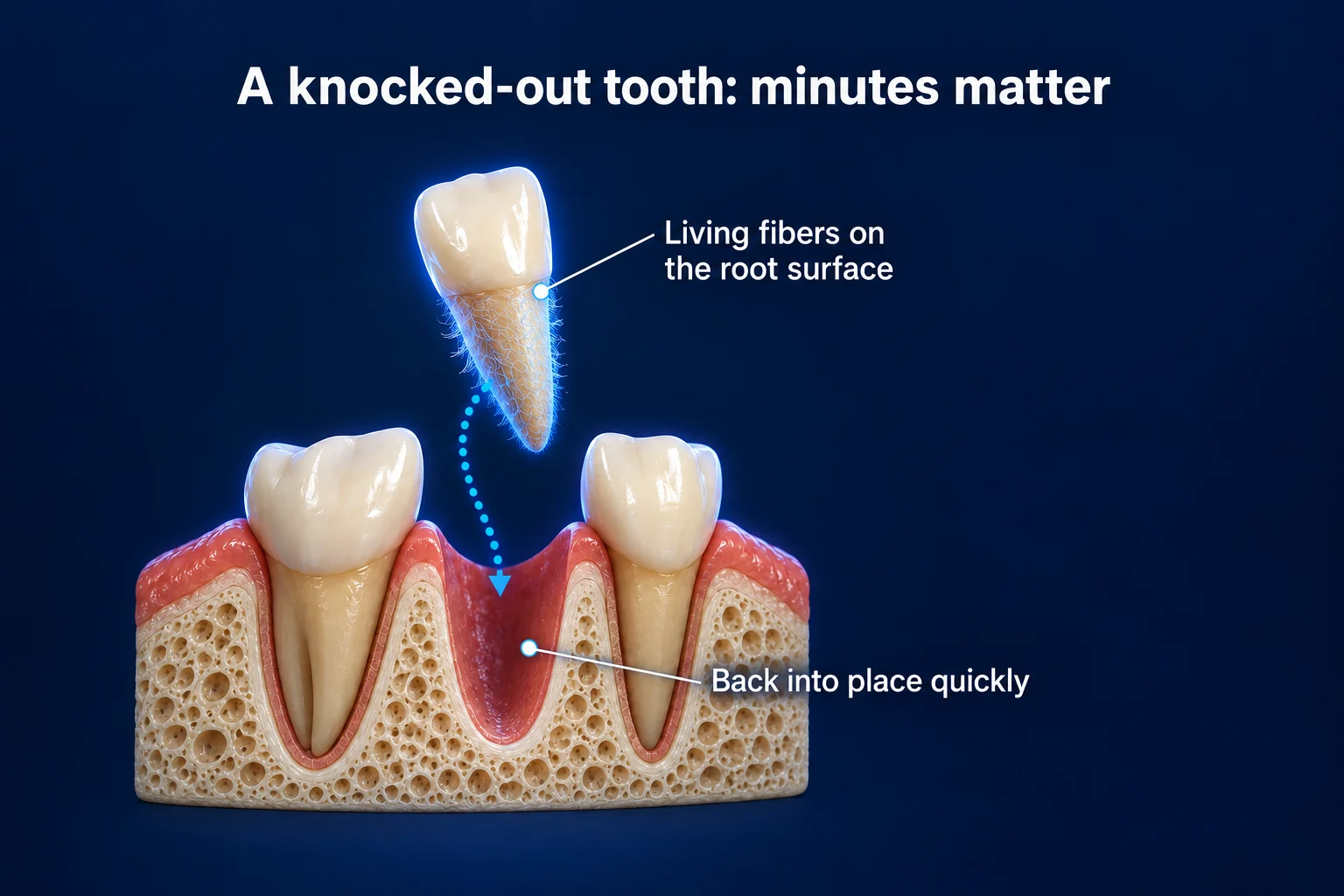
- Ideal: replant as soon as possible the sooner the tooth is back in the socket, the higher the success rate
- Pick the tooth up by the crown never touch the root surface
- If you can, gently rinse with clean water and reinsert into the socket hold it in place by biting on a cloth
- If reinsertion isn’t possible store the tooth in milk, saline, or between the cheek and gum, not in water, which destroys the ligament cells
- Get to an endodontist or emergency dental clinic immediately
- Note: this guidance applies to permanent teeth only, never attempt to reimplant a baby tooth
What Makes Dental Infections Uniquely Dangerous
The proximity of the teeth to critical structures, the airway, the sinuses, the brain, and major blood vessels, means dental infections that spread carry risks that infections elsewhere in the body do not. A periapical (relating to the area surrounding the very tip of a tooth’s root) abscess (a pocket of infection at the root tip of a tooth, caused by bacteria spreading from inside the tooth) from a lower molar can track into the floor of the mouth. An upper tooth infection can reach the eye socket or the cavernous sinus. These spreading abscesses are usually polymicrobial, and although serious outcomes are uncommon, the morbidity of an acute dental abscess is frequently underestimated and still accounts for hospital admissions for dental sepsis today.2 These outcomes are rare, but they are well-documented and largely preventable with timely treatment.1
The safest approach: when in doubt, call. Our team at Mid-Florida Endodontics can help you assess whether your symptoms need same-day attention and get you seen as quickly as possible.
What About After Hours?
If you experience a dental emergency outside of office hours:
- For life-threatening signs (swelling to the neck, breathing difficulty, high fever), go to the emergency room immediately
- For severe pain without life-threatening signs, take medications as directed by your provider and call the office first thing in the morning for a same-day appointment; over-the-counter analgesics manage most acute dental pain, which typically settles within a day or two once the source is addressed5
- For a knocked-out tooth, call every emergency dental contact available immediately; time is the determining factor
Serious head and neck infections that begin in a tooth are well-documented in the surgical literature, and delay in seeking professional dental care is a recognized contributor to how severely they present.1 Surgical drainage, combined with antibiotics for spreading or severe cases, is the established management for these odontogenic infections.1 The American Dental Association’s evidence-based guideline reinforces the same principle: antibiotics are reserved for patients with systemic involvement such as fever or malaise, while prompt, definitive dental treatment should be prioritized in all cases.4 Early endodontic intervention remains the most effective strategy for keeping a tooth problem from escalating into a medical emergency.
Works Cited
- Flynn TR. Surgical management of orofacial infections. Atlas Oral Maxillofac Surg Clin North Am. 2000;8(1):77-100.
- Robertson D, Smith AJ. The microbiology of the acute dental abscess. J Med Microbiol. 2009;58(Pt 2):155-162. doi:10.1099/jmm.0.003517-0
- Levin LG, Law AS, Holland GR, Abbott PV, Roda RS. Identify and define all diagnostic terms for pulpal health and disease states. J Endod. 2009;35(12):1645-1657. doi:10.1016/j.joen.2009.09.032 Systematic Review
- Lockhart PB, Tampi MP, Abt E, et al. Evidence-based clinical practice guideline on antibiotic use for the urgent management of pulpal- and periapical-related dental pain and intraoral swelling: a report from the American Dental Association. J Am Dent Assoc. 2019;150(11):906-921. doi:10.1016/j.adaj.2019.08.020 Clinical Practice Guideline
- Pergolizzi JV, Magnusson P, LeQuang JA, Gharibo C, Varrassi G. The pharmacological management of dental pain. Expert Opin Pharmacother. 2020;21(5):591-601. doi:10.1080/14656566.2020.1718651 Review