
The phrase “emergency root canal” sounds alarming. In reality, it is one of the most relieving procedures in dentistry, you arrive in significant pain, and you leave with the source of that pain eliminated. This guide helps you recognize when tooth pain points to a true dental emergency, what a same-day visit involves, and how soon you can expect relief, so you can act with informed calm instead of anxiety. See whether to go to the ER or call an endodontist. Read what happens during a root canal step by step.
What Happens During an Emergency Root Canal Appointment
Arrival and Pain Assessment
You describe your symptoms, when they started, and what you have taken for pain. Your endodontist reviews any available X-rays or takes new ones. The priority is getting an accurate picture of what is happening quickly so treatment can begin without delay.
3D CBCT Imaging
At Mid-Florida Endodontics, CBCT imaging is taken for the vast majority of patients. In an emergency, this is particularly valuable, the 3D image confirms the affected tooth, reveals the extent of any periapical (relating to the area surrounding the very tip of a tooth’s root) infection, shows the number and shape of root canals. Identifies any anatomical factors that might affect treatment. This takes only seconds and provides information that dramatically improves precision.
Local Anesthesia
Getting numb in the presence of acute infection can be more challenging because the low pH of infected tissue reduces local anesthetic effectiveness. In teeth with irreversible pulpitis (severe inflammation of the tooth’s inner tissue), a standard inferior alveolar nerve block (the routine “lower jaw” numbing injection) carries a meaningfully high failure rate, so a single injection is often not enough on its own.3 Experienced endodontists anticipate this and use supplemental anesthetic techniques, including intraligamentary and intraosseous injections, to achieve complete numbness even in acutely infected teeth. You should not feel sharp pain during the procedure. If you do, tell your endodontist immediately, additional anesthesia can almost always resolve it.
Access and Pulp Removal
A small opening is made in the crown of the tooth. The infected or inflamed pulp tissue is removed from the pulp (the soft living tissue inside the tooth, containing nerves and blood vessels) chamber (the hollow space inside the crown of the tooth that houses the nerve and blood vessels) and root canals. This is the step that eliminates the source of pressure and pain, most patients notice a sense of relief even during this stage as the acute pressure is released.
Canal Cleaning and Disinfection
The root canals are carefully shaped and irrigated with antimicrobial solutions to eliminate bacteria. This step is thorough and methodical, the goal is to eliminate all bacterial contamination before the canal is sealed.
Canal Sealing or Dressing
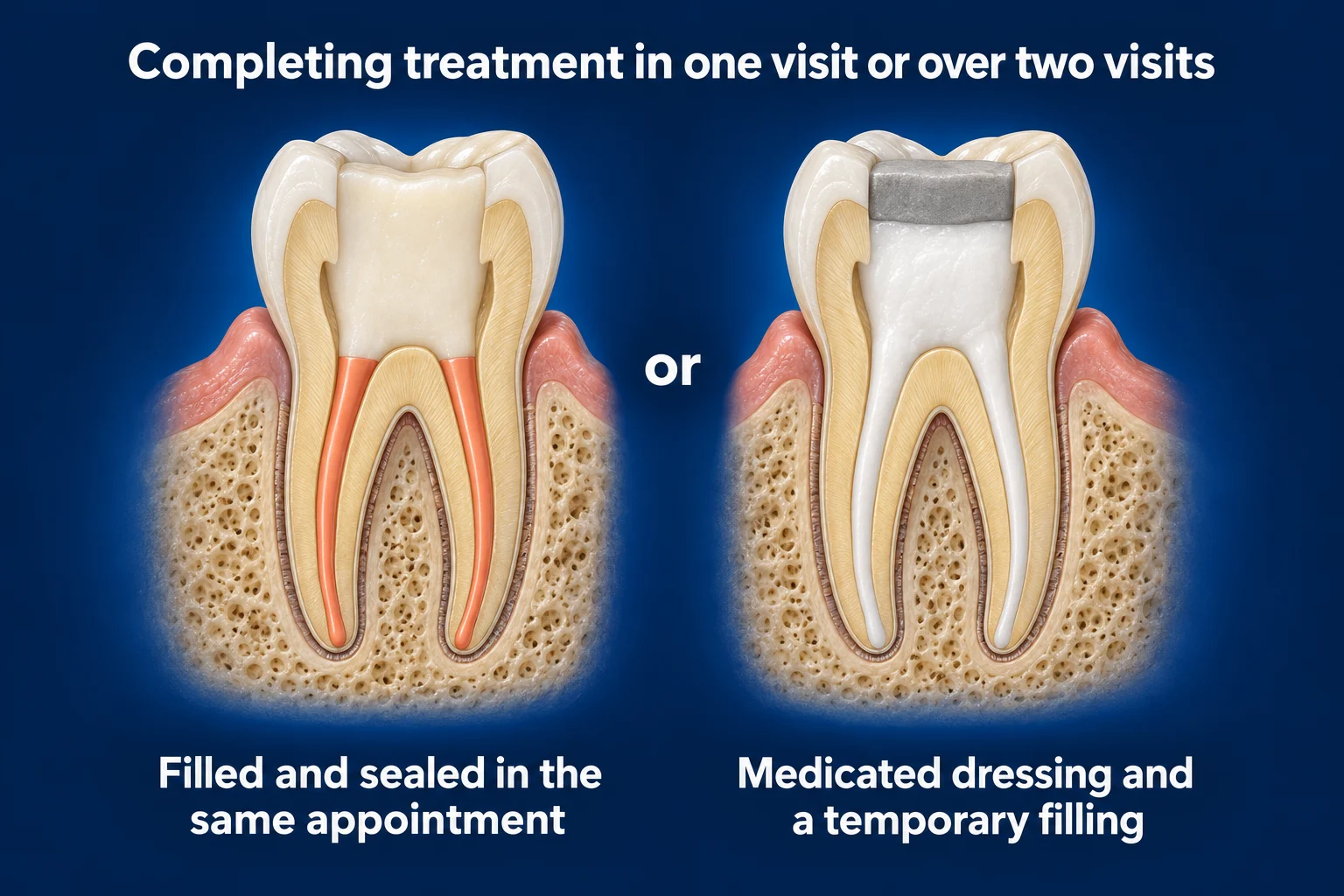
In most cases, the canals are filled and sealed in the same appointment. In cases with significant active infection or complex anatomy, a medicated dressing may be placed inside the canals and a temporary filling placed over it, with a second appointment scheduled to complete the sealing once the infection has settled. Completing treatment in one visit or over two visits has been shown to produce comparable outcomes and complication rates, so your endodontist will choose the approach that best fits your tooth and the level of infection.2 Your endodontist will explain which approach is appropriate for your case.
Post-Operative Instructions
Your endodontist will go over what to expect during recovery, medications as prescribed or recommended, and when to follow up with your general dentist for the permanent crown. A treatment report is sent to your referring dentist. Find out how long the procedure and recovery typically take.
A Word on Getting Numb With an Active Infection
Patients with acute dental abscesses sometimes worry they “can’t be numbed.” This is a real phenomenon, infected tissue is more acidic, which reduces the effectiveness of local anesthetics. Clinical trial evidence confirms that no single anesthetic injection reliably numbs an acutely inflamed tooth on its own, which is exactly why your endodontist plans for backup techniques from the start.3 However, experienced endodontists are familiar with this challenge and have a range of supplemental techniques to achieve profound anesthesia even in the most acute cases. It is not a reason to delay treatment. Tell your provider if you have had difficulty getting numb in the past, this helps them plan ahead.
How Quickly Does an Emergency Root Canal Relieve Pain?
Most patients notice significant pain reduction within hours of the procedure as the source of pressure and infection is removed. A systematic review of root canal pain found that pain prevalence and severity drop substantially after treatment, falling to minimal levels within about a week.1 The acute throbbing that was keeping you awake typically resolves once the pulp is removed and the closed, pressurized space is decompressed.
Some mild soreness in the days following treatment is normal and expected, particularly when a significant abscess was present. Take medications as prescribed or recommended by your provider. Most patients feel meaningfully better within 2-3 days, though tenderness for up to a week is within the normal range, which matches what the published evidence reports for the recovery window.1 If symptoms are worsening rather than improving, contact your endodontist.
Will I Need Antibiotics?
Not always. Antibiotics are prescribed when there is evidence that infection has spread beyond the tooth, fever, swelling extending to the face or neck, or systemic symptoms. For a localized abscess without spreading infection, root canal treatment alone eliminates the bacterial source and antibiotics are not routinely required. National clinical guidance from the American Dental Association recommends against antibiotics for most pulp and periapical pain and reserves them for cases with systemic involvement such as fever or malaise.4 A systematic review and meta-analysis supporting that guidance found that antibiotics add little benefit for a localized problem while carrying real potential for harm.5 Your endodontist will assess whether antibiotics are indicated for your specific case.
Emergency endodontic treatment (treatment focused on the inside of the tooth, most commonly root canal therapy) has been shown to provide rapid and effective pain relief for acute irreversible pulpitis (inflammation of the living tissue inside the tooth) and acute apical abscess (a rapidly developing infection at the root tip causing severe pain and often swelling). Research published in the Oral Surgery, Oral Medicine, Oral Pathology journal reported that the type of emergency procedure performed at the initial visit was a significant predictor of post-operative pain, which is why your endodontist chooses the treatment approach carefully for each case rather than applying a one-size-fits-all method.6 Complementing this, a systematic review in the Journal of Endodontics confirmed that pain prevalence and severity fall substantially after treatment and reach minimal levels within about a week.1
If you are in severe tooth pain right now, most of our offices offer same-day emergency care. Find your nearest location.
Works Cited
- Pak JG, White SN. Pain prevalence and severity before, during, and after root canal treatment: a systematic review. J Endod. 2011;37(4):429-438. doi:10.1016/j.joen.2010.12.016 Systematic Review
- Manfredi M, Figini L, Gagliani M, Lodi G. Single versus multiple visits for endodontic treatment of permanent teeth. Cochrane Database Syst Rev. 2016;12(12):CD005296. doi:10.1002/14651858.CD005296.pub3 Systematic Review
- Allegretti CE, Sampaio RM, Horliana ACRT, Armonia PL, Rocha RG, Tortamano IP. Anesthetic efficacy in irreversible pulpitis: a randomized clinical trial. Braz Dent J. 2016;27(4):381-386. doi:10.1590/0103-6440201600663 RCT
- Lockhart PB, Tampi MP, Abt E, et al. Evidence-based clinical practice guideline on antibiotic use for the urgent management of pulpal- and periapical-related dental pain and intraoral swelling: a report from the American Dental Association. J Am Dent Assoc. 2019;150(11):906-921. doi:10.1016/j.adaj.2019.08.020 Systematic Review
- Tampi MP, Pilcher L, Urquhart O, et al. Antibiotics for the urgent management of symptomatic irreversible pulpitis, symptomatic apical periodontitis, and localized acute apical abscess: systematic review and meta-analysis, a report of the American Dental Association. J Am Dent Assoc. 2019;150(12):e179-e216. doi:10.1016/j.adaj.2019.09.011 Systematic Review
- Oguntebi BR, DeSchepper EJ, Taylor TS, White CL, Pink FE. Postoperative pain incidence related to the type of emergency treatment of symptomatic pulpitis. Oral Surg Oral Med Oral Pathol. 1992;73(4):479-483. doi:10.1016/0030-4220(92)90330-s Prospective Study