
It’s 11 p.m. and your tooth is throbbing unbearably. You’re wondering whether to tough it out until morning or head to the emergency room. The answer depends on your specific symptoms, and understanding what an ER can and cannot do for dental pain helps you make the right call. Understand when tooth pain qualifies as a dental emergency.
What the ER Can Do for Dental Pain
What an ER Can Do
- Prescribe pain medication
- Prescribe antibiotics if infection has spread
- Perform incision and drainage of a rapidly spreading facial abscess
- Manage life-threatening airway compromise
- Take X-rays and assess severity
- Provide IV fluids and IV antibiotics for severe spreading infection
- Refer you for follow-up dental care
What an ER Cannot Do
- Perform a root canal to eliminate the infection source
- Extract the infected tooth
- Permanently resolve dental pain
- Assess or treat the dental cause of infection
- Place a crown or temporary restoration
- Provide endodontic specialist evaluation
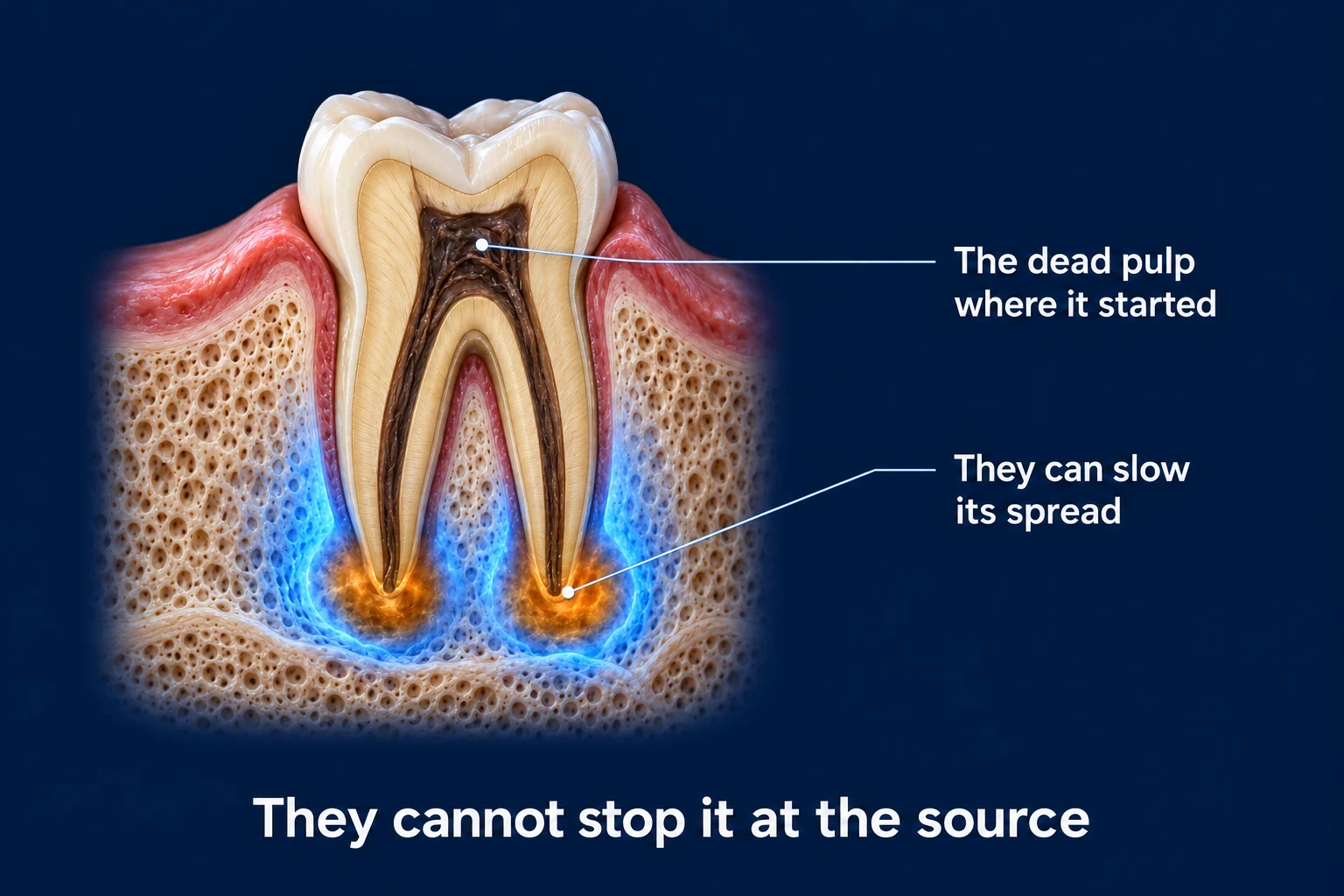
This is the fundamental limitation of ER care for dental pain: the ER can manage the downstream consequences of a dental infection, spreading bacteria, systemic effects, airway risk, and a spreading facial abscess may need surgical drainage in that setting.3 But it cannot address the source. The infected pulp or abscess inside the tooth remains. Antibiotics may reduce the spread for a time, but the infection can return once antibiotics stop unless the dental source is treated; current guidance recommends definitive dental treatment and reserves antibiotics for cases with systemic involvement such as fever or malaise.2 Read about symptoms of a dental abscess that signal it is spreading.
Go to the ER Right Away. If You Have:
- Swelling spreading to your neck, throat, or floor of your mouth
- Difficulty swallowing or breathing
- High fever (above 101°F / 38.3°C) with facial swelling
- Inability to open your jaw
- Swelling developing very rapidly over hours
- Feeling confused, severely unwell, or faint alongside dental pain
Urgent care clinics have the same limits as the ER: they can ease pain and prescribe antibiotics, but they cannot do a root canal or an extraction.
When to Call an Endodontist Instead of Going to the ER
For the majority of severe dental pain, even pain bad enough to consider the ER, an endodontic specialist is the more effective choice when the signs above are absent:
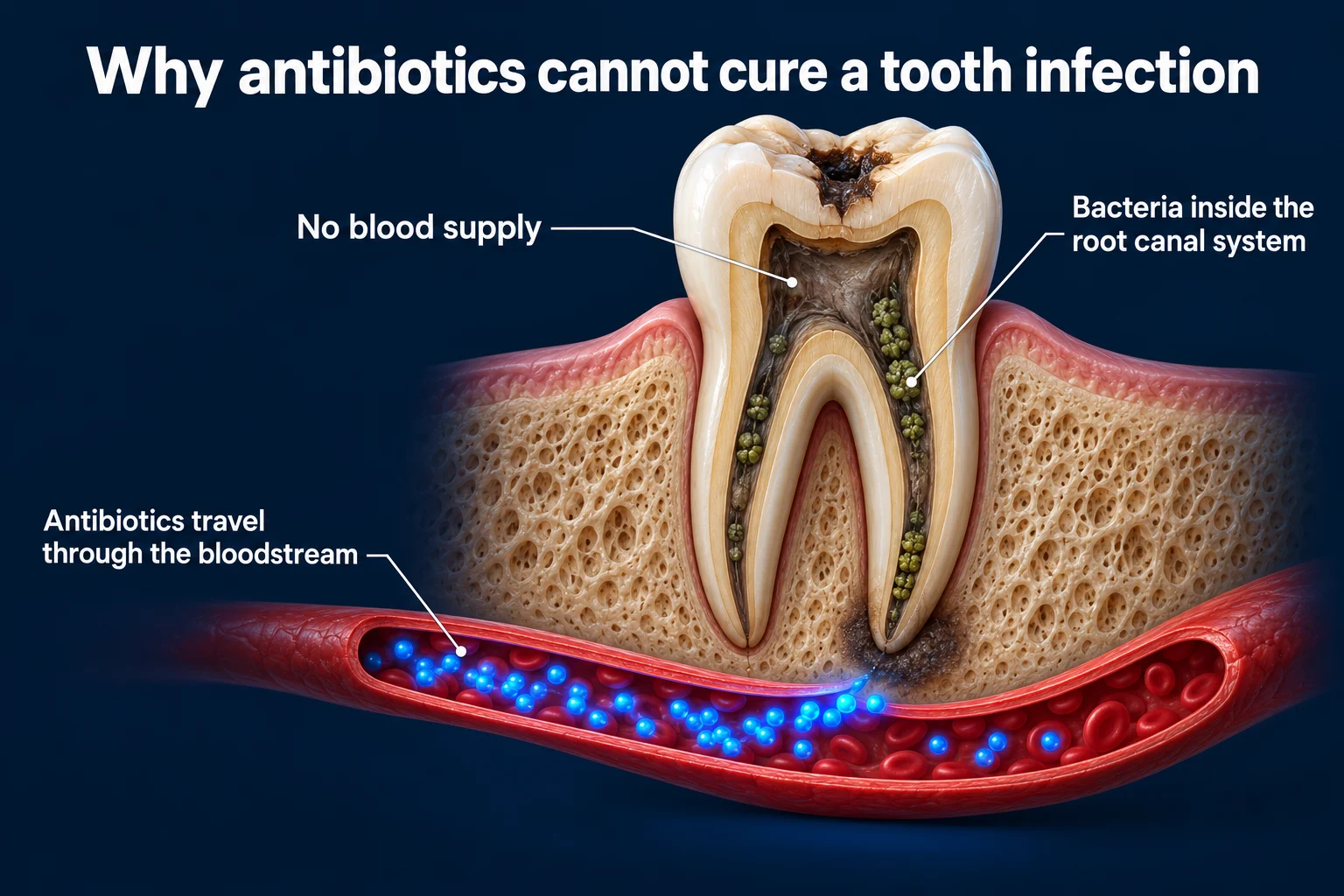
- Severe throbbing tooth pain without spreading swelling or fever a same-day endodontic appointment will eliminate the source of pain directly. The ER can provide pain medication, typically acetaminophen or anti-inflammatory medication, and potentially antibiotics, but you will still need an endodontist to resolve the problem4
- Localized abscess with a gum pimple but no spreading swelling endodontic treatment (treatment focused on the inside of the tooth, most commonly root canal therapy), not ER care, is the appropriate treatment pathway
- Dental trauma, cracked, broken, or knocked-out tooth an endodontist is better equipped to assess and treat these than an ER
- Severe pain after a recent procedure contact the treating provider first; a post-procedure flare-up needs dental evaluation, not emergency medicine
The Cycle to Avoid: ER Without Dental Follow-Up
A common and costly pattern: patient goes to the ER with severe dental pain, receives antibiotics and pain medication, feels better for a week, stops taking antibiotics. The infection returns, sometimes worse. This cycle can repeat multiple times, each time with additional cost, additional antibiotic exposure, and continuing bone destruction from the untreated infection source.
If you go to the ER for a dental infection, the most important next step is scheduling endodontic treatment as soon as possible after discharge, ideally the next day. The ER treats the emergency; the endodontist cures the problem.
After the ER: What Comes Next
If you have been to the ER for a dental infection and been discharged with antibiotics and pain medication, contact Mid-Florida Endodontics as soon as possible to schedule a same-day or next-day evaluation. Bring any discharge paperwork and let us know what antibiotics you were prescribed. We will assess the tooth, determine the appropriate treatment, and get you on the path to resolving the infection permanently.
Using emergency department resources for dental problems is a recognized public health concern, because the ER is not set up to deliver the definitive dental care these conditions need. In a study of adults who sought care for a dental problem, most of those who visited an emergency department (about 89%) were given a prescription or instructed to see a dentist rather than receiving definitive treatment, and the great majority who went to an ED subsequently visited a dentist for actual treatment.1 The pattern reported by the authors reflects a wider point that improving access to timely dental care, not repeat ED visits, is what resolves the underlying problem. (Cohen LA, et al. Comparison of patient visits to emergency departments, physician offices, and dental offices for dental problems and injuries. J Public Health Dent. 2011;71(1):13-22.)
If your pain is urgent but not a breathing or swallowing emergency, an MFE endodontist at your nearest location can often see you the same day. Find a location.
Works Cited
- Cohen LA, Bonito AJ, Eicheldinger C, et al. Comparison of patient visits to emergency departments, physician offices, and dental offices for dental problems and injuries. J Public Health Dent. 2011;71(1):13-22. doi:10.1111/j.1752-7325.2010.00195.x Prospective Study
- Lockhart PB, Tampi MP, Abt E, et al. Evidence-based clinical practice guideline on antibiotic use for the urgent management of pulpal- and periapical-related dental pain and intraoral swelling: a report from the American Dental Association. J Am Dent Assoc. 2019;150(11):906-921. doi:10.1016/j.adaj.2019.08.020 Systematic Review
- Flynn TR. Surgical management of orofacial infections. Atlas Oral Maxillofac Surg Clin North Am. 2000;8(1):77-100.
- Pergolizzi JV, Magnusson P, LeQuang JA, Gharibo C, Varrassi G. The pharmacological management of dental pain. Expert Opin Pharmacother. 2020;21(5):591-601. doi:10.1080/14656566.2020.1718651 Review