Life gets busy. Dental anxiety is real. Cost can be a barrier. And sometimes tooth pain fades, making it tempting to believe the problem has resolved. These are the real reasons patients delay seeking care for tooth infections, and they are entirely understandable.
But the question “how long can I wait?” does not have a reassuring answer. Here is what the timeline of an untreated tooth infection tends to look like, in honest, clinical terms. Keep in mind these stages are a general pattern, not a fixed schedule, because every infection and every patient is different.
The Timeline of an Untreated Tooth Infection
Acute Abscess Forms
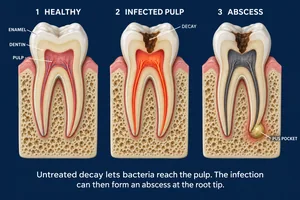
A periapical (relating to the area surrounding the very tip of a tooth’s root) abscess (a pocket of infection at the root tip of a tooth, caused by bacteria spreading from inside the tooth) develops at the root tip. Pain is often severe and throbbing. The tooth can be extremely sensitive to heat and biting pressure. The infection is still localized to the tooth and immediate surrounding bone. This is the ideal treatment window: root canal therapy at this stage resolves the infection predictably with minimal bone loss and faster healing.2 Find out how a tooth infection can spread to the body. Explore symptoms of a dental abscess to watch for.

Bone Erosion and Possible sinus tract Formation
The abscess can continue to expand through surrounding bone. A sinus tract (gum pimple) may form as the infection finds a drainage path. Pain may temporarily decrease if drainage occurs, but the infection has not resolved and may still be affecting bone. More bone loss often means a more complex treatment and longer healing time after root canal therapy.2
Pulp necrosis and Silent Spread
If not already present, the pulp (the soft living tissue inside the tooth, containing nerves and blood vessels) may die completely. Pain can decrease paradoxically. The infection, now often chronic, can continue spreading quietly through the bone. Adjacent teeth may become involved. The periapical lesion (an area of infection and bone damage at the tip of a tooth’s root, visible on X-rays) tends to grow. This kind of chronic, often symptom-free apical periodontitis is far more common than many people realize: a worldwide systematic review and meta-analysis estimated that about half of adults have at least one tooth affected.4 Treatment is still effective, but bone healing takes longer, often many months for large lesions.2
Significant Bone Loss and Possible Cellulitis
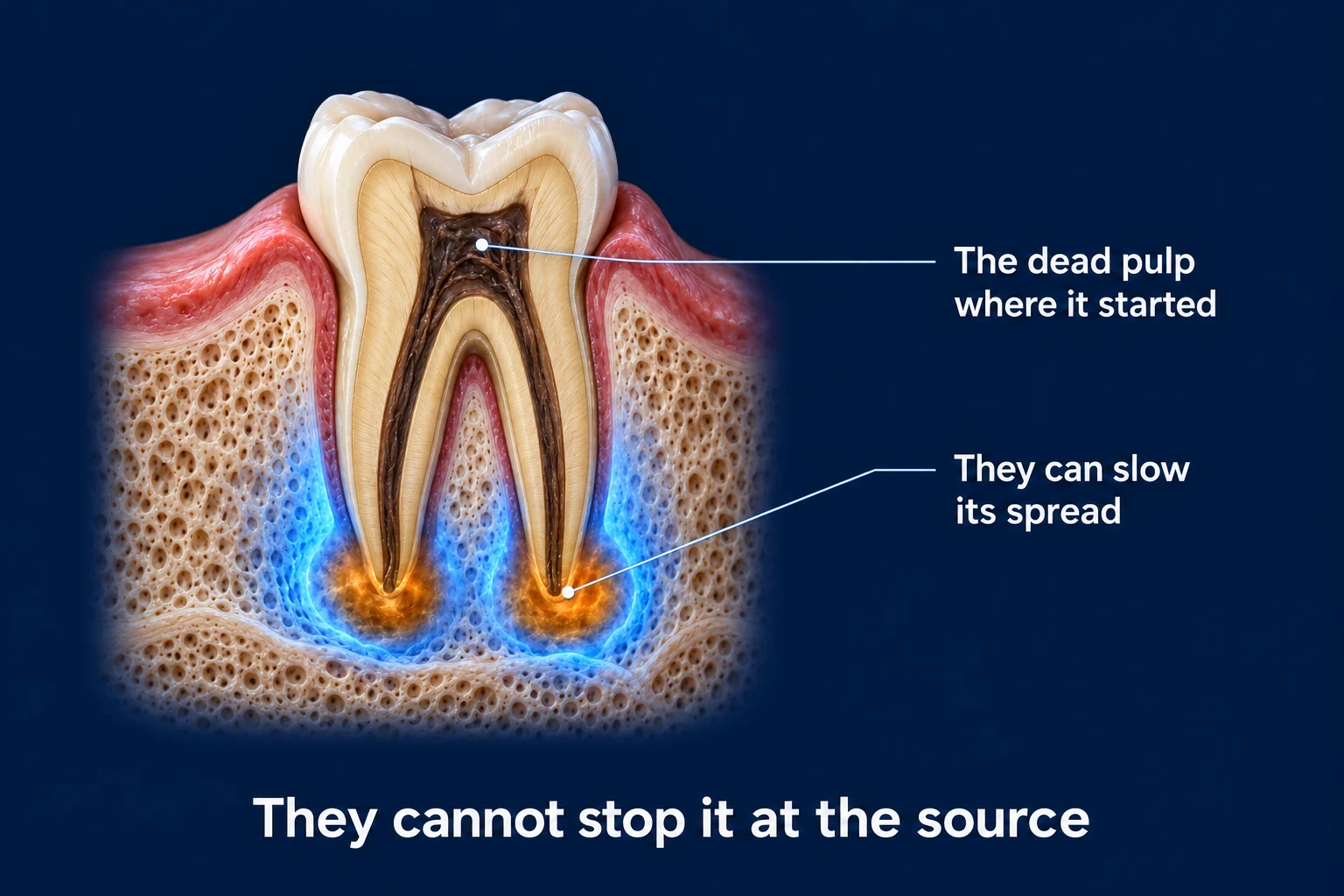
Extensive bone destruction can occur. In some cases, the infection breaks out of the bone into soft tissue, causing facial cellulitis, swelling, redness, and warmth of the cheek or jaw. Antibiotics may now be necessary alongside dental treatment, though they support care rather than replace it.3 The tooth may become more difficult to save, and in severe cases extraction becomes the better option if too much supporting bone is lost. Understand whether antibiotics are enough to cure the infection.
Serious Complications
In the most serious cases, particularly in patients with diabetes or a weakened immune system, infection from a tooth can spread into the deep spaces of the neck and, rarely, toward the chest.1 Conditions such as Ludwig’s angina, deep neck infection, mediastinitis (infection in the chest cavity), and sepsis are recognized complications of untreated dental abscess. In hospital case series of descending mediastinitis, a tooth-origin infection is the most common source, and many patients need airway protection and surgical drainage in the hospital.5 These are uncommon, but they can require emergency hospital care, which is why early treatment matters so much.1
What Happens to the Tooth If You Wait?
Beyond the systemic risks, delay directly affects the tooth itself and the complexity of treatment required:
- More bone is destroyed, leaving less support for the tooth after treatment
- Larger periapical lesions take longer to heal (months rather than weeks)
- Severely compromised teeth may no longer be salvageable with root canal therapy, requiring extraction instead
- Neighboring teeth can become involved, multiplying the treatment needed
- Post-treatment healing is slower and less predictable with extensive pre-existing bone loss2
The Cost of Waiting: Early vs. Late Treatment
Exact fees vary by tooth, by insurance, and by what care a tooth needs, so the figures below are general ranges rather than quotes. The pattern is consistent, though: treating a problem early is almost always simpler and less costly than treating it after the infection has advanced.
Treated Early
- Root canal therapy plus a crown
- Often a single visit, with same-day relief
- Bone heals fully over the following months
- Tooth saved with an excellent prognosis
- Antibiotics usually not needed
Treated Late
- Root canal therapy, a crown, and possibly antibiotics
- Possible extraction followed by an implant
- An emergency-room visit if the infection becomes systemic
- Lost work time and a longer recovery
- Possible permanent bone loss
Myths That Lead People to Wait Too Long
“The pain stopped, so it must be better.”
Pain stopping can mean the nerve has died. The infection has not resolved; it may be progressing quietly. A crack can hide the same way, so learn whether a cracked tooth can heal.
“I’ll take antibiotics and it will clear up.”
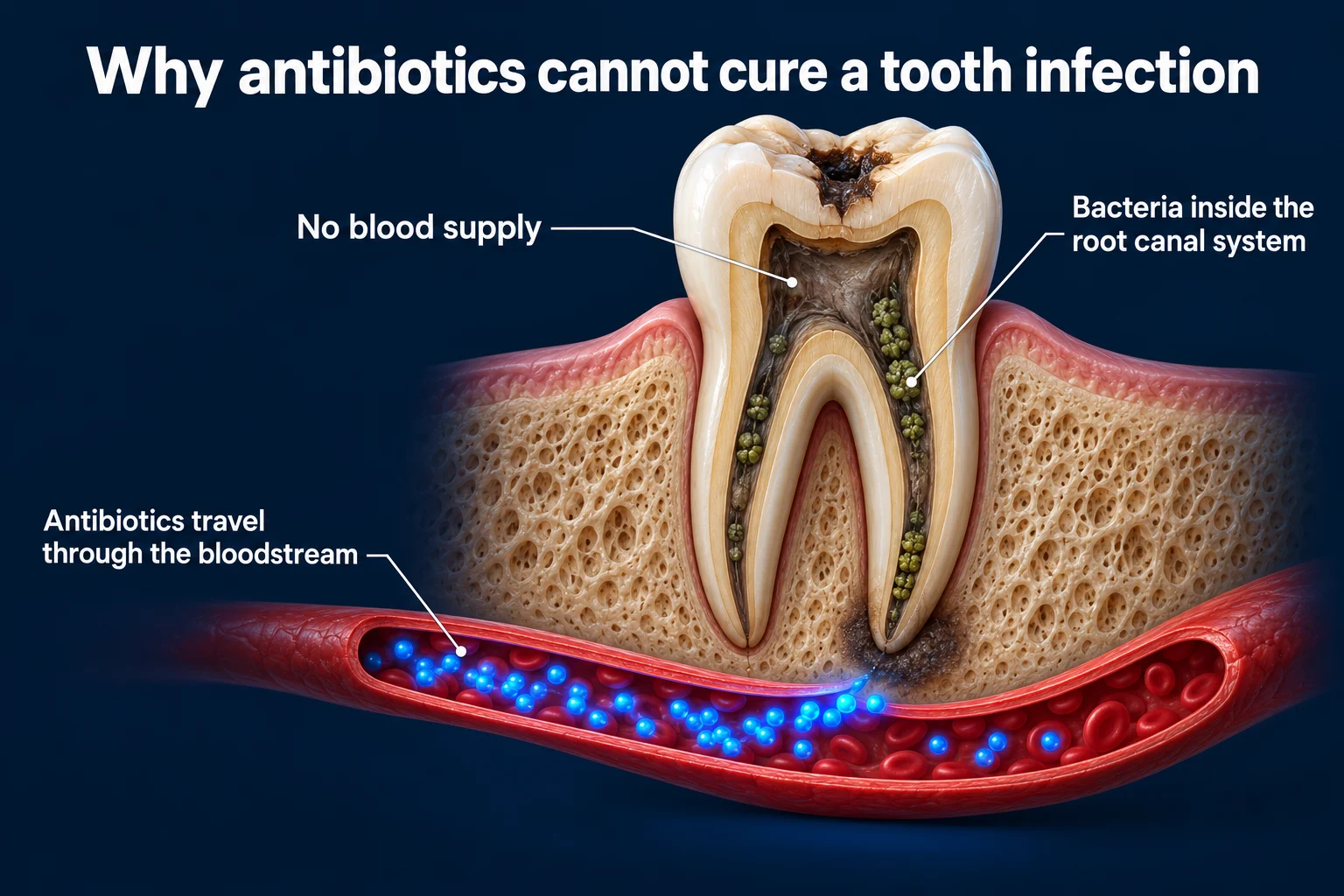
Antibiotics cannot reach the avascular (no blood supply) environment of a necrotic (dead, referring to tissue that has lost its blood supply and died, most commonly the pulp inside an infected tooth) tooth pulp. The current ADA guideline reserves antibiotics for cases with systemic involvement and prioritizes treating the tooth itself; antibiotics reduce spread, they do not cure the infection source.3
“It’s just a tooth, it’s not that serious.”
Serious complications from dental abscesses are uncommon, but they are documented even in otherwise healthy adults. The proximity of teeth to the airway, the deep neck spaces, and major blood vessels is what makes some dental infections dangerous when they spread.1
“I’ll wait until it’s unbearable.”
The most concerning stage of a tooth infection is often the quietest, after the nerve dies and pain decreases. Waiting for unbearable pain may mean waiting through the safest treatment window.
Research on the outcomes of root canal treatment (treatment focused on the inside of the tooth) helps explain why early care matters. A systematic review and meta-analysis in the International Endodontic Journal found that the pre-operative absence of a periapical radiolucency (no visible bone-loss lesion at the root tip on X-ray) was one of the clinical factors associated with a higher success rate of primary root canal treatment.2 Because delay tends to allow these lesions to form and grow, getting treated before significant bone loss develops supports a better, more predictable outcome. Separately, a retrospective study of patients hospitalized for deep neck infections of dental origin found that a delay of more than three days in addressing the source tooth was associated with worse outcomes, reinforcing that timely care matters once an infection has begun to spread.1
If you have a tooth infection, getting it treated as soon as possible is the right call. Most of our endodontist offices offer same-day emergency care. Find your nearest location.
Works Cited
- Treviño-Gonzalez JL, Santos-Santillana KM, Cortes-Ponce JR, Gonzalez-Andrade B, Morales-Del-Angel JA. Role of early extraction of odontogenic focus in deep neck infections. Med Oral Patol Oral Cir Bucal. 2023;28(1):e25-e31. doi:10.4317/medoral.25536
- Ng YL, Mann V, Rahbaran S, Lewsey J, Gulabivala K. Outcome of primary root canal treatment: systematic review of the literature. Part 2. Influence of clinical factors. Int Endod J. 2008;41(1):6-31. doi:10.1111/j.1365-2591.2007.01323.x Systematic Review
- Lockhart PB, Tampi MP, Abt E, et al. Evidence-based clinical practice guideline on antibiotic use for the urgent management of pulpal- and periapical-related dental pain and intraoral swelling: a report from the American Dental Association. J Am Dent Assoc. 2019;150(11):906-921. doi:10.1016/j.adaj.2019.08.020 Systematic Review
- Tibúrcio-Machado CS, Michelon C, Zanatta FB, Gomes MS, Marin JA, Bier CA. The global prevalence of apical periodontitis: a systematic review and meta-analysis. Int Endod J. 2021;54(5):712-735. doi:10.1111/iej.13467 Systematic Review
- Ma C, Zhou L, Zhao JZ, et al. Multidisciplinary treatment of deep neck infection associated with descending necrotizing mediastinitis: a single-centre experience. J Int Med Res. 2019;47(12):6027-6040. doi:10.1177/0300060519879308 Prospective Study