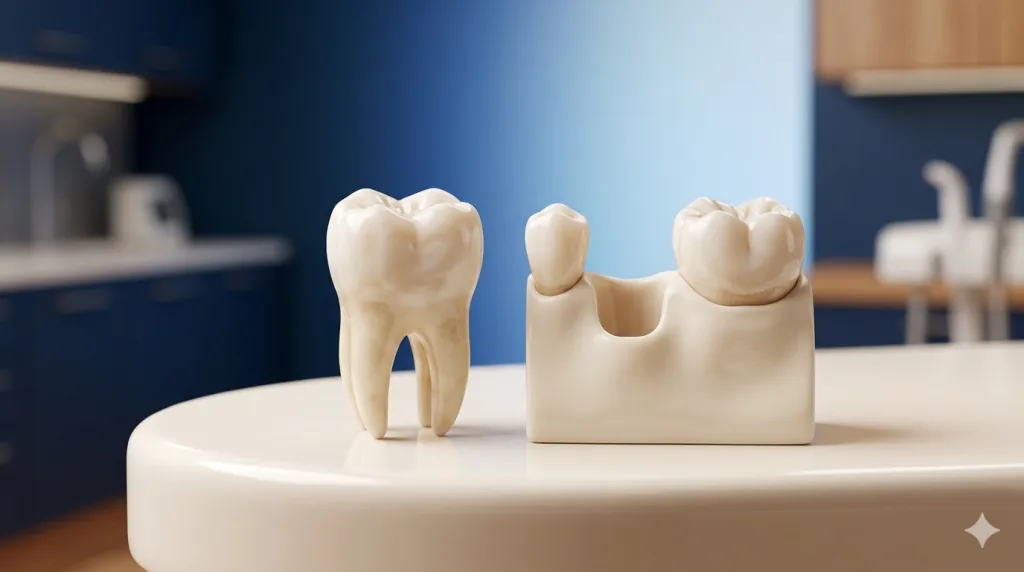
When a tooth is severely damaged or infected, you may be told you have a choice: root canal treatment to save the tooth, or extraction to remove it. For many patients, this feels like a coin flip, and the fear of a root canal sometimes pushes them toward extraction as the “easier” option. Understand why early treatment almost always preserves more tooth structure.
But the reality is that extraction isn’t simpler, it’s often more expensive, more disruptive, and creates new problems that require additional treatment. Here’s what you need to know to make an informed decision.
Side-by-Side Comparison: Root Canal vs. Extraction
| Factor | Root Canal | Extraction |
|---|---|---|
| Natural tooth preserved? | Yes, your own tooth is saved | No, tooth is permanently removed |
| Bone loss risk? | No, root stays in place, preserving bone | Yes, bone begins shrinking within months of extraction |
| Neighboring teeth affected? | No, adjacent teeth are unaffected | Yes, neighboring teeth can drift or tilt into the gap |
| Procedure time | 60-90 min, usually one visit | 30-60 min for simple extraction; longer for surgical |
| Recovery | 2-3 days mild soreness | 1-2 weeks; more restrictions on eating and activity |
| Cost over time | One procedure and a crown. The tooth you keep needs no replacement later. | Extraction, then a replacement tooth and a crown. Each step is billed separately. |
| Bone graft often needed? | No. The root stays in place, so the bone around it is preserved. | Often yes. Bone shrinks after a tooth is removed, and an implant needs enough bone to hold it. A graft adds a procedure and months of healing.8 |
| Chewing function | Full function restored with crown | Reduced until replacement tooth is placed |
| Long-term success rate | 85-95% success over 10+ years | Implant success: ~95% over 5 to 10 years,6 but requires surgery, healing time, and higher cost |
Why Is Saving Your Natural Tooth Usually Better?
Your Natural Tooth Is the Gold Standard
No dental implant, bridge, or partial denture fully replicates what your natural tooth does. Your real tooth has a periodontal ligament (the thin layer of fibers connecting the tooth root to the jawbone, which acts as a shock absorber and contains pressure-sensitive nerve fibers), a shock-absorbing structure connecting root to bone, that implants don’t replicate. Natural teeth transmit bite pressure more naturally, last longer when properly cared for, and require no surgical placement. More on how long a root canal treated tooth can last. We break down what happens during the root canal procedure itself.
Extraction Starts a Chain Reaction
Removing a tooth doesn’t solve the problem, it begins a new one. The jawbone at the extraction site begins to resorb (shrink) within months without a tooth root to stimulate it. Adjacent teeth slowly drift into the gap, changing your bite. These shifts can cause bite problems, increased wear on surrounding teeth, and TMJ issues over time. Replacing a missing tooth requires a bridge, partial denture, or dental implant, all of which involve additional procedures, costs, and maintenance.
Root Canal Treatment Is Predictable
Modern root canal treatment performed by an endodontic specialist has an excellent success rate. A large epidemiological study of more than one million treated teeth found that 97% were still in place eight years after treatment.1 Pooled outcome data and long-term cohort studies similarly show success and retention rates in the range of 85% to 95% over 10 years when the tooth receives a proper restoration such as a crown.234 This is comparable to implant survival over the same period, at a significantly lower cost and without surgical intervention.5 See why endodontists are the specialists for this decision.
When Is Extraction the Right Choice?
There are clinical situations where extraction is genuinely the appropriate treatment:
- The tooth is fractured vertically through the root, a crack that cannot be restored
- Severe bone loss from periodontal (gum) disease has left the tooth with inadequate support
- The tooth has been so severely damaged by decay that there is insufficient structure to place a crown
- The patient cannot afford the root canal and crown at this time, and extraction is the only immediate option for pain relief
- The tooth is a wisdom tooth (third molar) that serves limited function and is difficult to restore
In these cases, your dentist or endodontist will explain why extraction is recommended over root canal treatment, and a plan for tooth replacement should always follow.

The Bottom Line
If your endodontist tells you the tooth is saveable, save it. The long-term costs, financial, functional, and biological, of extraction and replacement almost always exceed those of root canal treatment and a crown. The question shouldn’t be “root canal vs. extraction” but rather “can this tooth be saved?” At Mid-Florida Endodontics, we’ll give you an honest answer.
A systematic review published in the Journal of Prosthetic Dentistry comparing tooth survival rates found that endodontically treated teeth with full-coverage restorations had long-term survival rates similar to implant-supported single crowns, while preserving the advantages of natural dentition including proprioception (the ability to sense pressure and force, natural teeth have this through the periodontal ligament; implants do not) and physiological bone maintenance.5 A separate review of single-tooth implant versus tooth-preservation decisions reached the same conclusion, reporting no difference in long-term prognosis between the two options and recommending that the choice rest on restorability, bone quality, cost, and patient preference rather than survival alone.7 (Torabinejad M, et al. J Prosthet Dent. 2007;98(4):285-311.)
Not sure which option is right for your tooth? An MFE endodontist can review your imaging and give you an honest recommendation. Find a location near you.
Works Cited
- Salehrabi R & Rotstein I. Endodontic treatment outcomes in a large patient population in the USA: an epidemiological study. J Endod. 2004;30(12):846-850. doi:10.1097/01.don.0000145031.04236.ca
- Ng YL, Mann V, Rahbaran S, Lewsey J, Gulabivala K. Outcome of primary root canal treatment: systematic review of the literature. Part 2. Influence of clinical factors. Int Endod J. 2008;41(1):6-31. doi:10.1111/j.1365-2591.2007.01323.x Systematic Review
- Fernández R, Cardona JA, Cadavid D, Álvarez LG, Restrepo FA. Survival of endodontically treated roots/teeth based on periapical health and retention: a 10-year retrospective cohort study. J Endod. 2017;43(12):2001-2008. doi:10.1016/j.joen.2017.08.003 Prospective Study
- Brochado Martins JF, et al. CBCT-assessed outcomes and prognostic factors of primary endodontic treatment and retreatment: a systematic review and meta-analysis. J Endod. 2025;51(6):687-706. doi:10.1016/j.joen.2025.03.004 Systematic Review
- Torabinejad M, et al. Outcomes of root canal treatment and restoration, implant-supported single crowns, fixed partial dentures, and extraction without replacement: a systematic review. J Prosthet Dent. 2007;98(4):285-311. doi:10.1016/S0022-3913(07)60102-4 Systematic Review
- Jung RE, Zembic A, Pjetursson BE, Zwahlen M, Thoma DS. Systematic review of the survival rate and the incidence of biological, technical, and aesthetic complications of single crowns on implants reported in longitudinal studies with a mean follow-up of 5 years. Clin Oral Implants Res. 2012;23(Suppl 6):2-21. doi:10.1111/j.1600-0501.2012.02547.x Systematic Review
- Iqbal MK & Kim S. A review of factors influencing treatment planning decisions of single-tooth implants versus preserving natural teeth with nonsurgical endodontic therapy. J Endod. 2008;34(5):519-529. doi:10.1016/j.joen.2008.01.002
- Tan WL, Wong TLT, Wong MCM, Lang NP. A systematic review of post-extractional alveolar hard and soft tissue dimensional changes in humans. Clin Oral Implants Res. 2012;23 Suppl 5:1-21. doi:10.1111/j.1600-0501.2011.02375.x Systematic Review