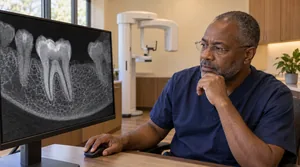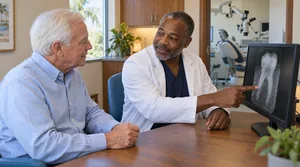
Your general dentist has referred you to an endodontist, or you’re wondering whether to seek a specialist yourself. The question is reasonable: both are dentists, both can perform root canals, so what does the specialist training add? Here’s why endodontists specialize in difficult-to-diagnose tooth pain.
The answer involves training depth, case volume, equipment, and measurable patient outcomes. Here is an honest, research-supported comparison so you can decide what kind of care fits your situation.
The Difference Between an Endodontist and a General Dentist
| Factor | Endodontist | General Dentist |
|---|---|---|
| Years of dental training | 8-11 years total (4 dental school + 2-3 residency + 2-4 undergrad) | 7-8 years total (4 dental school + 3-4 undergrad) |
| Specialty focus | Exclusively pulp and periapical (relating to the area surrounding the very tip of a tooth’s root) disease, root canals, trauma | All areas of general dentistry |
| Root canal case volume | Performs root canals exclusively, many times more often than a general dentist6 | A smaller share of a broad general-dentistry schedule |
| Surgical operating microscope | Standard, used on virtually every case | Not universally available; less commonly used |
| 3D CBCT (cone-beam CT, a low-dose 3D X-ray that lets us see the tooth and bone from every angle) imaging | Used routinely on the vast majority of patients, 3D imaging is standard practice, not reserved for complex cases only | Not always available in general practices |
| Complex case management | Calcified canals, S-curves, missed canals, C-shaped anatomy, retreatments | Straightforward cases; complex cases often referred |
| Pain diagnosis expertise | Specialist-level training in cracked tooth syndrome, referred pain, non-odontogenic (originating from a source other than a tooth) pain | General diagnostic training |
| Retreatment capability | Specialist training in removing existing root canal materials and retreating | Limited; often referred to specialists |
| Endodontic surgery | Apicoectomy and periapical surgery are within scope | Not typically performed |
| Published outcome data | Higher tooth survival rates in multiple studies | Good outcomes for straightforward cases |
When a General Dentist Is Appropriate for Root Canal Treatment
General dentists who are comfortable and experienced with endodontic procedures can successfully treat many routine root canal cases, particularly: Explore the advanced imaging tools endodontists use. Understand what a root canal retreatment involves when a prior treatment fails.
- Single-rooted front teeth with straightforward anatomy
- Premolars with uncomplicated single canals
- Patients in practices where the GP has significant endodontic training and uses a microscope
- Cases where the diagnosis is clear and the pulp (the soft living tissue inside the tooth, containing nerves and blood vessels) condition is straightforward
Many excellent general dentists perform routine root canals confidently and successfully. The point is not that GPs cannot do root canals, it is that the complexity threshold for referral to a specialist is lower than many patients expect. A good general dentist often recognizes a complex case early and refers it, which is itself a sign of sound judgment rather than a limitation.
Cases That Strongly Favor Endodontic Specialist Treatment
Root Canal Retreatment
Removing existing gutta-percha (a natural rubber-like material used to fill and seal root canals after treatment, the gold standard for over 150 years), posts, or broken instruments from previously treated canals requires specialized techniques and equipment. This is one of the most common reasons patients are referred to endodontists, and the quality of the prior filling and coronal seal influences how a retreated tooth heals.2
Complex Canal Anatomy
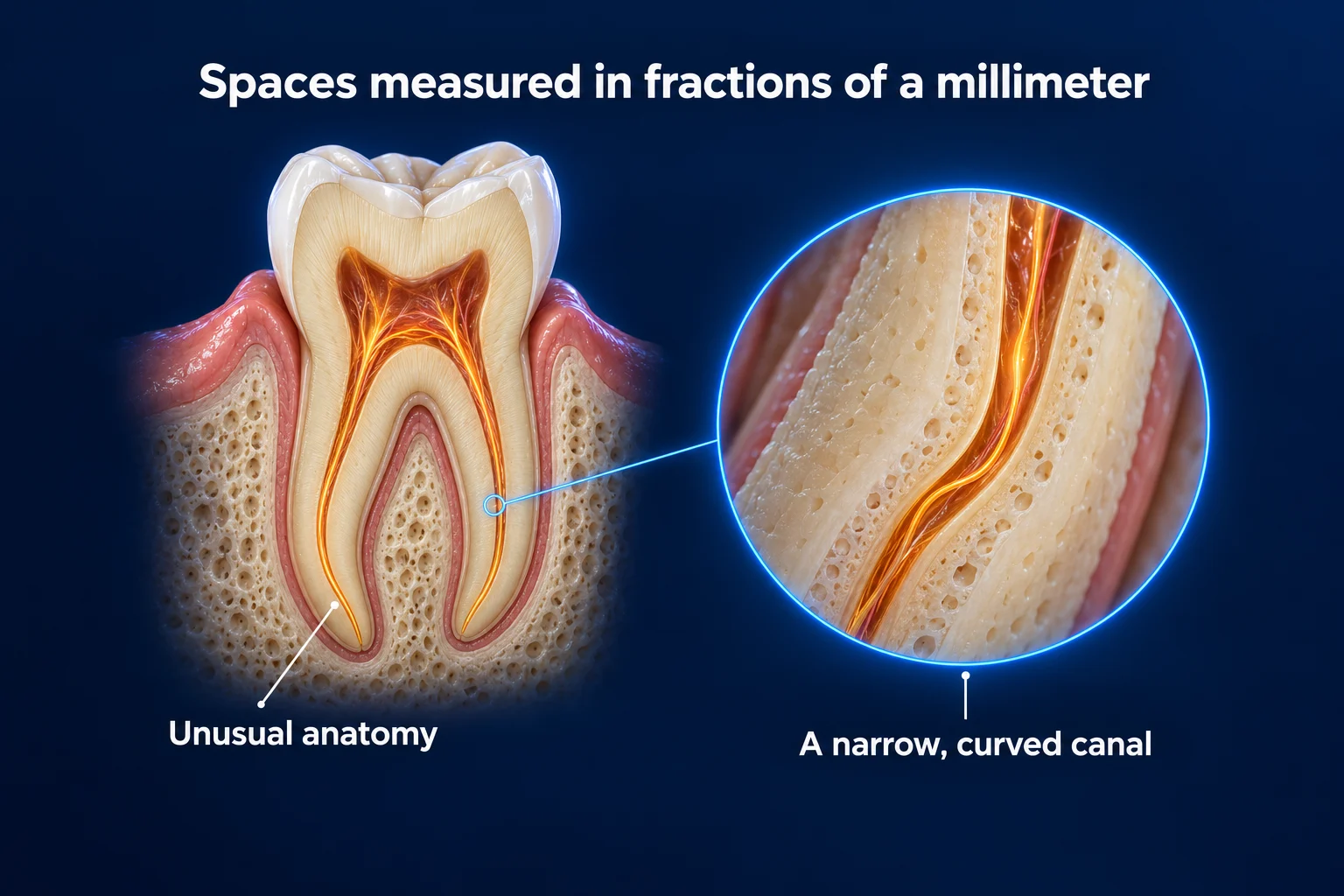
Severely curved canals (S-shapes), calcified canals, extra canals (C-shaped molars), very long roots, or unusually positioned teeth require the magnification and instrument control that a surgical microscope and specialist training provide.
Cracked Tooth Diagnosis
When the source of tooth pain is unclear and standard X-rays are normal, endodontists use the diagnostic tools, bite tests, transillumination (shining a bright light through the tooth to reveal crack lines that are otherwise invisible), surgical microscope, and 3D CBCT, to identify cracks that may be difficult to evaluate without that equipment.
Dental Trauma
Knocked-out teeth, root fractures, and luxation (when a tooth is displaced or pushed out of its normal position by an impact, but not fully knocked out) injuries require specific emergency management protocols that endodontists are trained in. Prompt, appropriate treatment in the hours after dental trauma meaningfully affects long-term tooth survival, since the time a knocked-out tooth spends out of its socket is one of the strongest factors in whether it heals.5
Endodontic Surgery (Apicoectomy)
When non-surgical root canal treatment cannot resolve a periapical infection, surgical access to the root tip may be needed. Apicoectomy (a minor surgical procedure that removes the tip of a tooth’s root and the surrounding infected tissue) is exclusively within the endodontic specialist’s scope of training.
Medically Complex Patients
Patients with bleeding disorders, on anticoagulants, with immunosuppression, or with other medical conditions that complicate anesthesia or healing benefit from specialist management and the additional clinical experience endodontists bring to complex cases.
The Volume Advantage: Why Repetition Matters in Endodontics
Endodontics is a skill-intensive specialty. Root canal treatment requires precise tactile feedback inside spaces measured in fractions of a millimeter. The more cases a clinician has completed, the more refined their technique and the more reliably they navigate unusual anatomy. Specialists also see the difficult cases that general practices refer out, which concentrates their experience with the situations most likely to go wrong.
An endodontist who has performed thousands of root canals has encountered and solved the full range of anatomical variations, difficult access situations, and complication scenarios that a general dentist who treats far fewer of these cases may not see for years, if ever.
This is not a criticism of general dentists, it is a recognition that specialization and volume matter measurably in procedural medicine and dentistry. Pre-operative and treatment factors such as a sound coronal seal and complete cleaning of the canal system are known to improve healing, and a specialist’s setup is built around achieving them consistently.1
Research has documented an outcome advantage for specialist endodontic treatment (treatment focused on the inside of the tooth, most commonly root canal therapy). A retrospective chart review published in Oral Surgery, Oral Medicine, Oral Pathology, Oral Radiology and Endodontology compared roughly 350 teeth and reported a 5-year survival rate of 98.1% for teeth treated by endodontists versus 89.7% for teeth treated by general dentists, a statistically significant difference in this single-survey sample.3 Larger systematic reviews of root canal outcomes report high success across the board when treatment factors are well controlled, which is part of why specialist setups emphasize them.4
If your case is complex, a second opinion from an endodontist costs nothing upfront and may change what treatment you need. Find an MFE location near you.
Works Cited
- Ng YL, Mann V, Rahbaran S, Lewsey J, Gulabivala K. Outcome of primary root canal treatment: systematic review of the literature. Part 1. Effects of study characteristics on probability of success. Int Endod J. 2007;40(12):921-939. doi:10.1111/j.1365-2591.2007.01322.x Systematic Review
- Ng YL, Mann V, Rahbaran S, Lewsey J, Gulabivala K. Outcome of primary root canal treatment: systematic review of the literature. Part 2. Influence of clinical factors. Int Endod J. 2008;41(1):6-31. doi:10.1111/j.1365-2591.2007.01323.x Systematic Review
- Alley BS, Kitchens GG, Alley LW, Eleazer PD. A comparison of survival of teeth following endodontic treatment performed by general dentists or by specialists. Oral Surg Oral Med Oral Pathol Oral Radiol Endod. 2004;98(1):115-118. doi:10.1016/j.tripleo.2004.01.004
- Brochado Martins JF, Georgiou AC, Nunes PD, et al. CBCT-assessed outcomes and prognostic factors of primary endodontic treatment and retreatment: a systematic review and meta-analysis. J Endod. 2025;51(6):687-706. doi:10.1016/j.joen.2025.03.004 Systematic Review
- Albertsson J, Lauridsen E, Andreasen JO, Gerds TA, Andersson L. The risks of ankylosis of 89 avulsed human teeth stored in saliva prior to replantation: a re-evaluation of a long-term clinical study. Dent Traumatol. 2021;37(4):537-545. doi:10.1111/edt.12659 Prospective Study
- American Association of Endodontists. Why See An Endodontist. Accessed September 28, 2026. aae.org