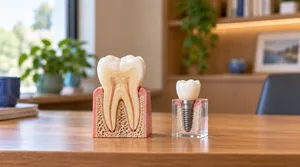
Few dental phrases cause as much anxiety as “you need a root canal.” Decades of outdated reputation have made root canals synonymous with pain, but modern endodontic treatment (treatment focused on the inside of the tooth, most commonly root canal therapy) tells a very different story. At Mid-Florida Endodontics, we perform thousands of root canals each year across our multiple Florida locations, and the most common thing patients say when they’re done is: “That was it? I barely felt anything.” That reaction is exactly what the research on root canal pain would predict, and it is the opposite of what most people expect before they sit down in the chair.
This article explains exactly what you’ll experience during a root canal, why it’s far more comfortable than you expect, and what mild soreness afterward is completely normal. We will also point to the published evidence behind each of these claims so you can see that the reassurance is grounded in studies, not marketing.
Why Do People Think Root Canals Are Painful?
The root canal’s painful reputation dates to a time before modern anesthesia, microscopic precision, and computer-assisted numbing systems. Older techniques were less predictable, and dental pain was less effectively managed. Today’s endodontic care is a different world entirely, and the experience patients describe now bears little resemblance to the stories they may have heard from a parent or grandparent.

A large part of the fear also comes from confusing the cause with the cure. The intense, throbbing pain that sends people to an endodontist is caused by an infected or inflamed dental pulp (the soft living tissue, nerves and blood vessels, inside a tooth). In a large systematic review of root canal pain, most patients arrived for treatment already in pain, and that pain dropped sharply within a day of treatment and to minimal levels within a week.1 The root canal procedure is what removes that infected tissue and ends that pain. Patients often arrive in significant discomfort and leave feeling genuine relief, which is why so many describe the appointment as the moment their toothache finally stopped.
What Does a Root Canal Actually Feel Like?
Here is what most patients experience at Mid-Florida Endodontics:
Before Treatment Begins
Your endodontist will take 3D CBCT (cone-beam CT, a low-dose 3D X-ray that lets us see the tooth and bone from every angle) imaging to precisely map your tooth’s canal anatomy. You’ll receive a thorough local anesthetic injection. At most MFE locations, we use The Wand, a computer-assisted delivery system that releases anesthetic slowly and steadily, making the injection itself feel gentle. You’ll feel the numbing take effect within a few minutes, and your endodontist will confirm the tooth is fully numb before any treatment begins.
During the Procedure
Once you’re numb, you should feel no sharp pain, only mild pressure, vibration, or movement. If you feel any discomfort at any point, tell your endodontist immediately. When a tooth is difficult to numb, a supplemental injection is a routine, well-studied step that reliably deepens the anesthesia.2 Most patients listen to music, watch TV, or simply relax during treatment.

After the Procedure
Once the anesthetic wears off (usually a few hours later), you may feel mild tenderness or soreness in the treated area for a few days. Over-the-counter ibuprofen or acetaminophen is typically all that’s needed, and taking an anti-inflammatory such as ibuprofen is well supported for managing this kind of dental pain.3 This is your body’s normal healing response, not a sign that something went wrong.
What Makes Root Canals More Comfortable Today?
Several advances in endodontic care have transformed the experience:
Endodontists use high-powered operating microscopes to see inside the tooth with extraordinary clarity, reducing the time and manipulation needed to complete treatment.
Three-dimensional imaging reveals the exact number, shape, and curvature of root canals before treatment begins, no surprises, no additional visits for missed canals.
The Wand system, available at most MFE locations, delivers local anesthetic at a computer-controlled rate, making the injection experience far gentler than traditional dental syringes.
Flexible rotary files shaped from nickel-titanium navigate curved canals efficiently and safely, reducing treatment time significantly.
Is It Normal to Have Pain After a Root Canal?
Mild tenderness for a few days after a root canal is completely normal and expected. The tissue surrounding the root tip has been through an inflammatory process, and it needs a few days to calm down. This post-treatment soreness is typically mild and easily managed with over-the-counter pain relievers, and whether your treatment is finished in one visit or two makes little difference to the overall outcome.4 If your endodontist places a medicated dressing between visits, that is a normal part of care and can also help keep post-treatment discomfort low.5

Lasting pain that does not settle is uncommon, and when a tooth still aches long after healing should be complete, the cause is sometimes a non-dental source of pain rather than the treated tooth itself.6 You should call your endodontist if you experience severe pain that worsens after a few days, visible swelling, or a fever, as these can indicate that the infection needs additional treatment.
A systematic review and meta-analysis of 72 studies published in the Journal of Endodontics measured pain before, during, and after root canal treatment. It found that pain was common before treatment but fell sharply afterward: average pain prevalence dropped from about 81% before treatment to roughly 40% one day later and around 11% one week later, with pain severity following the same downward path.1 In other words, for most patients a root canal reduces the pain they came in with rather than causing new pain. A separate randomized clinical trial of 160 patients with symptomatic irreversible pulpitis confirms that a supplemental injection is a reliable way to deepen anesthesia when a numbing block alone is not enough: a standard block alone kept only about 40% of these inflamed teeth comfortable, but adding a supplemental injection raised that to as high as 92.5%, which is why this extra step is a routine, expected part of care rather than a sign of trouble.2
Ready to find out what a modern root canal actually feels like? The endodontists at your nearest MFE location are glad to answer your questions before you commit to anything. Find a location.
Works Cited
- Pak JG, White SN. Pain prevalence and severity before, during, and after root canal treatment: a systematic review. J Endod. 2011;37(4):429-438. doi:10.1016/j.joen.2010.12.016 Systematic Review
- Saber SM, Hashem AA, Khalil DM, Pirani C, Ordinola-Zapata R. Efficacy of four local anaesthesia protocols for mandibular first molars with symptomatic irreversible pulpitis: a randomized clinical trial. Int Endod J. 2022;55(3):219-230. doi:10.1111/iej.13667 RCT
- Li C, Yang X, Ma X, Li L, Shi Z. Preoperative oral nonsteroidal anti-inflammatory drugs for the success of the inferior alveolar nerve block in irreversible pulpitis treatment: a systematic review and meta-analysis based on randomized controlled trials. Quintessence Int. 2012;43(3):209-219. Systematic Review
- Manfredi M, Figini L, Gagliani M, Lodi G. Single versus multiple visits for endodontic treatment of permanent teeth. Cochrane Database Syst Rev. 2016;12(12):CD005296. doi:10.1002/14651858.CD005296.pub3 Systematic Review
- Ahmad MZ, Sadaf D, Merdad KA, Almohaimeed A, Onakpoya IJ. Calcium hydroxide as an intracanal medication for postoperative pain during primary root canal therapy: a systematic review and meta-analysis with trial sequential analysis of randomised controlled trials. J Evid Based Dent Pract. 2022;22(1):101680. doi:10.1016/j.jebdp.2021.101680 Systematic Review
- Nixdorf DR, Moana-Filho EJ, Law AS, McGuire LA, Hodges JS, John MT. Frequency of nonodontogenic pain after endodontic therapy: a systematic review and meta-analysis. J Endod. 2010;36(9):1494-1498. doi:10.1016/j.joen.2010.06.020 Systematic Review