
What people mean by “Ozempic teeth”
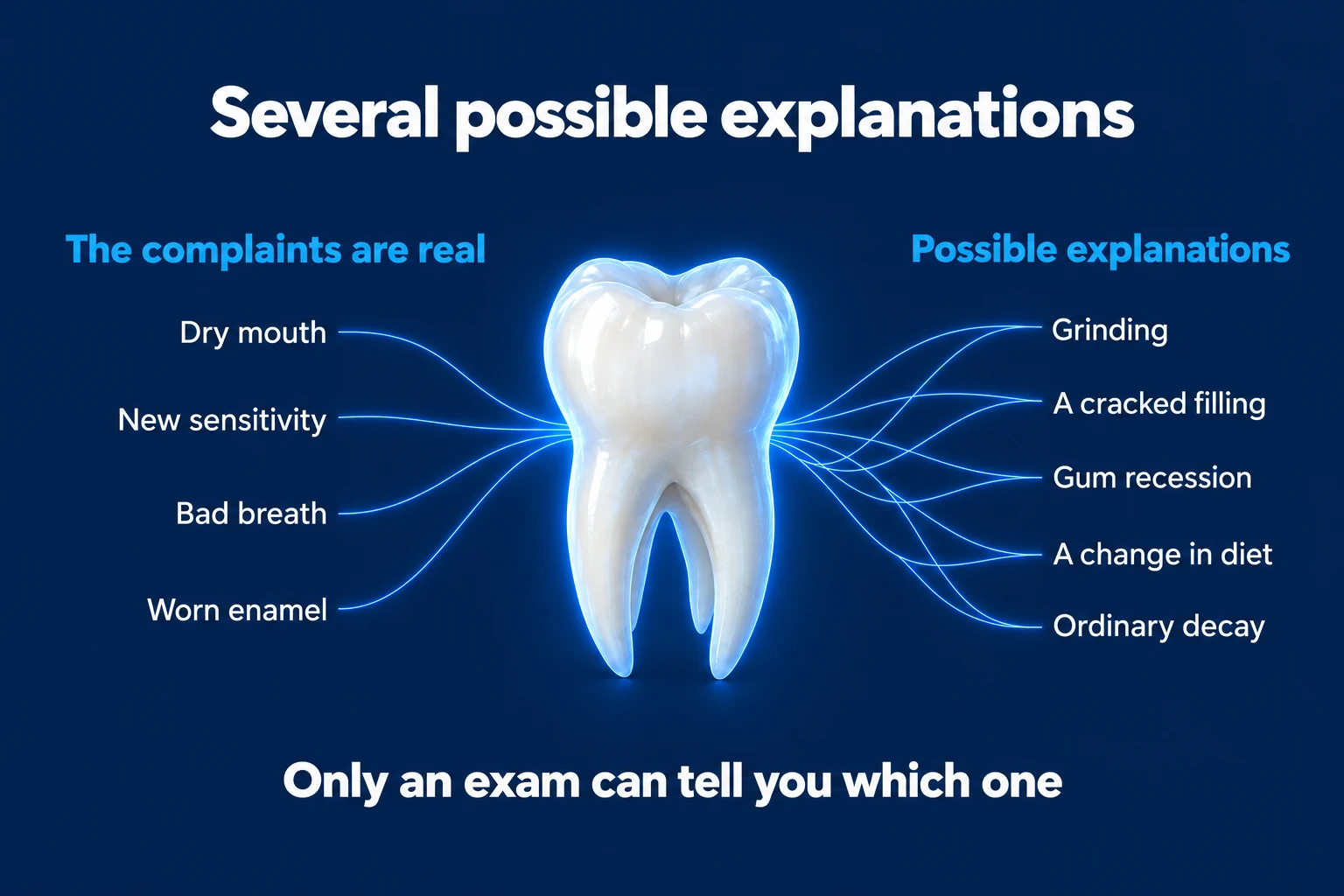
People use the phrase for a group of complaints. They come up on semaglutide, sold as Ozempic and Wegovy. They come up on tirzepatide too, sold as Mounjaro and Zepbound. Usually it means dry mouth, new sensitivity, bad breath, a sour taste, worn enamel, or a feeling that cavities are showing up faster than they used to.
Those complaints are real. What the phrase gets wrong is the implied cause. Each of those symptoms has several possible explanations, and most of them have nothing to do with any medication. Grinding, a cracked filling, gum recession, a change in diet, and ordinary decay all produce overlapping symptoms. Only an exam can tell you which one you are dealing with.
It helps to know why the phrase spread. Weight loss changes how a face looks, and changes in the mouth tend to get noticed in the same stretch of time. People also reach for one explanation when several symptoms arrive at once. A medication that is new, widely discussed, and taken on a schedule is an easy thing to point at. That is how a search term catches on, which is a different thing from how a diagnosis gets made.
Names matter here. Semaglutide and tirzepatide are different drugs. Tirzepatide acts on two receptors, semaglutide on one. A finding about one may not hold for the other, or for the rest of the group.
Does Ozempic damage teeth directly?
The most useful evidence so far comes from a 2026 study of 226,485 people. It set out to test this exact question. It even named the “Ozempic teeth” claim.1 Those people were all taking GLP-1 receptor agonists. Researchers compared them with a matched group who were not. The data came from a large health records network. They checked four groups of mouth and face conditions: the soft tissue lining the mouth, the saliva glands, the nerves, and the teeth themselves.
Matching is what makes that comparison worth anything. The control group was built to look like the medication group in age and sex, and anyone who already had a mouth problem was left out.1 That gets the two groups much closer than a raw comparison would, but it still falls short of proving cause.
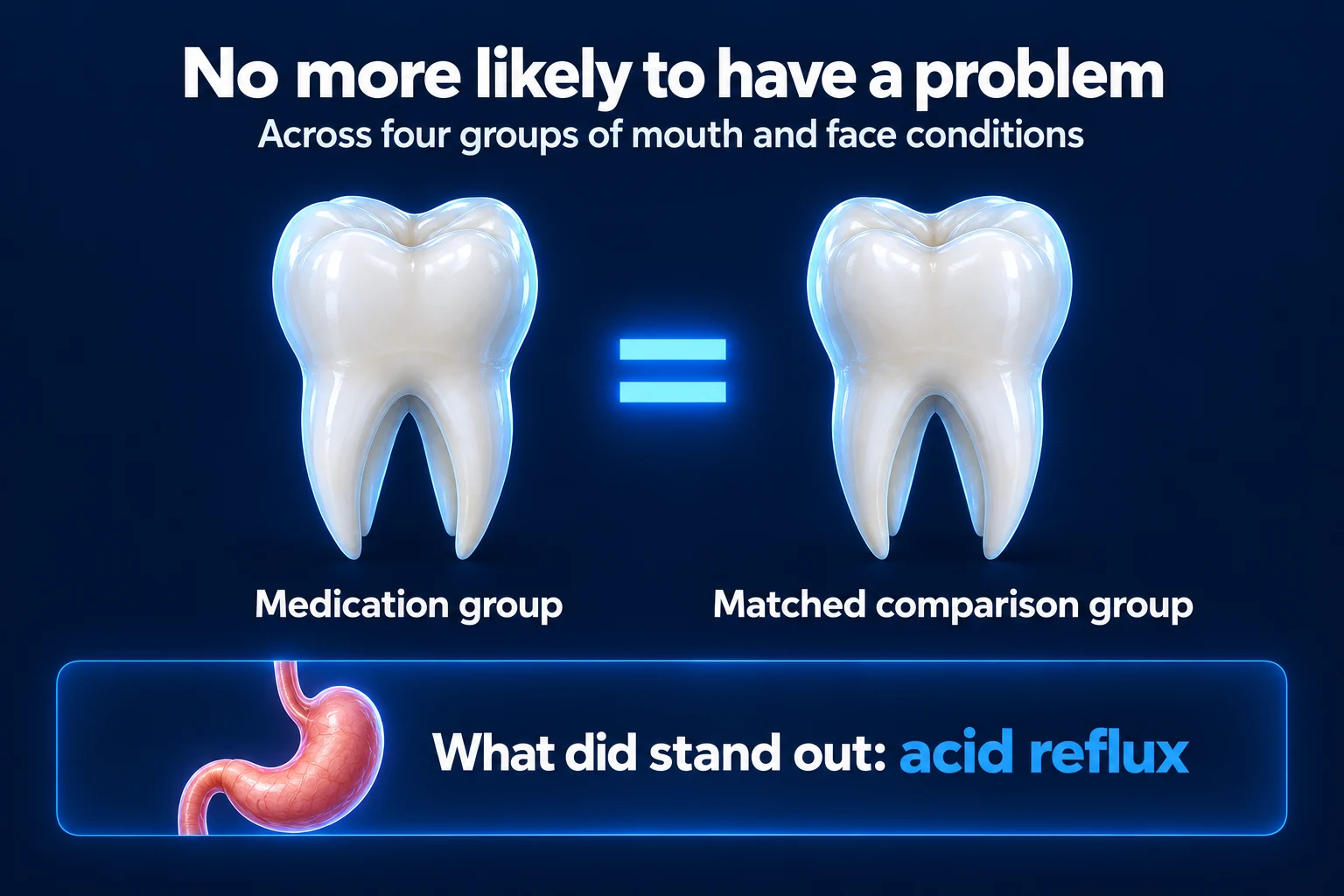
Across those four groups, the medication group was no more likely to have a problem than the comparison group. What did stand out was acid reflux, also called GERD. It was the most frequently recorded condition in the study, at 5.36%. In the medication group the odds of it were about a third higher.1 That finding turns out to be the important one.
The drug labels are worth a look too. Neither the Ozempic label nor the Mounjaro label lists any dental or tooth condition as a side effect.78 Both do list a change in taste. Both list stomach effects, including nausea and vomiting.78 Nothing on either label points at the tooth, though several of the effects they do list can reach it by another route.
Two cautions belong with that result, and they cut in opposite directions.
First, this is an observational study. It compares groups of people as they already are. It can show that two things occur together, but it cannot establish that one causes the other. The authors say plainly that prospective research is needed to confirm what they found.1
Second, the same study found lower odds of some dental and salivary conditions in the medication group. That is an interesting result, but it is a long way from proof that these drugs protect teeth. The same limits apply in both directions. People who take a prescription differ from people who do not. A study cannot fully adjust for that, including how often someone sees a doctor.
Where does the real risk come from?
A 2026 clinical review looked at semaglutide and oral health.2 It describes the path clinicians watch for. The drug’s known stomach effects include slower emptying, reflux, belching, and nausea. Those can show up second hand in the mouth. It lists dry mouth, bad breath, enamel wear tied to vomiting, and taste changes as possible effects.2 Possible is the operative word. The review describes what is plausible rather than measuring how often any of it happens.
Bad breath and taste changes tend to surprise people, because few of us connect either one to the stomach. Both can follow reflux and dryness rather than signal anything wrong with a tooth.2 Both are still worth raising at a dental visit, since they help explain a pattern that would otherwise look random.
Acid from vomiting and reflux
Enamel is the hard outer layer of the tooth, and acid softens it. When stomach acid reaches the mouth, whether through vomiting or through reflux, it can wear enamel down over time. Dentists call this erosion, and it is different from a cavity. A cavity is a hole caused by bacteria. Erosion is a thinning of the surface caused by acid.
This is where the reflux finding matters. Nausea and vomiting are known effects of these drugs. Reflux odds were also higher in the people taking them.1 Neither one is a dental problem by itself. Both are ways acid can reach a tooth more often.
Dry mouth
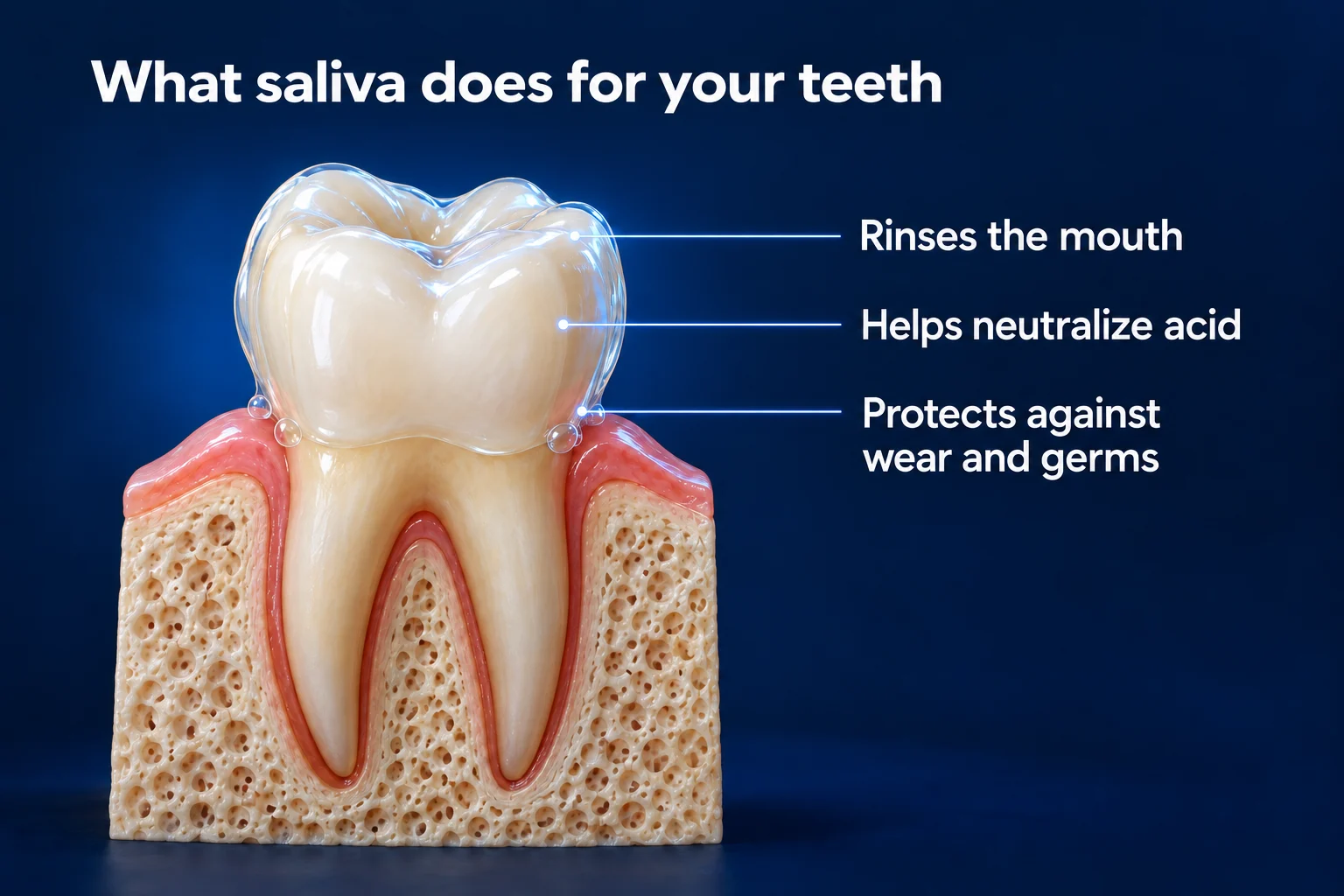
Saliva does more than keep your mouth comfortable. It rinses the mouth, buffers acid, and helps protect teeth against wear and germs.4 When saliva drops, that cover drops with it. The ADA notes that low flow can raise the risk of cavities, weak enamel, sensitivity, and infection.4
The ADA lists GLP-1 receptor agonists among the drug classes tied to dry mouth.4 Past that, the evidence for these drugs is thin. The most direct evidence is a report on three patients who got dry mouth while taking semaglutide.3 Three patients is a starting point rather than a rate, and the authors call it a first report and ask for larger studies.3 So dry mouth can happen. How often, nobody yet knows, and it is far from a given.
How to protect your teeth while taking a GLP-1 medication
None of this means changing your medication. That call belongs to the clinician who prescribed it.
After vomiting
Rinse your mouth. The ADA suggests water, milk, or baking soda stirred into water. It also warns against brushing right away.5
You may have read that you should wait a set number of minutes before brushing. No current ADA guidance gives a wait time.5 What the ADA does say is simple. Rinse first, and do not brush right away.5 Brush a little later, gently, with a soft brush and fluoride toothpaste.5 If you have been sick more than once in a day, rinsing each time matters more than the brushing question does.
Day to day
- Brush gently twice a day with a fluoride toothpaste and a soft brush.45
- Sip water through the day if that is right for you medically.4
- Ask your dentist whether sugar-free gum suits you, since it gets saliva going.45
- Ask about stronger fluoride if your mouth stays dry. There are rinses that help too.4
- Keep up your dental visits. Tell the team about the medicine and any side effects.
Mention nausea or dryness in particular. Then they can watch the spots where acid shows up first, and step in sooner.
And if your mouth feels dry when you wake up, say so at your next visit. Small details like that are how your dental team spots a pattern early.
Keep both of your care teams in the loop
This topic is less a warning about a medication than a handoff between two teams. Your prescribing clinician manages the medication and its effects. Your dental team manages what those effects do in your mouth. Each one works better knowing what the other is seeing.
Tell your dentist which medication you take. Mention any nausea, vomiting, reflux, or dryness. Tell your prescriber if dry mouth keeps up, since there may be options to discuss. Do not stop, skip, or change a prescription on your own.
When tooth pain means something else
A twinge that fades in a second or two is common, and rarely a worry. Other patterns point inside the tooth, not at the surface.
The American Association of Endodontists points to pain that lingers. If it lasts more than about 30 seconds after something hot or cold, the pulp may be damaged.6 The pulp is the living tissue inside the tooth. Sharp pain when you bite down can mean decay, a loose filling, a crack, or damaged pulp.6 Constant strong pain with swelling and tenderness can mean an abscess. That needs care right away.6
None of those are signs of “Ozempic teeth.” They are signs that a particular tooth needs looking at. An endodontist is a dentist with extra training in tooth pain who treats the inside of the tooth, and testing is how the cause gets found. It may be decay that reached the nerve, a crack that shows up when you bite, or sensitivity that is not an infection.

An exam for this is usually quick. The dentist or endodontist checks how the tooth answers to cold and to pressure, then compares it with the teeth beside it. That comparison is often what points to the tooth causing the trouble.
If the pulp is inflamed or infected, root canal therapy treats the inside of the tooth. It also keeps the tooth in place. Our endodontists see patients across our Florida offices.
This article is here to explain, not to diagnose. Talk to your dentist about your teeth and to your prescriber about your medicine.
Wondering whether one specific tooth is the problem? An endodontist at your nearest MFE location can test it and tell you. Find a location.
Works Cited
- Oyewole SO, Owosho AA. Orofacial adverse events associated with Glucagon-like peptide-1 receptor agonists: a real-world multinational retrospective matched cohort study. Oral Surg Oral Med Oral Pathol Oral Radiol. 2026. doi:10.1016/j.oooo.2026.06.002
- Kofman K, Ouanounou A. Oral Health Considerations and Dental Management Guidelines for Semaglutide Medications. Can J Diabetes. 2026. doi:10.1016/j.jcjd.2026.03.008
- Mawardi HH, Almazrooa SA, Dakhil SA, et al. Semaglutide-associated hyposalivation: a report of case series. Medicine (Baltimore). 2023;102(52):e36730. doi:10.1097/MD.0000000000036730
- American Dental Association. Xerostomia (Dry Mouth). ADA Oral Health Topics. Updated March 4, 2026. Accessed August 22, 2026. ada.org
- American Dental Association. Dental Erosion. ADA Oral Health Topics. Updated October 22, 2025. Accessed August 22, 2026. ada.org
- American Association of Endodontists. Tooth Pain. Accessed August 22, 2026. aae.org
- US Food and Drug Administration. Ozempic (semaglutide) injection, prescribing information. Revised November 2024. Accessed August 22, 2026. accessdata.fda.gov
- US Food and Drug Administration. Mounjaro (tirzepatide) injection, prescribing information. Revised December 2025. Accessed August 22, 2026. accessdata.fda.gov