Dental anxiety, cost concerns, a busy schedule, or simply not being sure how urgent it is, there are many reasons patients put off a recommended root canal. The intent of this article is not to judge those reasons, which are completely understandable, but to give you a clear-eyed picture of what is happening inside the tooth during the delay period, so you can make an informed decision.
What Happens to the Tooth During a Delay
Treatment is straightforward
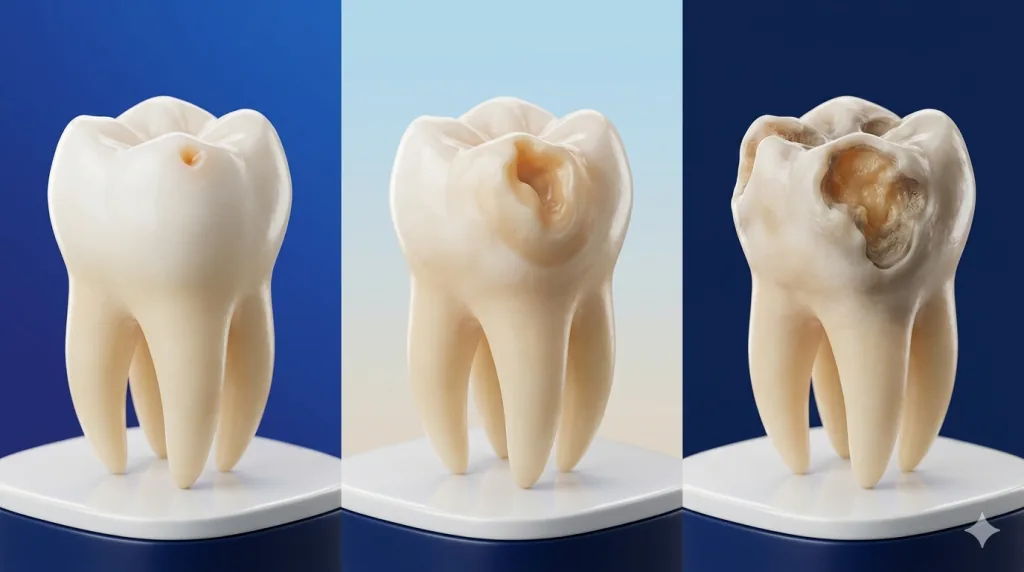
The pulp is inflamed or infected but the infection is contained within the tooth. Root canal therapy at this stage is typically a single appointment. The tooth is fully saveable. Bone loss, if any, is minimal and will heal well after treatment. When a tooth is treated before a periapical radiolucency (a dark area on an X-ray that signals infection and bone loss at the root tip) develops, published success rates exceed 96%.2
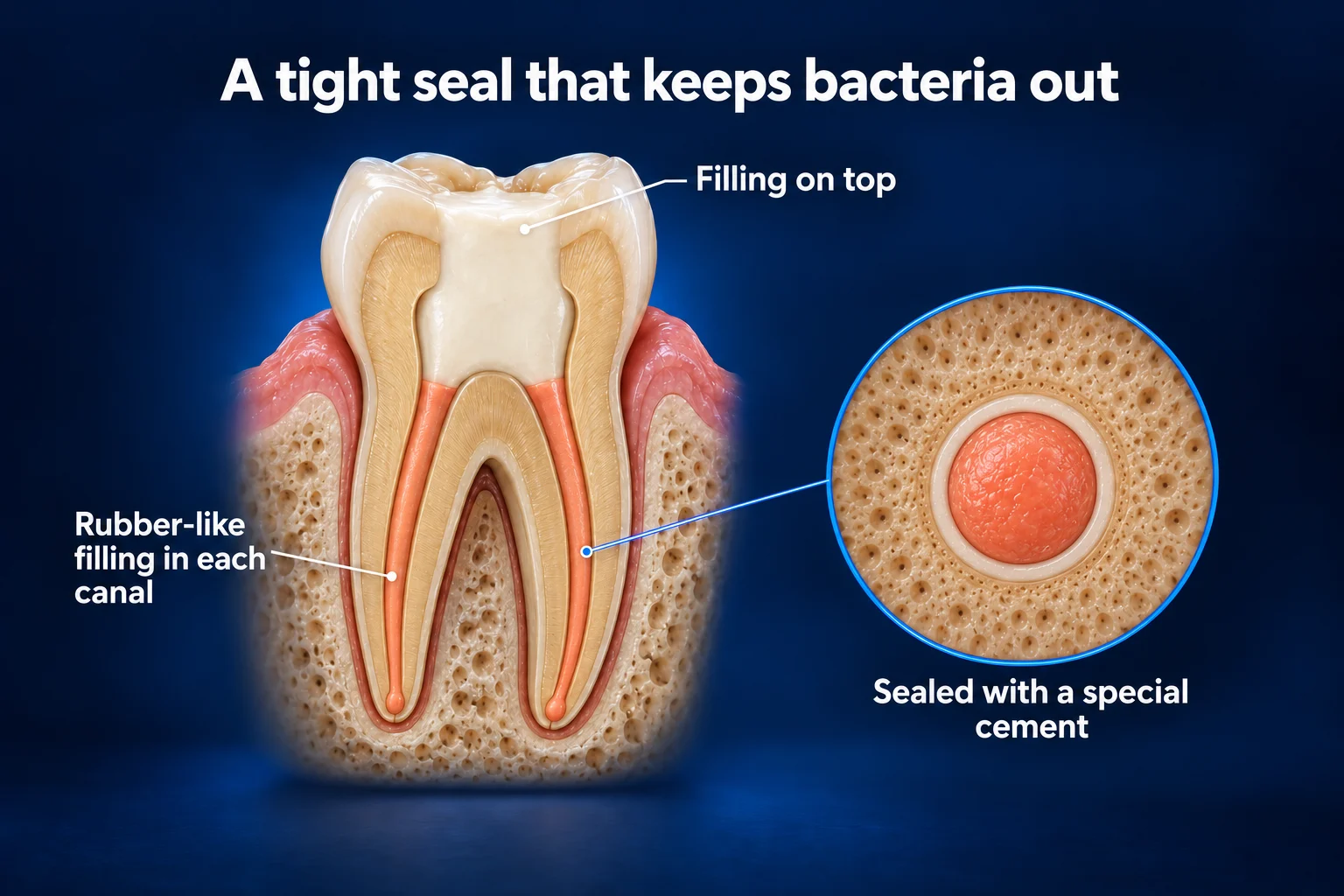
Infection spreads to the bone
Without treatment, bacteria spread from the pulp (the soft living tissue inside the tooth, containing nerves and blood vessels) into the periapical (relating to the area surrounding the very tip of a tooth’s root) bone, the bone surrounding the root tip. A periapical lesion (an area of infection and bone damage at the tip of a tooth’s root, visible on X-rays) forms and begins growing. Pain may fluctuate or briefly disappear as the pulp dies. Swelling and pressure sensitivity develop. Treatment is still highly effective, but once a periapical radiolucency is present the reported healing rate is lower than for a tooth treated before that point.12
Significant bone destruction and possible spread
The periapical lesion grows, destroying increasing amounts of surrounding bone. The infection may break through the bone into soft tissue, causing facial swelling, cellulitis (a spreading bacterial infection of the soft tissue, in dental contexts, this means infection has moved from the tooth into the face, jaw, or neck), or a draining sinus tract (a small channel that forms through the gum tissue to drain pus from a tooth abscess, sometimes looks like a pimple on the gum). Adjacent teeth may become involved. Antibiotics may now be required alongside treatment. The tooth may still be saved but restoration is more complex and healing takes longer.
Life-threatening risk and possible tooth loss
In the most serious cases, particularly in patients with compromised immunity, spreading infection can reach the deep spaces of the neck, the mediastinum, the bloodstream, or the brain.3 These outcomes are rare but documented and entirely preventable. Separately, extensive bone destruction may render the tooth unsalvageable. Extraction becomes necessary, followed by the time and expense of tooth replacement.

The Myths That Lead People to Wait
“The pain went away, so it must be getting better.”
Pain stopping is not improvement, it most often means the pulp has died completely. The nerve is no longer generating a pain signal because it no longer has viable tissue. The infection has not resolved; it is now spreading silently from the root tip into surrounding bone. A tooth that hurts and then stops hurting still needs evaluation urgently.
“Antibiotics will clear up the infection.”
Antibiotics can reduce the systemic spread of a dental infection but they cannot eliminate the source, the bacteria inside the dead pulp tissue of the tooth. Blood supply to a necrotic (dead, referring to tissue that has lost its blood supply and died, most commonly the pulp inside an infected tooth) pulp is absent, meaning antibiotics cannot reach the infection at its core. Symptoms may temporarily improve on antibiotics, masking the progression of disease. The infection will return when the antibiotic course ends.
“I’ll wait until it gets really bad before doing anything.”
Waiting until pain is severe means waiting until the infection has progressed significantly, often to the point where bone loss is substantial, the tooth’s prognosis is worse. Treatment is more complex. The window where a root canal is a simple, single-appointment procedure can close relatively quickly. By the time symptoms are “really bad,” treatment may require multiple appointments, antibiotics, and potentially surgical intervention.
“I’ll just pull the tooth instead, it’s simpler.”
Extraction of a tooth that could have been saved is not simpler, it initiates a new set of problems. Did a holistic office tell you to remove the tooth? See what holistic dentists do instead of a root canal. Bone loss at the extraction site begins almost immediately, with the ridge losing much of its width within the first few months after a tooth is removed.6 Adjacent teeth begin to shift. The cost of the extraction plus a future implant and crown typically far exceeds the cost of root canal treatment and a crown. And once extracted, the natural tooth option is gone permanently.
The Real Cost of Delaying: Early vs. Late Treatment
Treated Promptly
- Single-visit root canal
- Crown from your general dentist
- Minimal bone loss, heals quickly
- No antibiotics typically needed
- Tooth saved with excellent prognosis5
- Return to full function within weeks
Treatment Delayed
- Possible multi-visit treatment
- Antibiotics likely required
- Larger periapical lesion, longer healing
- Risk of surgical intervention
- Possible tooth loss requiring implant
- Higher total cost by a significant margin
What If Cost or Anxiety Is the Barrier?
These are legitimate concerns, and neither is a reason to avoid treatment altogether. If cost is a barrier, Mid-Florida Endodontics works with most major dental insurance plans, we verify your coverage before your appointment, and CareCredit financing is accepted. If dental anxiety is the issue, discuss this openly with your endodontist before treatment. We can accommodate patients with anxiety and in many cases offer options to make the experience as comfortable as possible.
The important thing to understand is that delaying treatment is not a cost-saving strategy, it is a cost-increasing one. The longer treatment is postponed, the more complex and expensive it becomes. Calling to discuss options is always better than waiting.
A note on referrals: If your general dentist has recommended a root canal, working through them for a referral to an endodontic specialist is the recommended path, they will coordinate the restorative work needed after treatment and some insurance plans require a referral for specialist coverage. For emergencies, contact us directly.
The relationship between treatment delay and endodontic outcomes is documented in the literature. A systematic review with meta-analysis in the International Endodontic Journal identified the pre-operative presence of a periapical radiolucency, the bone-damage shadow that develops as an untreated infection persists, as one of the clinical factors that significantly lowers the success rate of primary root canal treatment.1 A long-term clinical study of 356 patients reinforces this: teeth with no periapical radiolucency healed at a rate above 96%, while teeth that already showed pulp necrosis with a periapical radiolucency healed in roughly 86% of cases.2 Because that radiolucency forms and enlarges the longer an infection goes untreated, these findings support treating endodontic disease promptly rather than waiting for symptoms to worsen. More recent meta-analytic evidence using cone-beam imaging continues to report high pooled healing and success rates for primary root canal treatment, underscoring how effective timely care remains.4 When infection is allowed to advance unchecked, surgical drainage and management of deep-space spread can become necessary.3
Works Cited
- Ng YL, Mann V, Rahbaran S, Lewsey J, Gulabivala K. Outcome of primary root canal treatment: systematic review of the literature. Part 2. Influence of clinical factors. Int Endod J. 2008;41(1):6-31. doi:10.1111/j.1365-2591.2007.01323.x Systematic Review
- Sjögren U, Hägglund B, Sundqvist G, Wing K. Factors affecting the long-term results of endodontic treatment. J Endod. 1990;16(10):498-504. doi:10.1016/S0099-2399(07)80180-4 Prospective Study
- Flynn TR. Surgical management of orofacial infections. Atlas Oral Maxillofac Surg Clin North Am. 2000;8(1):77-100.
- Brochado Martins JF, Georgiou AC, Nunes PD, et al. CBCT-assessed outcomes and prognostic factors of primary endodontic treatment and retreatment: a systematic review and meta-analysis. J Endod. 2025;51(6):687-706. doi:10.1016/j.joen.2025.03.004 Systematic Review
- Prati C, Pirani C, Zamparini F, Gatto MR, Gandolfi MG. A 20-year historical prospective cohort study of root canal treatments. A multilevel analysis. Int Endod J. 2018;51(9):955-968. doi:10.1111/iej.12908 Prospective Study
- Tan WL, Wong TLT, Wong MCM, Lang NP. A systematic review of post-extractional alveolar hard and soft tissue dimensional changes in humans. Clin Oral Implants Res. 2012;23 Suppl 5:1-21. doi:10.1111/j.1600-0501.2011.02375.x Systematic Review