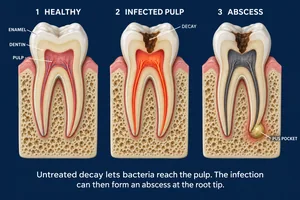
This is the question patients hesitate to ask, because they’re afraid of the answer. But understanding how a tooth infection can spread is one of the most important things a dental patient can know. The good news: when treated promptly, dental abscesses are highly manageable. The danger comes mainly with delay. Read about symptoms of a dental abscess and what they mean. Here’s how long a tooth infection can safely go untreated. Understand when to go to the ER for tooth pain.
At Mid-Florida Endodontics, our endodontic specialists treat tooth infections across multiple Florida locations every day. Here is a clear-eyed look at what can happen when an infection isn’t treated, and how to recognize the warning signs early.
How Does a Tooth Infection Spread?
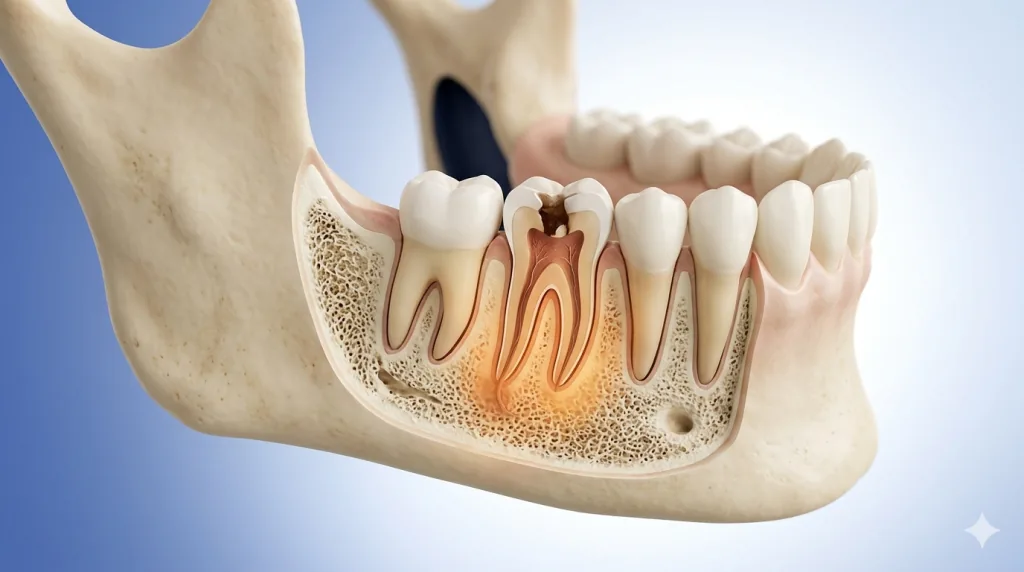
A periapical (relating to the area surrounding the very tip of a tooth’s root) abscess (a pocket of infection at the root tip of a tooth, caused by bacteria spreading from inside the tooth) begins at the tip of the tooth root. From there, bacteria and pus follow the path of least resistance through surrounding bone.6 Once they break through the bone, the infection enters the soft tissue spaces of the face and neck, a system of connected fascial planes that allow infection to travel rapidly and widely.5
The direction of spread depends largely on which tooth is infected and the thickness of the surrounding bone, so upper teeth tend to spread differently than lower teeth. In studies of deep neck infections that started in a tooth, the lower molars are the teeth most often responsible, and the submandibular space below the jaw is the space most often involved.1 The specific root length and position determine whether infection tracks toward the palate, cheek, or floor of the mouth.

Where Can a Tooth Infection Spread?
Adjacent Teeth and Bone (Alveolar Bone Loss)
The most common form of spread. The infection erodes the bone surrounding the infected tooth and can extend toward neighboring teeth, causing bone loss that complicates future restorative work.6 This is often visible on X-rays as a dark shadow around the root tip.
Facial cellulitis
Infection spreads from the bone into the surrounding soft tissue of the face and cheek, causing significant, painful swelling. The skin becomes red, warm, and tender. Facial cellulitis from a dental source is a serious condition requiring prompt care, which may combine antibiotics with root canal therapy, surgical drainage, or extraction depending on the case.2
Ludwig’s Angina (Floor of the Mouth)
One of the most dangerous complications of a lower tooth abscess. Infection spreads to the floor of the mouth and submandibular space, causing rapid, severe swelling that can push the tongue upward and backward, directly threatening the airway.1 Ludwig’s angina requires emergency hospitalization, IV antibiotics, and often surgical drainage. It can be fatal without immediate treatment.2
Cavernous Sinus Thrombosis (Brain)
Rare but life-threatening. Infection from upper teeth can track along venous pathways toward the cavernous sinus, a large venous channel at the base of the brain. This can cause blood clots, severe headache, high fever, and eye swelling, and may lead to meningitis or stroke.2 It requires intensive medical intervention.
Bacterial Endocarditis (Heart)
Bacteria from a dental infection can enter the bloodstream (bacteremia) and travel to the heart, where they can infect the heart valves, a condition called bacterial endocarditis. This risk is higher in patients with certain pre-existing heart conditions, artificial valves, or a history of endocarditis.4 This is one reason some cardiac patients are advised to take preventive antibiotics before certain dental procedures.
Sepsis (Bloodstream Infection)
In severe cases, dental bacteria can enter the bloodstream and contribute to sepsis, the body’s extreme response to widespread infection. Sepsis can cause organ dysfunction and is a medical emergency.2 While this is a rare outcome of a dental abscess, documented cases exist and underscore the importance of early treatment.
Seek Emergency Care Immediately If You Have:
- Swelling spreading toward your neck, throat, or under your jaw
- Difficulty breathing or swallowing
- A fever above 101°F / 38.3°C alongside tooth pain
- Inability to fully open your mouth (trismus)
- Severe headache with facial swelling near an upper tooth
- Feeling generally unwell, confused, or faint
How Do You Prevent a Tooth Infection from Spreading?
The answer is straightforward: treat it early. A tooth infection that is diagnosed and treated with root canal therapy at the abscess stage, before it spreads beyond the tooth, is a manageable, routine procedure. The same infection left for weeks or months becomes increasingly difficult and costly to treat, and the risk of serious complications rises with delay.1
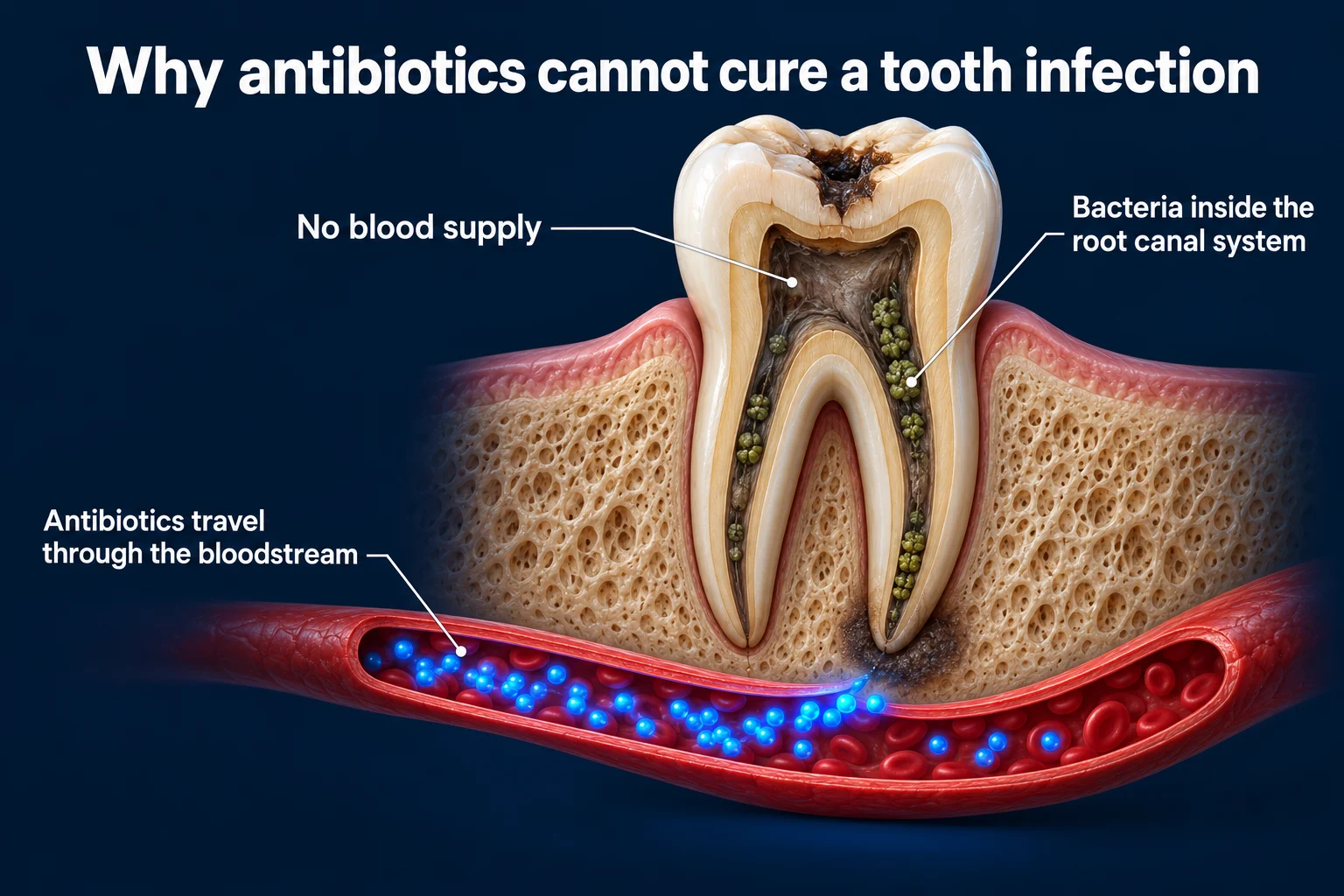
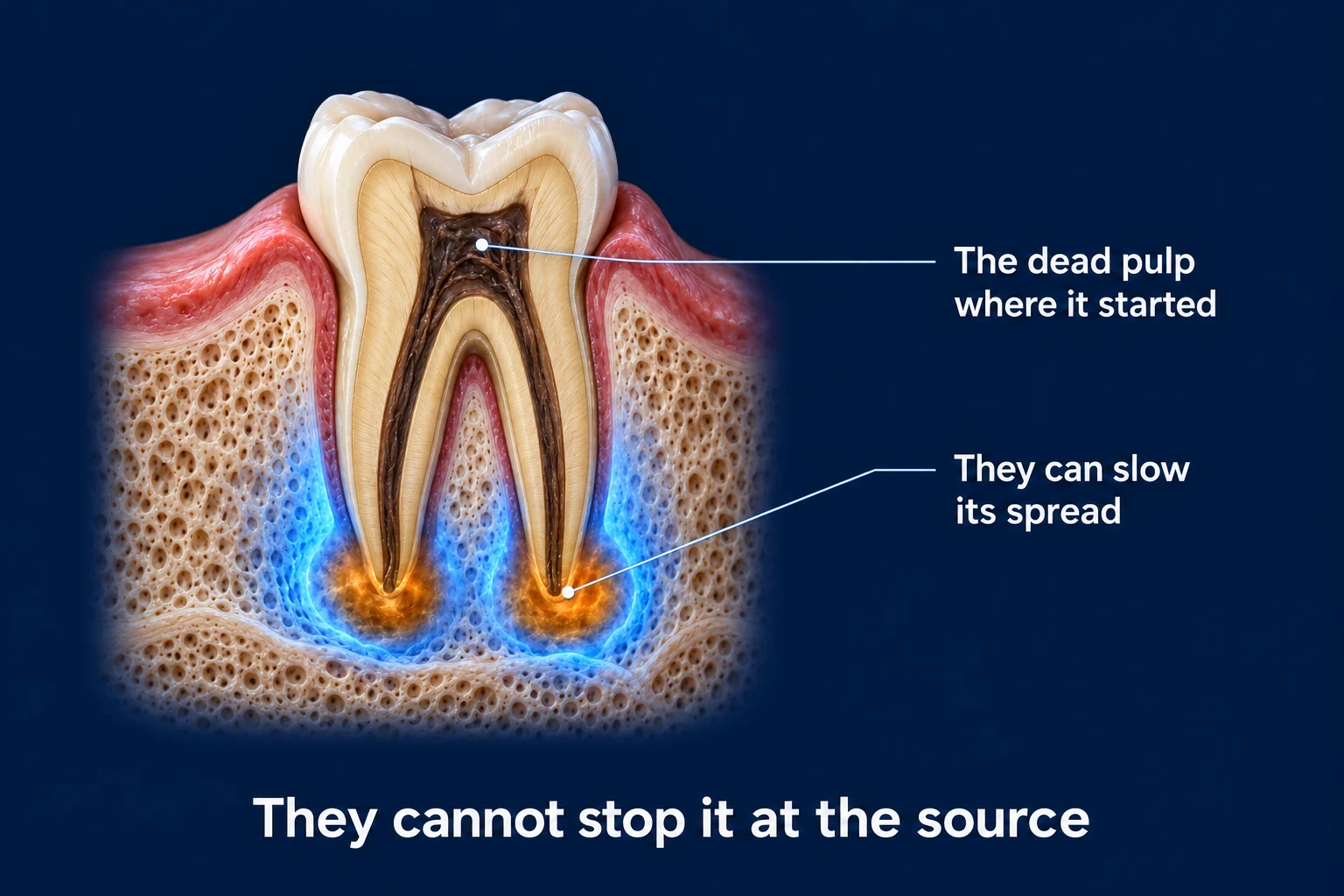
Antibiotics alone are not a cure. Clinical guidelines from the American Dental Association advise that antibiotics be reserved for cases with signs of systemic spread, such as fever or significant swelling, and that the source of infection still be treated directly through dental care.3 Key prevention steps include attending regular dental check-ups (infections are often caught on imaging before symptoms appear), and seeking same-day evaluation whenever tooth pain is severe or accompanied by swelling.4 Never assume a tooth infection will “go away on its own.”
The potential for odontogenic (originating from a tooth, as in a dental infection that started inside a tooth) infections to cause serious systemic complications is well established in the medical and dental literature. A retrospective study of patients hospitalized with deep neck infections of dental origin, published in Medicina Oral, Patología Oral y Cirugía Bucal, reported that a delay of more than three days before treating the source tooth was associated with a higher rate of complications, including mediastinitis (infection spreading into the chest), more surgical procedures, and longer intensive-care stays.1 The authors concluded that prompt drainage, intravenous antibiotics, and early removal of the infection source are essential, reinforcing the importance of same-day evaluation for patients with signs of a spreading infection.
A spreading tooth infection needs treatment today, not later this week. Have an active infection? Most of our endodontist offices offer same-day emergency care. Find your nearest location.
Works Cited
- Treviño-Gonzalez JL, Santos-Santillana KM, Cortes-Ponce JR, et al. Role of early extraction of odontogenic focus in deep neck infections. Med Oral Patol Oral Cir Bucal. 2023;28(1):e25-e31. doi:10.4317/medoral.25536 Prospective Study
- Flynn TR. Surgical management of orofacial infections. Atlas Oral Maxillofac Surg Clin North Am. 2000;8(1):77-100.
- Lockhart PB, Tampi MP, Abt E, et al. Evidence-based clinical practice guideline on antibiotic use for the urgent management of pulpal- and periapical-related dental pain and intraoral swelling: a report from the American Dental Association. J Am Dent Assoc. 2019;150(11):906-921. doi:10.1016/j.adaj.2019.08.020 Systematic Review
- Jevon P. Updated guidance on medical emergencies and resuscitation in the dental practice. Br Dent J. 2012;212(1):41-43. doi:10.1038/sj.bdj.2011.1101
- Bahl R, Sandhu S, Singh K, et al. Odontogenic infections: microbiology and management. Contemp Clin Dent. 2014;5(3):307-311. doi:10.4103/0976-237X.137921
- Hargreaves KM, Cohen S, eds. Cohen’s Pathways of the Pulp. 10th ed. St. Louis: Mosby Elsevier; 2011.