
Sweet sensitivity gets less attention than cold sensitivity, but it is often just as clinically meaningful, and it is commonly one of the first signs that decay has reached or is approaching the inner layers of a tooth. Sensitivity to sweet and other osmotic stimuli is a well-described feature of exposed, sensitive dentin.1 Understanding what causes it helps you act before a small problem becomes a large one.
Why Does Sugar Cause Tooth Pain?
The Science Behind Sweet Sensitivity
Dentin, the layer beneath tooth enamel, contains thousands of microscopic tubules that run from the outer surface toward the pulp. These tubules are filled with fluid. When dentin is exposed (from recession, erosion, or decay), external stimuli like sugar can cause osmotic (relating to fluid movement across a membrane due to concentration differences, sugar causes tooth sensitivity through this mechanism) changes in this fluid, essentially pulling fluid outward. This fluid movement stimulates nerve fibers at the inner end of the tubules, producing a sharp pain signal.
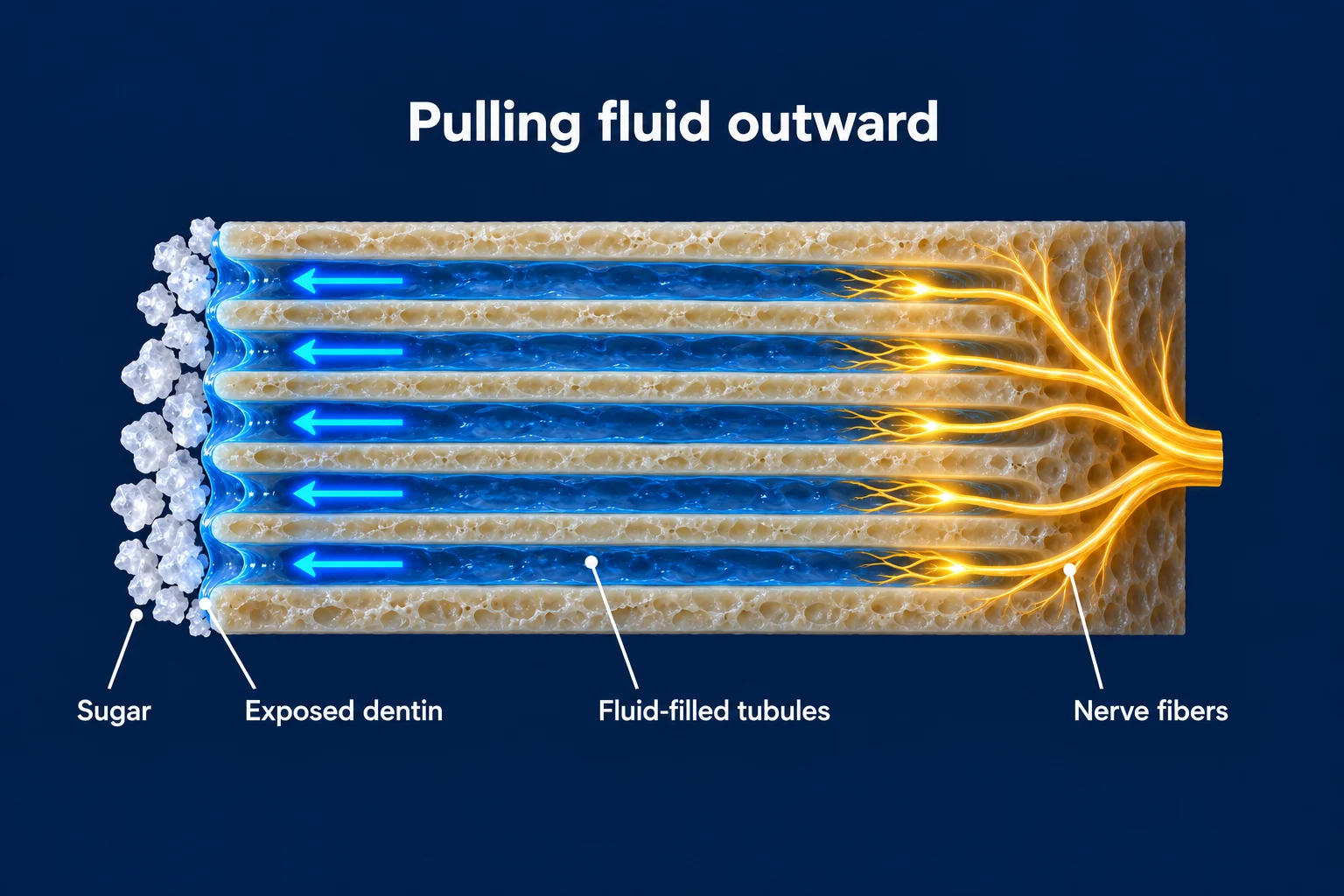
This hydrodynamic explanation, in which rapid fluid shifts within the tubules trigger the nerve, is the most widely accepted model for dentin sensitivity.2 The same mechanism helps explain cold sensitivity, since cold also causes fluid changes in dentinal tubules (microscopic fluid-filled channels in the dentin that can transmit temperature, pressure, and osmotic stimuli toward the nerve). Sugar tends to produce a slightly different, often more prolonged sensation, because osmotic gradients can persist longer than a brief temperature change. Because many stimuli act through the same pathway, exposed dentin can react to sweet, cold, touch, and evaporative air alike.1
Common Causes of Sweet Sensitivity
Tooth Decay (Cavity)
A cavity exposes dentin by destroying the enamel above it. As decay progresses deeper toward the pulp, sweet sensitivity tends to become more noticeable. A tooth that is newly sensitive to sweets, especially if the sensitivity is new and localized to one tooth, should be evaluated for decay promptly. Early decay can often be treated with a simple filling; decay that reaches the pulp generally requires root canal treatment. Catching it early keeps the treatment as straightforward as possible.
Cracked Tooth
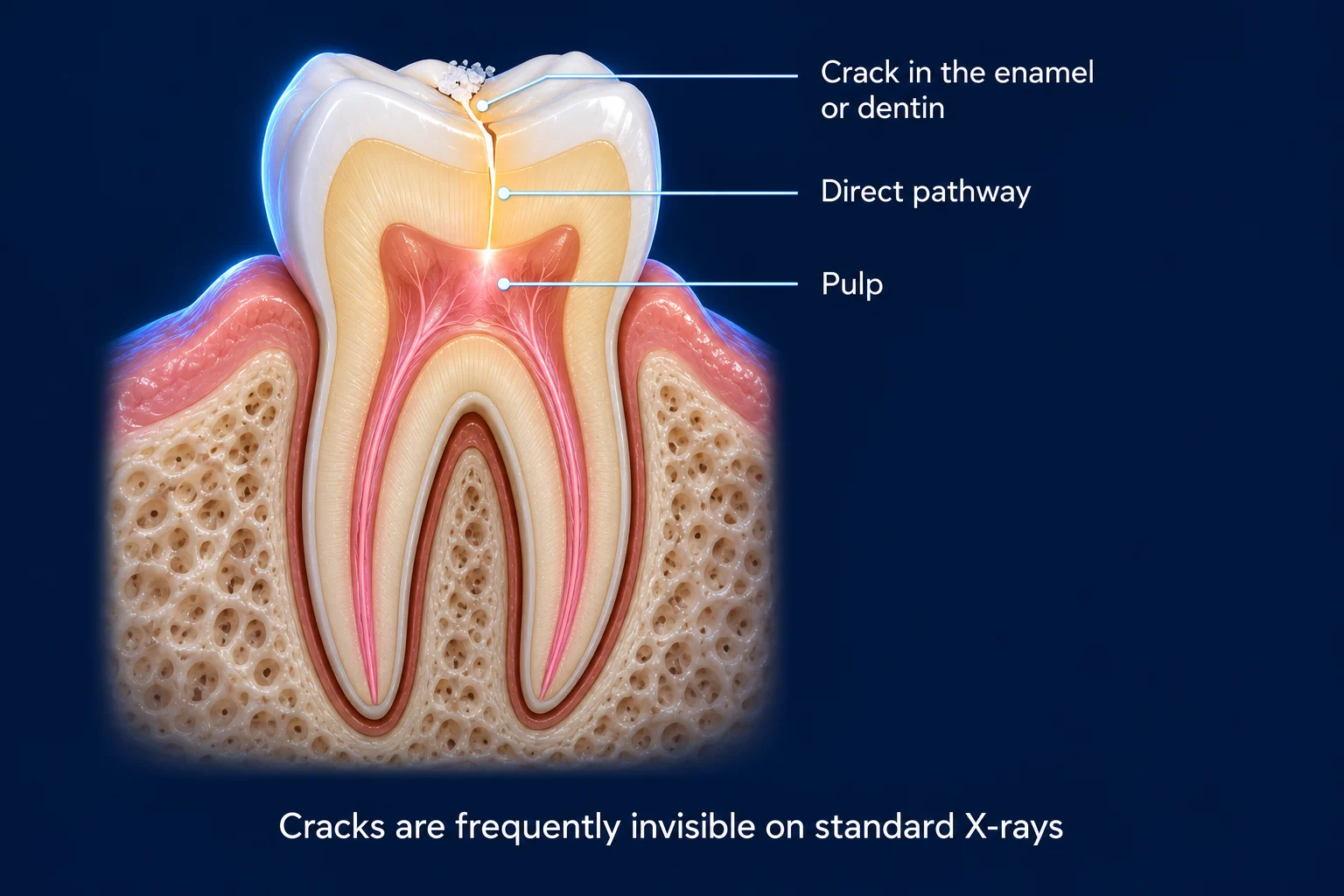
A crack in the enamel or dentin creates a direct pathway for sweet substances to reach the dentin tubules or pulp. Cracked tooth sweet sensitivity is often more acute and localized than recession-related sensitivity. It may be accompanied by sharp pain when biting in a specific direction, a common feature of cracked tooth syndrome.3 Cracks are frequently invisible on standard X-rays and often require specialist evaluation to confirm.
Gum Recession and Exposed Root Surfaces
Root surfaces are covered by cementum (the thin, bone-like layer covering the root surface of a tooth beneath the gumline), a much thinner, more permeable layer than enamel. When gums recede, the root surface is exposed directly to food, temperature, and sugar. This produces sweet sensitivity that typically affects multiple teeth along the gumline rather than a single isolated tooth. Desensitizing toothpaste can help manage this type of sensitivity, and at-home measures are a reasonable first step, but the underlying recession should still be assessed by a dentist.1
Enamel Erosion
Prolonged exposure to acidic foods, drinks (particularly carbonated and citrus beverages), or acid reflux gradually thins the enamel layer, exposing the dentin beneath. This produces widespread sweet and cold sensitivity affecting many teeth. Dietary modifications and fluoride treatments can slow progression, but lost enamel cannot be regenerated, making early intervention important. Limiting how often acidic items contact the teeth is one of the simplest protective habits.
Is Sweet Sensitivity a Sign I Need a Root Canal?
Sweet sensitivity alone, particularly when brief, is not a direct indicator of irreversible pulpitis (severe inflammation of the tooth’s inner tissue, too damaged to heal on its own) or the need for root canal treatment. It most commonly points to exposed dentin from one of the causes above, which may be manageable without endodontic treatment (treatment focused on the inside of the tooth, most commonly root canal therapy). Dentin sensitivity is generally diagnosed only after other possible causes of the pain have been ruled out, which is why a clinical exam matters.1

However, sweet sensitivity becomes more significant when:
- It is clearly localized to one specific tooth (suggests decay or a crack rather than generalized exposure)
- It is accompanied by cold sensitivity that lingers, suggesting the pulp may be inflamed beyond recovery
- It is accompanied by spontaneous pain, throbbing, or pain at night
- It is getting worse over weeks rather than staying the same
- A cavity has been identified on X-ray near or at the pulp
Any of these accompanying features warrants professional evaluation, and potentially a referral to an endodontic specialist if pulp involvement is suspected. An endodontic specialist focuses on diagnosing tooth pain and on saving teeth, so the assessment is both careful and conservative.
What to Do If a Tooth Hurts With Sweets
- See your general dentist sweet sensitivity is a useful early warning sign. Getting it evaluated while it is still minor is the most cost-effective path
- Don’t assume sensitivity toothpaste will fix it desensitizing products manage surface-level dentin exposure but will not address an underlying cavity or crack
- Note whether it’s one tooth or many a single symptomatic tooth is more likely to represent a structural problem (cavity, crack) than generalized recession or erosion
- Track whether it’s worsening stable, mild sweet sensitivity is less urgent than sensitivity that has been increasing over weeks
Sweet sensitivity is a recognized clinical feature of dentin hypersensitivity (tooth sensitivity caused when the dentin layer is exposed and reacts to temperature, sweet foods, or pressure) and can also signal early decay reaching the dentin. A review of dentin hypersensitivity in the Journal of the American Dental Association describes how exposed dentin responds to osmotic and other stimuli through the hydrodynamic mechanism (the process by which fluid movement in tiny tooth channels triggers nerve pain, explaining why cold, sweet, or pressure can cause sensitivity), and emphasizes that the condition is diagnosed only after other causes of pain are excluded, with management starting from prevention and at-home care.1 The fluid-movement model itself traces back to foundational work on the sensitivity of dentin.2 Localized sweet sensitivity to a single tooth is therefore best treated as a prompt to have that tooth evaluated, rather than as proof of any one diagnosis on its own.
Works Cited
- Orchardson R, Gillam DG. Managing dentin hypersensitivity. J Am Dent Assoc. 2006;137(7):990-998. doi:10.14219/jada.archive.2006.0321 Systematic Review
- Brännström M. Sensitivity of dentine. Oral Surg Oral Med Oral Pathol. 1966;21(4):517-526. doi:10.1016/0030-4220(66)90411-7
- Li F, Diao Y, Wang J, et al. Review of cracked tooth syndrome: etiology, diagnosis, management, and prevention. Pain Res Manag. 2021;2021:3788660. doi:10.1155/2021/3788660 Review