Direct Answer
Many holistic dentists remove the tooth instead of doing a root canal. They clean the empty socket and then replace the tooth. The new tooth is often a ceramic implant, a bridge or a partial denture. Some try ozone gas or a pulp cap first. A root canal is the other path. It keeps your own tooth, and a large review found it lasts about as long as an implant.1 An endodontist can check whether your tooth can be saved.
What do holistic dentists do instead of a root canal?
Holistic dentists aim to treat the mouth as part of the whole body. Some call themselves biological dentists. Many try to use less metal and gentler methods. When a tooth is badly decayed or infected, many of them do not suggest a root canal. They suggest a three-step plan instead.
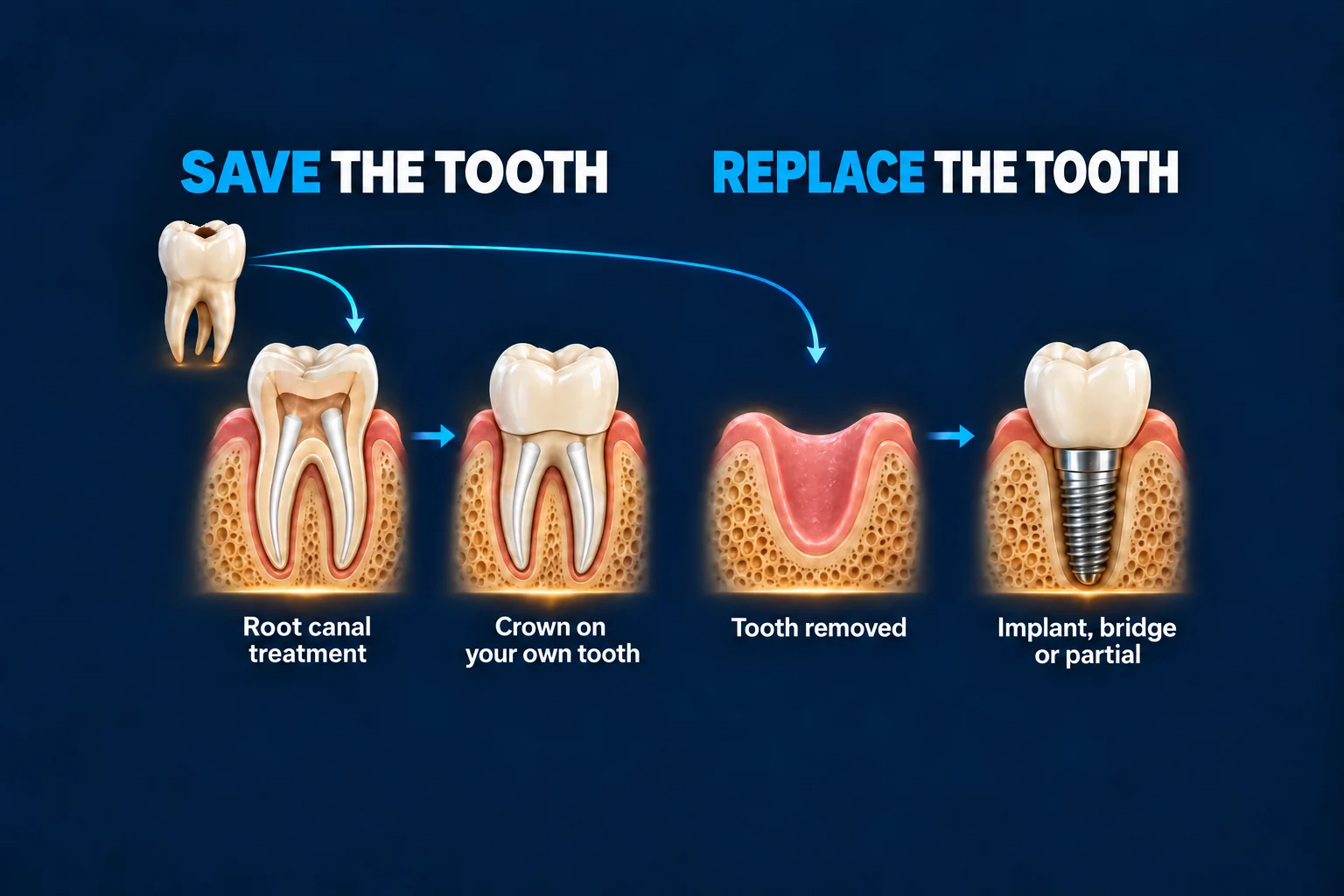
- Remove the tooth. The dentist takes out the whole tooth, roots and all.
- Clean the socket. The dentist cleans the empty socket with care. Some offices also rinse it with ozone gas.
- Replace the tooth. Common choices are a ceramic implant, a bridge or a partial denture. Some people choose to leave the gap open.
Ceramic implants are made of zirconia, a white material with no metal in it. A 2023 review of 25 studies found good results so far. It estimated that about 95% of these implants would still be in place after 10 years.2 The same review noted that ceramic implants have been studied less than titanium ones.2
Some holistic dentists also test for and treat jawbone cavitations. These are described as hollow spots in the jawbone that did not heal well. A review of 29 studies found the research behind this is weak, with no agreed way to diagnose them.3
A smaller group of holistic dentists try to keep the tooth first. They may use ozone gas or a pulp cap. Both are covered below, along with what research says about each.
Why do some holistic dentists avoid root canals?
The concern goes back about 100 years. In the early 1900s, many doctors believed in the focal infection theory. It held that germs in one spot, such as a tooth, could cause illness in other parts of the body. A dentist named Weston Price ran tests in the 1920s that seemed to support it. In 1925, he urged that treated teeth be removed.4
Many holistic dentists still share a form of that concern. A root canal cleans and seals the inside of a tooth. The worry is that a few germs could stay behind in tiny side channels of the root. Some also feel that a tooth without its living pulp no longer belongs in the body.
Later researchers took a closer look. In 1952, a researcher named Easlick found flaws in how Price ran his tests.4 Over time, the focal infection idea was dropped. A 2000 review gives the reason. Only personal stories had ever backed it, not careful tests.5
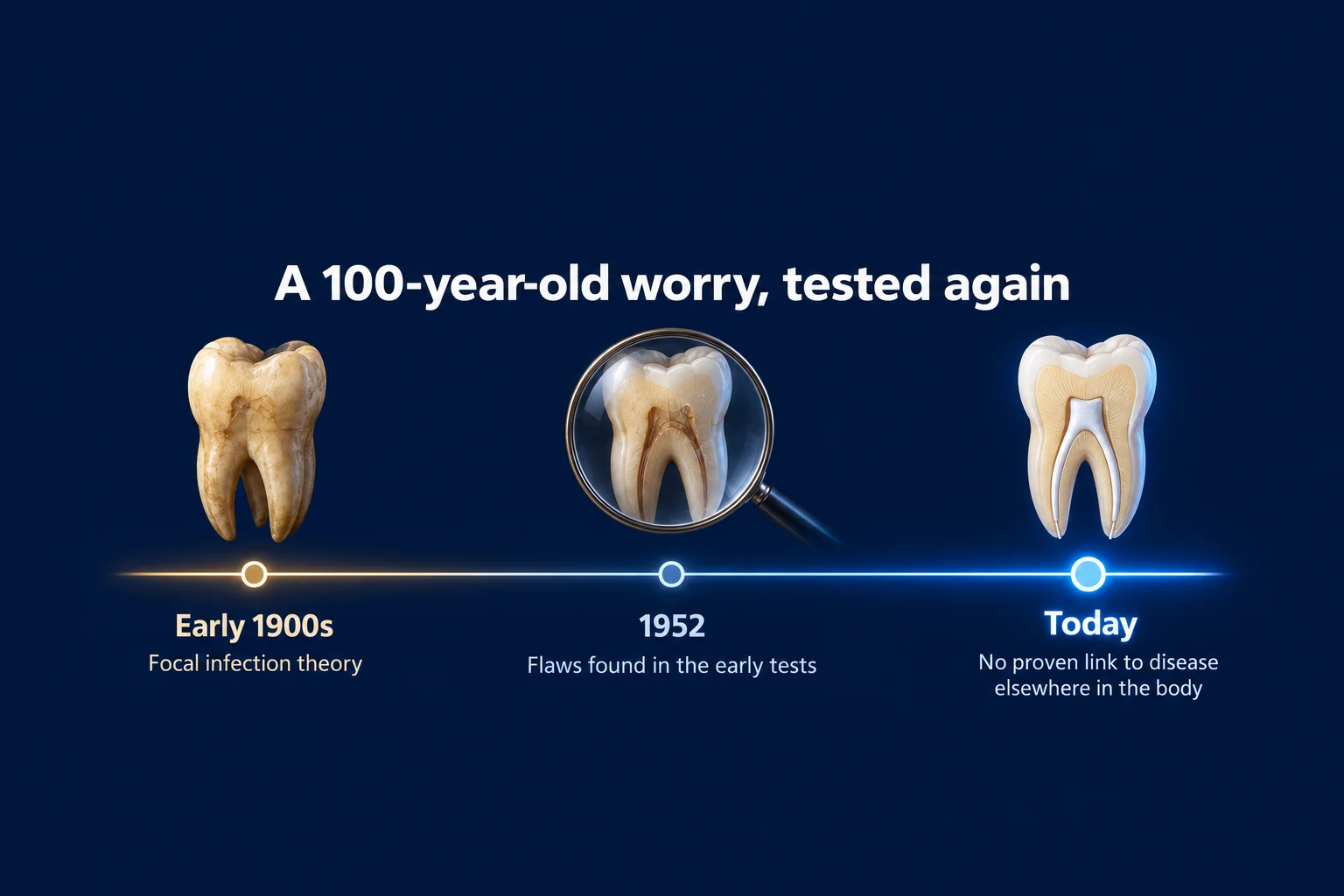
What does research show today? A 2022 review sums it up. Today’s research does not show that a tooth treated with a root canal causes disease in other parts of the body.4 Clearing up a tooth infection may even help lower inflammation (irritation and swelling) in the body, though the authors say more research is needed.4 Keep in mind that this is about treated teeth. An infected tooth still needs care, whichever path you choose.
Cancer is another common worry. In one study of 620 people, those who had root canals did not have a higher risk of head and neck cancer.6
Holistic dentists who hold these views care about whole-body health, and that is a goal worth sharing. The evidence that treated teeth harm health is limited, though. It is fair to ask any dentist which studies back their advice.
Can a tooth be saved without a full root canal?
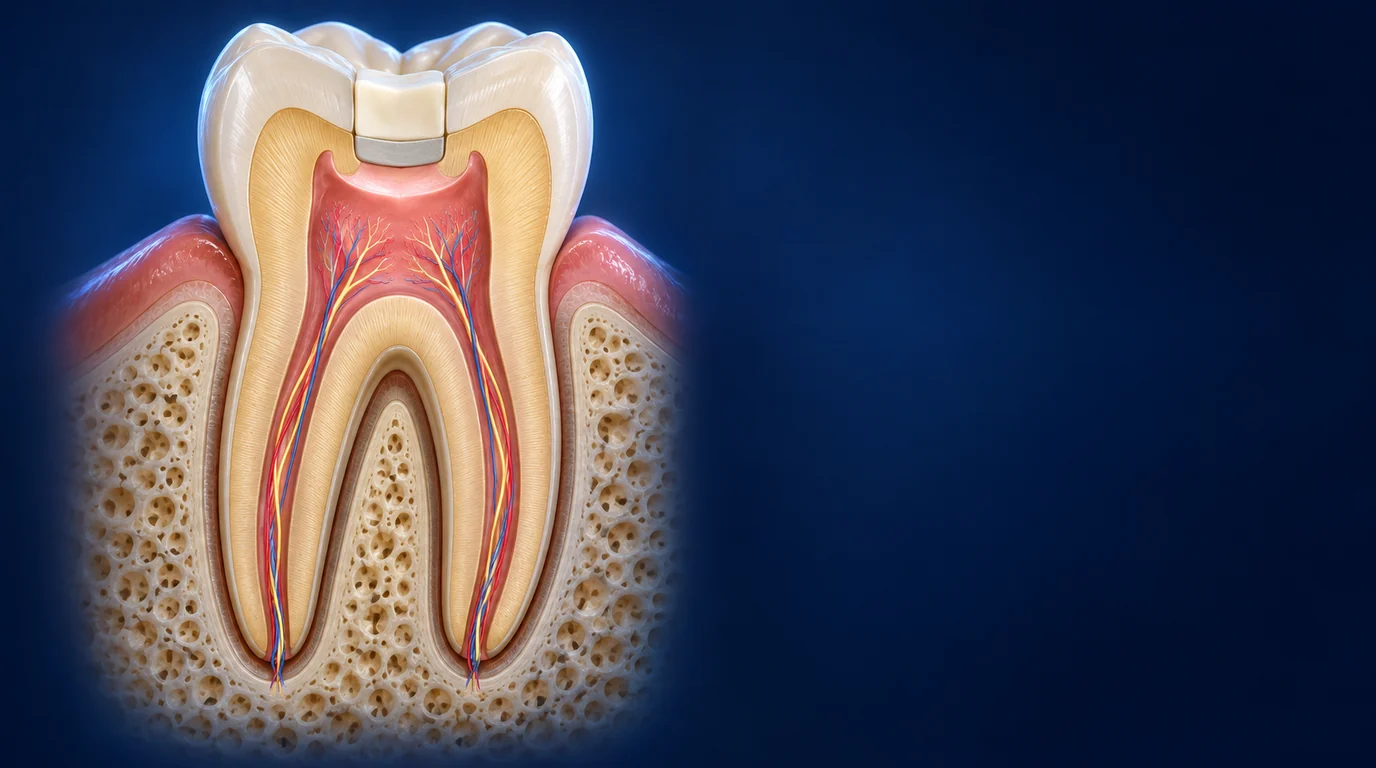
Sometimes, yes. The pulp is the soft, living tissue inside a tooth, with nerves and blood vessels. If decay reaches the pulp while it is still healthy, a dentist may be able to seal the spot and keep the pulp alive. This is called vital pulp therapy. One common type is a pulp cap.
Endodontists offer pulp caps too. So this is one place where holistic dentists and root canal specialists often agree. Both would rather keep a healthy pulp than remove it.
During a pulp cap, the dentist places a thin layer of special cement over the exposed spot. Then the tooth is sealed with a filling. The goal is to keep the pulp alive and the tooth whole.
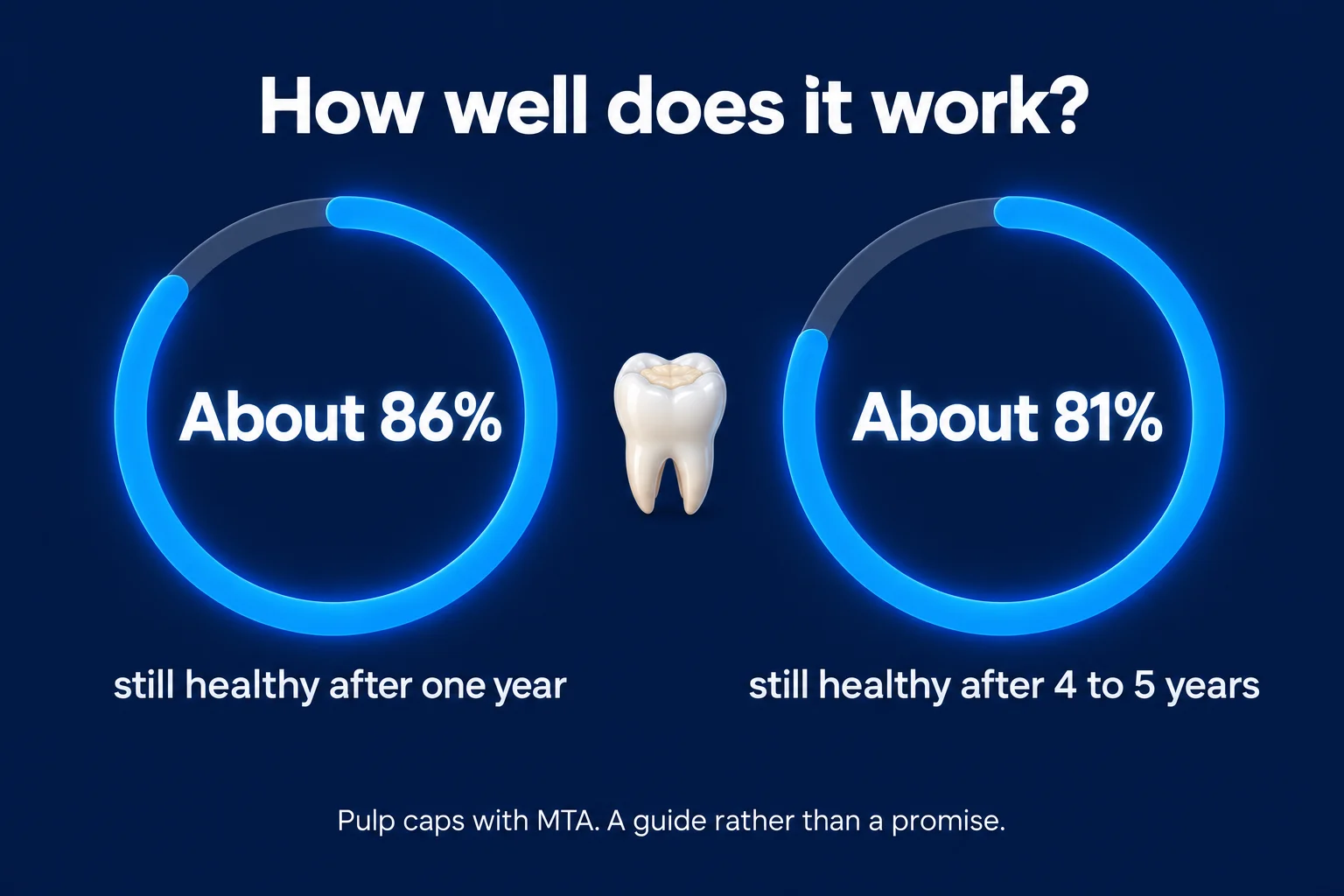
How well does it work? A 2021 review looked at pulp caps in adult teeth where decay had reached the pulp. With a cement called MTA, about 86% of teeth were still healthy after one year. About 81% were still healthy after 4 to 5 years.7 Older cements did worse. The authors rated the evidence as low quality, so these numbers are a guide rather than a promise.
A pulp cap only fits some teeth. Your dentist will test the pulp first. If it is badly inflamed or infected, a pulp cap is usually not an option. An endodontist can check the tooth closely and may use 3D CBCT imaging to see the roots and bone.
Does ozone therapy work for an infected tooth?
Ozone is a form of oxygen. As a gas or mixed into water, it can kill germs. Some holistic dentists use it to clean a decayed tooth or an empty socket. Others use it in place of a root canal, to try to clear the infection without one.
A 2020 review gathered 8 studies on ozone inside the root canal. Seven were lab tests on teeth that had been removed. One was a trial in patients. Ozone killed fewer germs than the standard cleaning rinse used in root canals.8 The authors did not recommend it as a replacement for that rinse, or as an add-on.8
So the evidence for ozone as a root canal substitute is limited. If ozone is offered for an infected tooth, ask what studies support it. Also ask what the next step would be if the infection does not clear.
How does pulling a tooth compare with a root canal?
Both paths can end an infection and stop the pain. The big difference is what you keep. A root canal saves your own tooth. Removal leaves a gap, which can be filled with an implant, a bridge or a partial denture.
How long does each one last? Large reviews found that a tooth saved with a root canal and a single implant tend to last about the same amount of time.19 In one review, about 9 in 10 root canal-treated teeth were still in place up to 10 years later.10 A study of nearly 1.5 million teeth in the United States found that 97% were still in the mouth 8 years after treatment.11
| Question | Root canal | Removal and replacement |
|---|---|---|
| What do you keep? | Your own tooth and its roots. | The tooth is gone. A new tooth takes its place. |
| How long does it last? | Most saved teeth last for many years.10 | A single implant lasts about as long as a saved tooth.1 |
| What happens to the bone? | The root stays in place in the jawbone. | The bone in the empty spot shrinks over the first few months.12 |
| What comes next? | A crown or filling to protect the tooth. | Healing time, then an implant, bridge or partial denture. |
Bone change matters most if you plan to get an implant. After a tooth comes out, the bone in that spot starts to shrink. In studies, it lost about 30% to 60% of its width within about 6 months.12 Nearby teeth can also tip or shift into an open gap over time. That is one reason dentists usually suggest filling the space.
Time is another difference. A root canal is often done in one or two visits, followed by a crown. An implant takes longer, because the bone needs time to heal around it. Cost and insurance also differ, so ask for a written plan for each path.
When is pulling the tooth the right choice?
Sometimes removing the tooth is the best plan, and a good endodontist will tell you so. Saving a tooth works best when there is enough healthy tooth and bone to support it. Removal is often the better option when:
- A crack runs down into the root.
- Too little healthy tooth is left above the gum to hold a crown.
- Severe gum disease has left the tooth loose, with little bone around it.
In these cases, removal and a replacement tooth can be the right plan. Our guide to root canal vs. extraction walks through the choice step by step.
The harder case is a tooth that could be saved. Removing it is a step you cannot undo. If you are told a tooth must come out and no specialist has tested it, a second look makes sense. Learn more about why saving your natural tooth is often worth it.
How do you choose what is right for you?
Start with a clear diagnosis, then compare your options side by side. These questions work with any dentist, holistic or not:
- Can this tooth be saved, and how sure are you?
- Is the pulp healthy enough for a pulp cap?
- What studies support the treatment you suggest?
- If the tooth comes out, what will replace it, and when?
- How will each option affect the teeth and bone nearby?
- What does each path cost, and what does my insurance cover?
Get a second opinion from an endodontist before any tooth is removed. Endodontists are dentists with extra years of training in saving teeth. They test the pulp, look for cracks and check the bone around the root. Then they can tell you plainly whether your tooth can be saved.
Safety questions are common, and they deserve clear answers. Our guide to whether root canals are safe covers them in more depth. You can also see how root canal therapy works at MFE, from the first exam to the final seal.
Our endodontists work at multiple offices across Florida. We will talk through each option with you, including removal. The choice is always yours. To book a visit, find your nearest office.
This page is for general education and is not a diagnosis. Talk with your dentist or endodontist about your own tooth.
Not sure if your tooth can be saved? An endodontist at your nearest MFE location can check it and explain every option. Find a location.
Works Cited
Each reference below was verified against PubMed records on October 13, 2026.
- Torabinejad M, Anderson P, Bader J, et al. Outcomes of root canal treatment and restoration, implant-supported single crowns, fixed partial dentures, and extraction without replacement: a systematic review. J Prosthet Dent. 2007;98(4):285-311. doi:10.1016/S0022-3913(07)60102-4
- Mohseni P, Soufi A, Chrcanovic BR. Clinical outcomes of zirconia implants: a systematic review and meta-analysis. Clin Oral Investig. 2023;28(1):15. doi:10.1007/s00784-023-05401-8
- Sekundo C, Wiltfang J, Schliephake H, et al. Neuralgia-inducing cavitational osteonecrosis: a systematic review. Oral Dis. 2022;28(6):1448-1467. doi:10.1111/odi.13886
- Niazi SA, Bakhsh A. Association between endodontic infection, its treatment and systemic health: a narrative review. Medicina (Kaunas). 2022;58(7):931. doi:10.3390/medicina58070931
- Murray CA, Saunders WP. Root canal treatment and general health: a review of the literature. Int Endod J. 2000;33(1):1-18. doi:10.1046/j.1365-2591.2000.00293.x
- Tezal M, Scannapieco FA, Wactawski-Wende J, et al. Dental caries and head and neck cancers. JAMA Otolaryngol Head Neck Surg. 2013;139(10):1054-1060. doi:10.1001/jamaoto.2013.4569
- Cushley S, Duncan HF, Lappin MJ, et al. Efficacy of direct pulp capping for management of cariously exposed pulps in permanent teeth: a systematic review and meta-analysis. Int Endod J. 2021;54(4):556-571. doi:10.1111/iej.13449
- Silva EJNL, Prado MC, Soares DN, Hecksher F, Martins JNR, Fidalgo TKS. The effect of ozone therapy in root canal disinfection: a systematic review. Int Endod J. 2020;53(3):317-332. doi:10.1111/iej.13229
- Iqbal MK, Kim S. For teeth requiring endodontic treatment, what are the differences in outcomes of restored endodontically treated teeth compared to implant-supported restorations? Int J Oral Maxillofac Implants. 2007;22(suppl):96-116. PMID: 18437793
- Ng YL, Mann V, Gulabivala K. Tooth survival following non-surgical root canal treatment: a systematic review of the literature. Int Endod J. 2010;43(3):171-189. doi:10.1111/j.1365-2591.2009.01671.x
- Salehrabi R, Rotstein I. Endodontic treatment outcomes in a large patient population in the USA: an epidemiological study. J Endod. 2004;30(12):846-850. doi:10.1097/01.don.0000145031.04236.ca
- Tan WL, Wong TL, Wong MC, Lang NP. A systematic review of post-extractional alveolar hard and soft tissue dimensional changes in humans. Clin Oral Implants Res. 2012;23(suppl 5):1-21. doi:10.1111/j.1600-0501.2011.02375.x