Yes, root canal treatment is safe and well studied. Root canal and other endodontic treatments are performed about 15 million times a year. Research shows it clears infection, relieves pain, and keeps teeth for years. Claims it causes illness elsewhere have been repeatedly disproven. An untreated infected tooth is the greater risk.
Despite the strong evidence supporting root canal safety, concerns about the procedure persist, often fueled by outdated or discredited claims that circulate online. Patients deserve honest, evidence-based answers to this question. This article addresses the most common safety concerns directly and transparently, and explains why each one falls apart when measured against the actual research. More on how the procedure works, step by step.
Addressing the Common Safety Myths
“Root canals cause cancer or systemic disease.”
This claim originates primarily from a 1920s theory by Dr. Weston Price, the “focal infection theory,” which proposed that bacteria trapped in root canal treated teeth leach toxins that cause systemic diseases including cancer and arthritis. A review of the literature in the International Endodontic Journal describes how this theory was eventually discredited because it rested on anecdotal evidence and few scientifically controlled studies.1 A later narrative review reached a similar conclusion, noting that the misconceptions of the focal infection theory have been dismissed and that successful root canal treatment can reduce the body’s inflammatory burden.2 No credible peer-reviewed research has established a causal link between root canal treatment and any systemic disease.
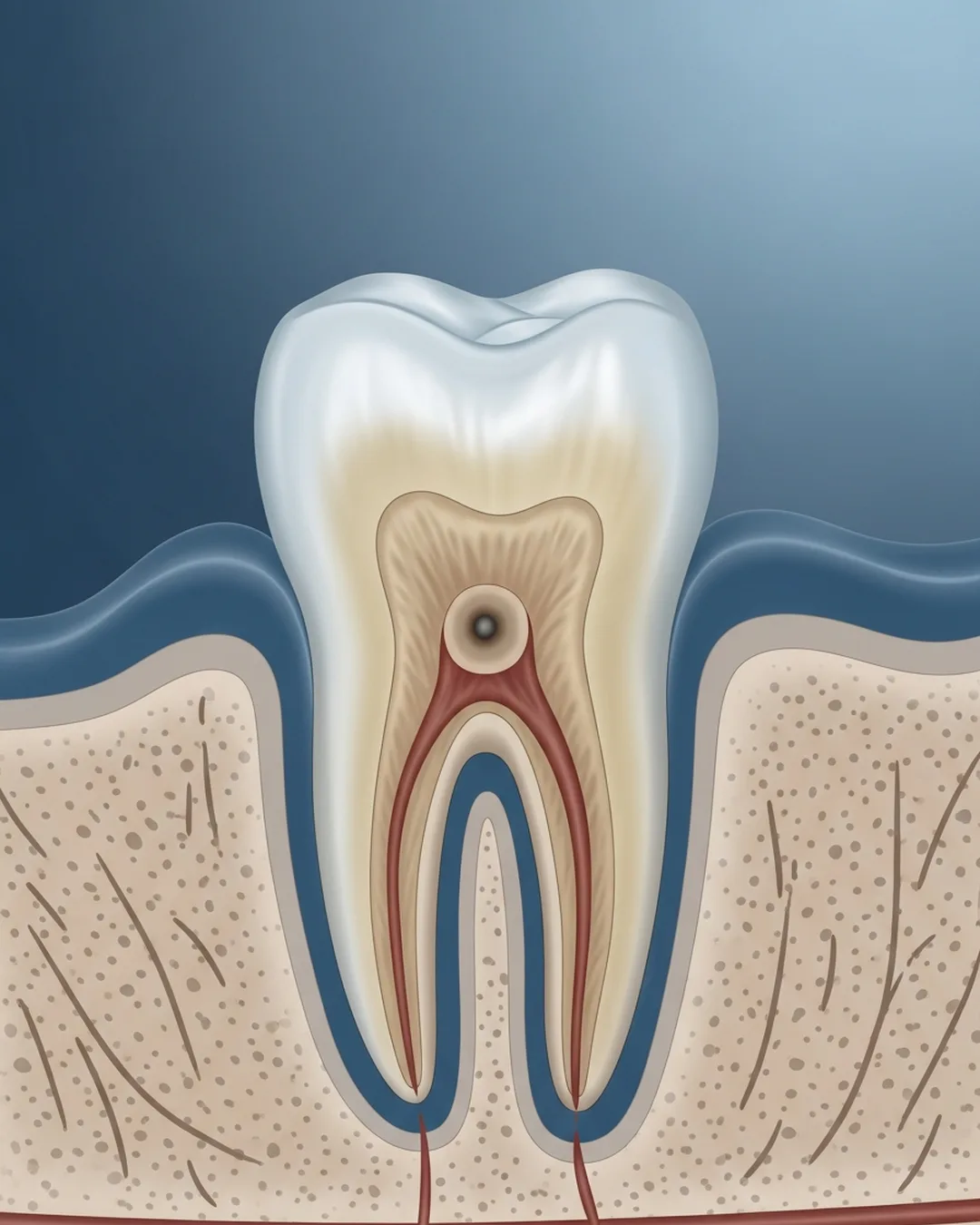
“Bacteria always remain in the tooth after a root canal.”
All dental procedures, including fillings and cleanings, leave some bacteria in the oral environment. The goal of root canal treatment is not absolute sterility (which is unachievable in the mouth) but the elimination of the primary bacterial reservoir and the creation of a sealed, inhospitable environment that prevents reinfection. Research consistently shows that properly performed root canals with adequate obturation (the step where cleaned root canals are filled and sealed to prevent bacteria from re-entering) create conditions in which residual bacteria, if any remain, cannot sustain infection.4 The immune system handles the rest. This is reflected in the high rates of periapical (relating to the area surrounding the tip of a tooth’s root) healing observed on follow-up imaging after successful treatment.6
“Extraction is safer than a root canal.”

Tooth extraction is itself a surgical procedure with its own risks: bleeding, dry socket, nerve injury, and infection. It also initiates bone loss at the extraction site and can require implant surgery to restore the missing tooth. Root canal treatment preserves the natural tooth, requires no surgical incision, and carries a well-established safety profile supported by decades of clinical use and large outcome studies.589 A national insurance-database analysis of more than half a million treated teeth found that the great majority were still retained and functioning years after treatment.8 Every major dental and medical organization supports root canal treatment as a safe and appropriate procedure for saving infected teeth.
“Root canals weaken the immune system.”
Root canal treatment eliminates an active source of infection, which is the opposite of immunologically harmful. Leaving an infected tooth untreated forces the immune system to continuously respond to a persistent bacterial reservoir. Treating the infection removes that chronic immune burden, and the available evidence indicates that successful treatment lowers, rather than raises, the body’s overall inflammatory load.2 There is no credible mechanism by which properly performed root canal treatment suppresses or harms immune function.
What Makes Root Canal Treatment Safe
Decades of Validated Research
Root canal treatment has been the subject of continuous clinical research since the mid-20th century. Long-term outcome studies consistently report high success rates and low complication rates, and they find no association with systemic harm.3 Pooled analyses of many studies place the success of initial treatment in a consistently favorable range across decades of data.3
Sterile Technique and Rubber Dam Isolation
The rubber dam isolates the treatment area from the rest of the mouth, preventing contamination from saliva and cross-contamination between the oral environment and the treatment site. Good isolation and a well-sealed final restoration are among the factors linked to better long-term outcomes.4

Biocompatible Materials
Gutta-percha, the primary filling material, has been used safely in root canal treatment for well over a century. Modern sealers and irrigants used in endodontics are rigorously tested for biocompatibility before clinical use.
Specialist Training and Precision Technology
Endodontic specialists complete 2-3 years of advanced post-graduate training focused exclusively on these procedures. Under the surgical microscope and with 3D CBCT (cone-beam CT, a low-dose 3D X-ray that lets us see the tooth and bone from every angle) imaging, we see canal anatomy the naked eye cannot, and precision instruments help us minimize procedural risk and maximize treatment accuracy. More on the modern technology MFE uses for root canal treatment. We break down why specialist training affects outcomes.
Routine Safety Profile
Serious complications from root canal treatment are uncommon, and large cohort studies show most treated teeth are retained and healthy years later.7 The most common post-treatment issue is temporary soreness, which resolves within days to a week for most patients with medications as recommended by their provider.
Endorsed by All Major Health Organizations
The American Dental Association, the American Association of Endodontists, the American Medical Association, and major cancer research organizations all affirm that root canal treatment is safe and without established systemic health risk.
What Are the Actual Risks of Root Canal Treatment?
Being transparent about real risks is important. While root canal treatment has an excellent safety profile, it is a clinical procedure and carries the following acknowledged risks:
- Post-operative soreness: mild to moderate tenderness for several days to up to a week; managed with medications as recommended by your provider
- Treatment flare-up: a small percentage of cases experience increased swelling or pain in the first day or two; usually managed with prescription anti-inflammatory medication
- Instrument separation: uncommon; a small file tip may occasionally separate in a canal; manageable in most cases by retrieval or bypass
- Root perforation (an accidental hole made in the side of the root during treatment, manageable with modern repair materials): uncommon; a complication of complex anatomy; manageable with appropriate repair materials
- Treatment failure requiring retreatment: a minority of cases may need retreatment over time due to missed canals, recontamination, or complex anatomy, and several of these factors are well documented predictors of outcome4
None of these risks are systemic or life-threatening. They are procedural considerations that experienced endodontic specialists anticipate and manage routinely, which is part of why long-term retention of treated teeth stays so high.7
The safety of root canal treatment has been evaluated across decades of literature. A review in the International Endodontic Journal describes how the focal infection theory was discredited for resting on anecdotal evidence and few scientifically controlled studies, and it found no established link between root canal treatment and systemic disease.1 A 2022 narrative review in Medicina reached a similar conclusion: successful root canal treatment can have a beneficial impact on systemic health by reducing the inflammatory burden, dismissing the misconceptions of focal infection theory.2 Alongside that safety record, large outcome and cohort studies report that the majority of treated teeth remain healthy and in function for many years, with high rates of periapical healing on follow-up imaging.367
Questions about root canal safety that you have not seen answered elsewhere? The endodontists at your nearest MFE location are glad to talk through them before you decide anything. Find a location near you.
Works Cited
- Murray CA, Saunders WP. Root canal treatment and general health: a review of the literature. Int Endod J. 2000;33(1):1-18. doi:10.1046/j.1365-2591.2000.00293.x
- Niazi SA, Bakhsh A. Association between endodontic infection, its treatment and systemic health: a narrative review. Medicina (Kaunas). 2022;58(7):931. doi:10.3390/medicina58070931
- Ng YL, Mann V, Rahbaran S, Lewsey J, Gulabivala K. Outcome of primary root canal treatment: systematic review of the literature. Part 1. Effects of study characteristics on probability of success. Int Endod J. 2007;40(12):921-939. doi:10.1111/j.1365-2591.2007.01322.x Systematic Review
- Ng YL, Mann V, Rahbaran S, Lewsey J, Gulabivala K. Outcome of primary root canal treatment: systematic review of the literature. Part 2. Influence of clinical factors. Int Endod J. 2008;41(1):6-31. doi:10.1111/j.1365-2591.2007.01323.x Systematic Review
- Salehrabi R, Rotstein I. Endodontic treatment outcomes in a large patient population in the USA: an epidemiological study. J Endod. 2004;30(12):846-850. doi:10.1097/01.don.0000145031.04236.ca
- Brochado Martins JF, Georgiou AC, Nunes PD, et al. CBCT-assessed outcomes and prognostic factors of primary endodontic treatment and retreatment: a systematic review and meta-analysis. J Endod. 2025;51(6):687-706. doi:10.1016/j.joen.2025.03.004 Systematic Review
- Fernández R, Cardona JA, Cadavid D, Álvarez LG, Restrepo FA. Survival of endodontically treated roots/teeth based on periapical health and retention: a 10-year retrospective cohort study. J Endod. 2017;43(12):2001-2008. doi:10.1016/j.joen.2017.08.003 Prospective Study
- Raedel M, Hartmann A, Bohm S, Walter MH. Three-year outcomes of root canal treatment: mining an insurance database. J Dent. 2015;43(4):412-417. doi:10.1016/j.jdent.2015.01.013 Prospective Study
- American Association of Endodontists. Root Canal Safety. Accessed September 28, 2026. aae.org