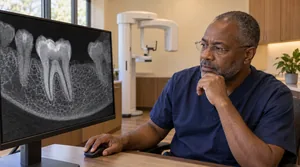
Tooth pain is not always straightforward. Sometimes it moves. Sometimes it’s present without any visible cause. Sometimes a patient has had multiple fillings and X-rays and still doesn’t have answers. Endodontists specialize in tooth pain like this; it is the diagnostic territory they are uniquely trained to work in. More on what an endodontic diagnostic visit involves.
Understanding why endodontists are the specialists for tooth pain, not only root canals, helps you know when seeking their evaluation is the right next step. More on the difference in training and outcomes between a specialist and a general dentist.
The Spectrum of Tooth Pain Endodontists Diagnose
Not all tooth pain originates from the same source. Endodontists are trained to distinguish between several fundamentally different categories, and that distinction is what protects a healthy tooth from an unnecessary procedure:
Odontogenic Pain (Tooth-Origin)
Pain that originates directly from the tooth or its supporting structures, pulpitis (inflammation of the living tissue inside the tooth), periapical (relating to the area surrounding the very tip of a tooth’s root) infection, cracked tooth syndrome, dentin (the layer of tooth beneath the hard enamel (the hard outer shell of the tooth, the hardest substance in the human body), softer and more sensitive, containing microscopic channels that connect to the nerve) hypersensitivity. This is the most common type and the primary focus of endodontic diagnosis. The challenge is that even odontogenic pain can be difficult to localize to a specific tooth, particularly when pain is referred along nerve branches. Mapping that pain to the correct tooth is a core part of the specialist examination.
Referred Dental Pain
Pain that is perceived in a different location from where it originates.3 For example, a lower molar infection can produce pain that feels like it’s in the upper jaw. A cracked lower premolar can cause what seems like ear pain. The trigeminal nerve, which serves most of the face and jaw, has branches that frequently cause confusion about which tooth, or even which jaw, the pain is coming from. Endodontists are specifically trained to test and map this referred pain systematically rather than treating the tooth a patient happens to point at.
Non-Odontogenic Pain (Not Tooth-Origin)
Pain that feels exactly like a toothache but doesn’t come from a tooth at all.2 Sources include myofascial pain (muscle pain from clenching or bruxism), TMJ disorders, sinus conditions mimicking upper tooth pain, and neuropathic pain (nerve pain after prior dental treatment). In rare cases, referred pain from cardiac or neurological conditions. Correctly identifying non-odontogenic pain is critical: treating healthy teeth for pain that comes from another source causes unnecessary harm and does not resolve the symptoms. Conditions such as atypical odontalgia, a persistent tooth-area pain with no visible cause, are reported in a meaningful share of patients evaluated for endodontic treatment, which is why a careful specialist work-up comes before any irreversible step.2
The Diagnostic Toolkit That Sets Endodontists Apart
How Endodontists Find What Others Miss
- Cold and heat pulp testing systematically applied to each tooth to map which teeth respond and how, helping distinguish reversible from irreversible inflammation and necrosis (tissue death, when the living tissue inside a tooth dies due to infection or loss of blood supply)
- Electric pulp testing (EPT) delivers a small electrical stimulus to assess pulp vitality, particularly useful in teeth where thermal (relating to temperature, heat or cold) testing is inconclusive
- Bite testing with Tooth Slooth isolates pain to a specific cusp or region, helping identify cracks and fractured cusps that X-rays cannot show
- Percussion and palpation (pressing on the gum tissue to check for tenderness or swelling that indicates infection beneath) testing tapping individual teeth and pressing on the gum to assess periapical inflammation and abscess formation
- Selective anesthesia injecting anesthetic to specific teeth or nerve branches in sequence to determine which tooth, or even which jaw, is the source of referred pain
- Transillumination shining a focused light beam through the tooth to visualize crack lines
- 3D CBCT imaging three-dimensional imaging that can reveal periapical lesions, root fractures, bone loss, and canal anatomy not visible on 2D X-rays
- Surgical microscope examination high magnification that lets us directly visualize the tooth, pulp chamber (the hollow space inside the crown of the tooth that houses the nerve and blood vessels), and canal orifices the naked eye can miss
The “Tooth of Doom” Problem, and How Endodontists Solve It
Every endodontist has seen the patient who arrives after months of frustrating treatment, multiple fillings replaced, a crown placed, antibiotics tried, and the tooth still hurts. Sometimes called the “tooth of doom” scenario colloquially among clinicians, this often represents a diagnosis that was missed earlier in the process. We break down how endodontists use CBCT imaging to find problems other dentists miss.

In many of these cases, the endodontic evaluation reveals what prior exams missed: a hairline crack in a molar, a second root canal in an upper premolar that was never treated, or referred pain from the opposite jaw that pointed to the wrong tooth entirely. Persistent tooth pain after a root canal is not always coming from the treated tooth; in patients still reporting pain months later, a substantial share have a non-odontogenic or referred source rather than a failed root canal.1 Systematic endodontic diagnosis, working through all the possibilities methodically, finds the source.
When to See an Endodontist for Pain Diagnosis Specifically
- Tooth pain that has persisted for more than 2-3 weeks despite dental treatment
- Pain that is difficult to locate, moves between teeth, changes sides, or radiates to the ear or jaw
- Pain that your dentist cannot explain or reproduce on examination
- X-rays that look normal but symptoms continue
- Pain after a recent filling, crown, or other dental work that isn’t settling down
- Any tooth pain with unexplained neurological symptoms, facial numbness, tingling, or burning
The diagnostic complexity of dental pain is documented in the endodontic literature. In a National Dental Practice-Based Research Network study, among patients still reporting pain six months after a root canal, roughly half of those evaluated had a non-odontogenic or referred pain source, including temporomandibular disorder and persistent dentoalveolar pain, conditions that a further procedure on the presenting tooth would not have resolved.1 Findings like these underscore why specialist-level diagnostic evaluation belongs before any irreversible treatment, so the right source of pain is identified the first time.
If you have tooth pain that has not been explained or successfully treated, the endodontists at your nearest MFE location are the right next step. Find a location.
Works Cited
- Nixdorf DR, Law AS, John MT, et al. Differential diagnoses for persistent pain following root canal treatment: a study in the National Dental PBRN. Northwest Dent. 2015;94(4):33-40. PMID 26433993. Prospective Study
- Melis M, Lobo SL, Ceneviz C, et al. Atypical odontalgia: a review of the literature. Headache. 2003;43(10):1060-74. doi:10.1046/j.1526-4610.2003.03207.x
- Okeson JP. The classification of orofacial pains. Oral Maxillofac Surg Clin North Am. 2008;20(2):133-44. doi:10.1016/j.coms.2007.12.009