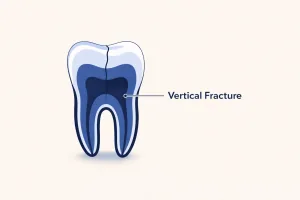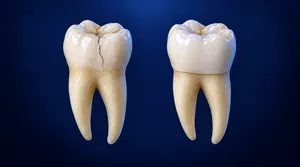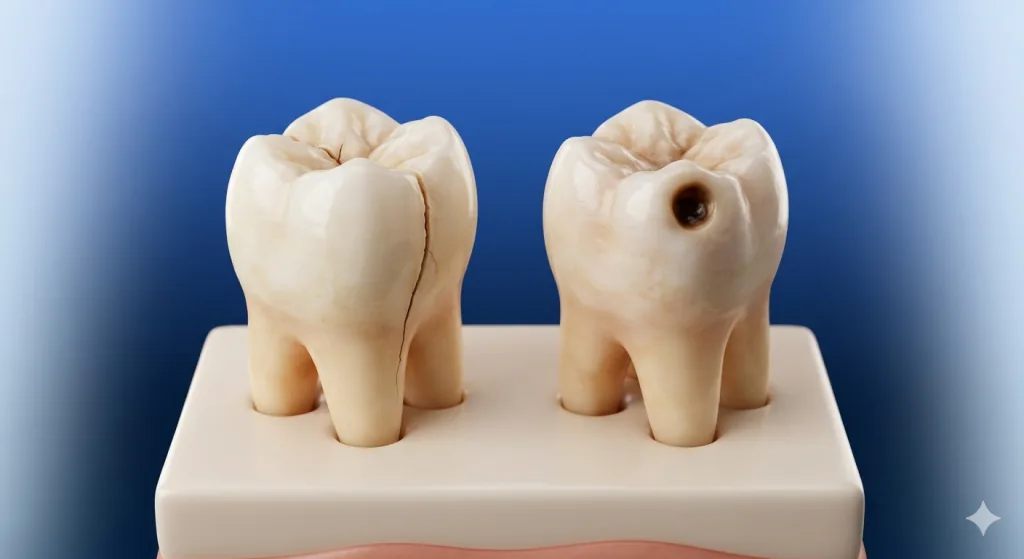
Tooth pain is tooth pain, until you need to explain it to your dentist. Understanding whether what you’re experiencing sounds more like a crack or a cavity can help you communicate your symptoms more effectively and point your provider in the right direction. It can also help you understand why, when your X-ray looks perfectly normal, your dentist might still refer you to an endodontic specialist. Understand the full list of cracked tooth symptoms to look for.
Cracked Tooth vs. Cavity: Side-by-Side Comparison
| Feature | Cracked Tooth | Cavity (Tooth Decay) |
|---|---|---|
| Pain character | Sharp, sudden, intense, often brief | Dull ache or sensitivity, may linger |
| Main trigger | Biting or chewing, especially in one direction | Sweets, cold, heat, or pressure on decay site |
| Pain on releasing bite | Yes, classic “rebound” pain is common | No, pain does not worsen on release |
| Consistency | Intermittent, hard to reproduce reliably | More consistent, same trigger produces similar pain |
| Visible on X-ray | Usually not, most cracks are invisible on 2D X-rays | Yes, cavities appear as dark spots on radiographs |
| Visible to eye | Often not, may need special lighting or dye | Sometimes, dark spots, pits, or chalky white areas |
| Cold sensitivity duration | Brief if pulp not yet involved; lingering if pulp inflamed | Brief if early; lingering if decay has reached pulp |
| Spontaneous pain | Only if pulp has become inflamed or infected | Only if decay has reached the pulp (the soft living tissue inside the tooth, containing nerves and blood vessels) |
| Swelling possible | Yes, if crack leads to pulp death and abscess | Yes, if decay leads to pulp death and abscess |
| Primary treatment | Crown (± root canal if pulp involved) | Filling (± root canal if pulp involved) |
| Can it heal on its own? | No, cracks do not repair | No, decay does not reverse without intervention |
What They Have in Common
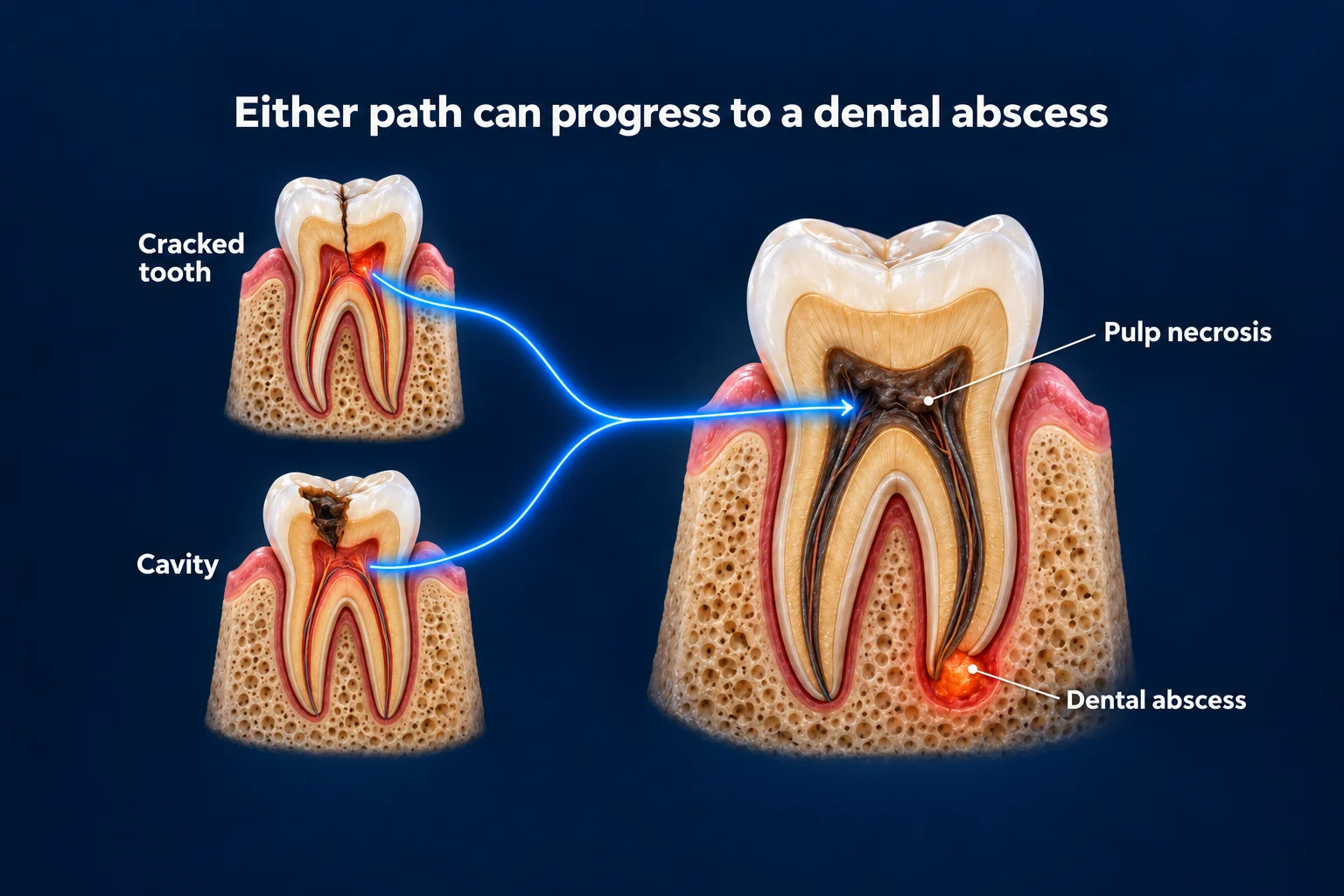
Both a cracked tooth and a cavity that has been left long enough can eventually lead to pulp inflammation, irreversible pulpitis (severe inflammation of the tooth’s inner tissue, too damaged to heal on its own), and pulp necrosis (death of the living tissue inside the tooth, when that tissue dies due to infection or loss of blood supply). From there, either path can progress to a dental abscess. The end-stage of either, an infected tooth that needs a root canal, looks the same regardless of how it got there. This is why early diagnosis and treatment of both conditions is important: catching either before the pulp is involved preserves the most treatment options and typically means a simpler, less costly procedure. For cracked teeth specifically, monitoring symptom-free cracks and restoring symptomatic ones before the pulp is lost gives the tooth the best chance of long-term survival.4 Read what happens when a crack goes untreated.
Chipped or Broken Tooth vs. Cavity
A chipped or broken tooth and a cavity damage a tooth in different ways. A chipped or broken tooth has lost a piece of its structure. When a piece of a back tooth’s chewing surface breaks off, often around a filling, it is called a fractured cusp; it rarely damages the nerve and usually doesn’t cause much pain.5 A cavity is decay: it forms gradually, as sugar-fed plaque bacteria pull minerals out of the tooth.6 Most chipped teeth can be repaired by reattaching the broken piece or with a tooth-colored filling. A larger break may need a crown, and if the nerve (pulp) is exposed or damaged, a root canal may be needed.7
How Each Is Diagnosed
Diagnosing a Cavity
Cavities are diagnosed through visual examination (looking for dark spots, pits, or white lesions), tactile probing (the explorer tip “catches” in a softened area), and bitewing X-rays (where decay appears as a dark area of reduced density between or beneath teeth). In early stages, some cavities are visible only on X-ray with no symptoms at all. Because decay shows up reliably on a radiograph, a confirmed cavity is usually a more straightforward diagnosis than a crack.
Diagnosing a Cracked Tooth
Cracked teeth require a more involved diagnostic process, particularly because they rarely appear on standard X-rays.1 A patient is often unable to point to the exact tooth, and may report a history of several dental visits without a clear answer, which is one of the hallmarks of cracked tooth syndrome.1 Endodontists use bite sticks to isolate pain to a specific cusp, transillumination (shining a bright light through the tooth to reveal crack lines that are otherwise invisible) to visualize crack lines, methylene blue dye staining, examination under a surgical operating microscope, and 3D CBCT (cone-beam CT, a low-dose 3D X-ray that lets us see the tooth and bone from every angle) imaging to assess crack depth and any associated bone changes.2 This is one reason a referral to an endodontic specialist is appropriate when bite pain persists with normal X-ray findings. Find out how endodontists find cracks that X-rays miss.
Can a Tooth Have Both a Crack and a Cavity?
Yes, and this is more common than many patients expect. A tooth with a large old filling or significant decay is structurally weakened, making it more susceptible to cracking.2 Conversely, a crack in a tooth creates microscopic channels through which bacteria can access the inner tooth layers more easily, accelerating decay. When both are present, treatment planning needs to address both issues, and root canal treatment is more likely to be needed. A crack that already reaches the pulp tends to carry a more guarded outlook, so identifying it early matters.
Why This Distinction Matters for Treatment
Getting the diagnosis right determines the treatment path:
- A cavity treated with a filling when a crack is the actual cause will not resolve the symptoms, the crack continues to flex and cause pain through the new filling
- A cracked tooth that is mistaken for sensitivity and managed with toothpaste gives the crack time to propagate to the root, potentially resulting in extraction of what could have been saved with a crown
- Both conditions, if they involve the pulp, require root canal treatment before any restoration, placing a crown or filling over an infected pulp leads to treatment failure
The restoration choice also matters for a cracked tooth. Pooled clinical data show that a cracked tooth restored after root canal treatment survives far better with full-crown (cuspal) coverage than with a simple filling alone, which is why a crown is so often recommended once a crack is confirmed.3
The diagnostic distinction between cracked tooth syndrome and cavity (decay) involvement is clinically significant because a misread can send a patient down the wrong treatment path. A narrative review of cracked tooth syndrome describes the condition as an incomplete fracture of a vital back tooth, marked by pain on chewing that eases when the pressure is withdrawn, with diagnosis made difficult by varied symptoms and the frequent inability to identify the offending tooth.1 Management depends on how far the crack extends, ranging from monitoring and occlusal adjustment to a cast restoration or endodontic treatment.1 The outlook is encouraging when cracks are caught and restored appropriately: a 2024 systematic review and meta-analysis reported tooth survival rates of roughly 93 to 98 percent at one to six years for cracked teeth with a healthy pulp, and around 90 to 91 percent at one to two years for cracked teeth treated with root canal therapy, with full-crown coverage strongly favored over direct fillings alone.3
Not sure which one you have? An endodontist at your nearest MFE location has the tools to tell the difference, including 3D imaging and microscopic evaluation. Find a location.
Works Cited
- Lynch CD, McConnell RJ. The cracked tooth syndrome. J Can Dent Assoc. 2002;68(8):470-475. Narrative Review
- Banerji S, Mehta SB, Millar BJ. Cracked tooth syndrome. Part 1: aetiology and diagnosis. Br Dent J. 2010;208(10):459-463. doi:10.1038/sj.bdj.2010.449 Narrative Review
- Zhang S, Xu Y, Ma Y, Zhao W, Jin X, Fu B. The treatment outcomes of cracked teeth: a systematic review and meta-analysis. J Dent. 2024;142:104843. doi:10.1016/j.jdent.2024.104843 Systematic Review
- Kang SH, Kim BS, Kim Y. Cracked teeth: distribution, characteristics, and survival after root canal treatment. J Endod. 2016;42(4):557-562. doi:10.1016/j.joen.2016.01.014 Prospective Study
- American Association of Endodontists. Cracked Teeth. Accessed September 28, 2026. aae.org
- Pitts NB, Zero DT, Marsh PD, et al. Dental caries. Nat Rev Dis Primers. 2017;3:17030. doi:10.1038/nrdp.2017.30 Narrative Review
- American Association of Endodontists. Traumatic Dental Injuries. Accessed September 28, 2026. aae.org