You just had a root canal to relieve pain, so why does it still hurt? This is one of the most common concerns patients have in the days after treatment, and it deserves a clear, thorough answer. Understanding what kind of post-treatment pain is expected, and what kind is a warning sign, makes the recovery period much less anxious. Research that followed patients through recovery confirms that some post-treatment soreness is the rule rather than the exception, and that it eases steadily over the first few days.5 We break down how long the full recovery from root canal therapy typically takes. See what to expect in the days and weeks after treatment.
What Level of Pain Is Normal After a Root Canal?
Post-Root Canal Pain: What Each Level Means
Mild to moderate soreness, most patients significantly better within 2-3 days, managed with ibuprofen, improving overall. This is the expected response and means healing is on track. Clinical trials that tracked patients day by day show pain ratings falling steadily across the first few days after treatment.6
Soreness and tenderness for up to a week, within the normal range. Every patient heals on a slightly different timeline. Tenderness through day 7 is not a cause for concern as long as the overall direction is improvement.
Longer tenderness if you cannot take NSAIDs, patients who cannot use ibuprofen due to medical conditions (GI issues, kidney conditions, blood thinners, etc.) should expect tenderness to last longer. This is anticipated and does not mean the treatment failed.
Gum tenderness and jaw soreness, from the rubber dam clamp, injection sites, or time with mouth open. Resolves within several days without treatment.
Still sore beyond a week, may still be normal, especially for complex cases or without NSAID use. The key question: is it slowly improving overall? If yes, continue monitoring. If there has been zero change or things are worse, call your endodontist.
No improvement at all, or symptoms worsening at any point, this is the trigger to call. The specific day doesn’t matter, a trend of worsening or complete stagnation with no improvement at all is when we want to hear from you.
Return of severe throbbing, swelling, or fever, not normal at any stage. Swelling of the cheek, jaw, or neck, fever, or return of pre-treatment severity all require prompt same-day evaluation.
Why Does a Root Canal Cause Any Pain at All?
This is the question that confuses most patients. The root canal procedure removes the nerve inside the tooth, so why is there still pain? Read how long a root canal treated tooth is expected to last.
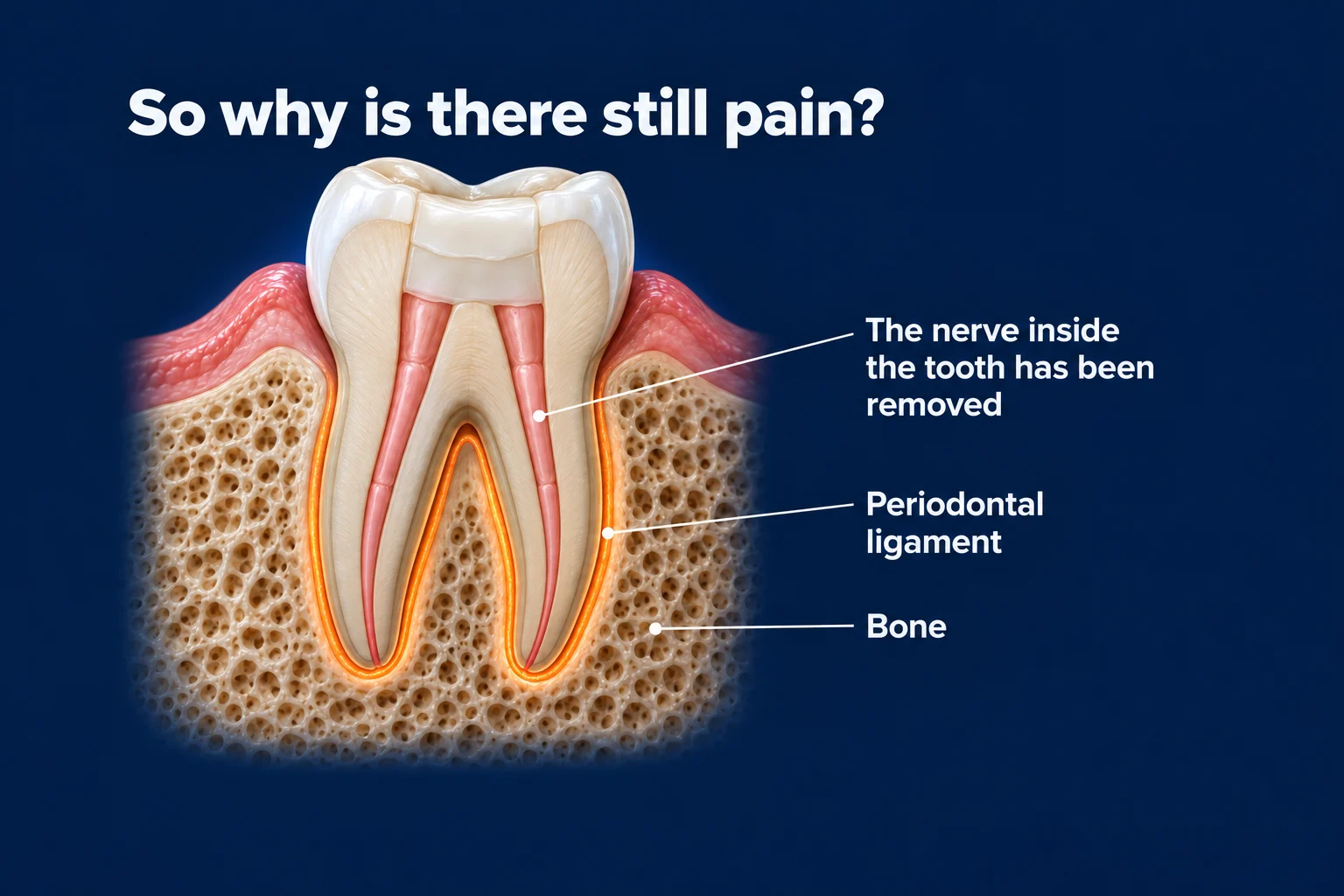
The nerve inside the tooth has been removed. But the tooth sits in a socket of bone lined with a periodontal ligament (the thin layer of fibers connecting the tooth root to the jawbone, which acts as a shock absorber and contains pressure-sensitive nerve fibers), a thin cushion of living tissue rich with nerve fibers. This ligament was inflamed before the procedure (from the infection or inflammation that prompted treatment) and responds to the mechanical manipulation of the root canal with a temporary inflammatory reaction. This is also why patients who walked in with pain before treatment, or with a painful infection at the root tip, tend to feel a bit more soreness afterward: the tissue was already irritated, so it has more settling down to do.3
Think of it like having a splinter removed from your finger. The splinter is gone, but the surrounding tissue that was irritated by it is still sore for a day or two. Same principle.
What Causes a Post-Treatment Flare-Up?
A small percentage of root canal cases experience a post-treatment flare-up: a significant increase in pain and sometimes swelling within the first 48 hours. One prospective study of multi-visit root canal treatment measured a flare-up rate of about 8.5%, with pre-treatment pain the main risk factor.2 A flare-up is not a sign of treatment failure, but it is worth understanding.

What Is a Post-Treatment Flare-Up?
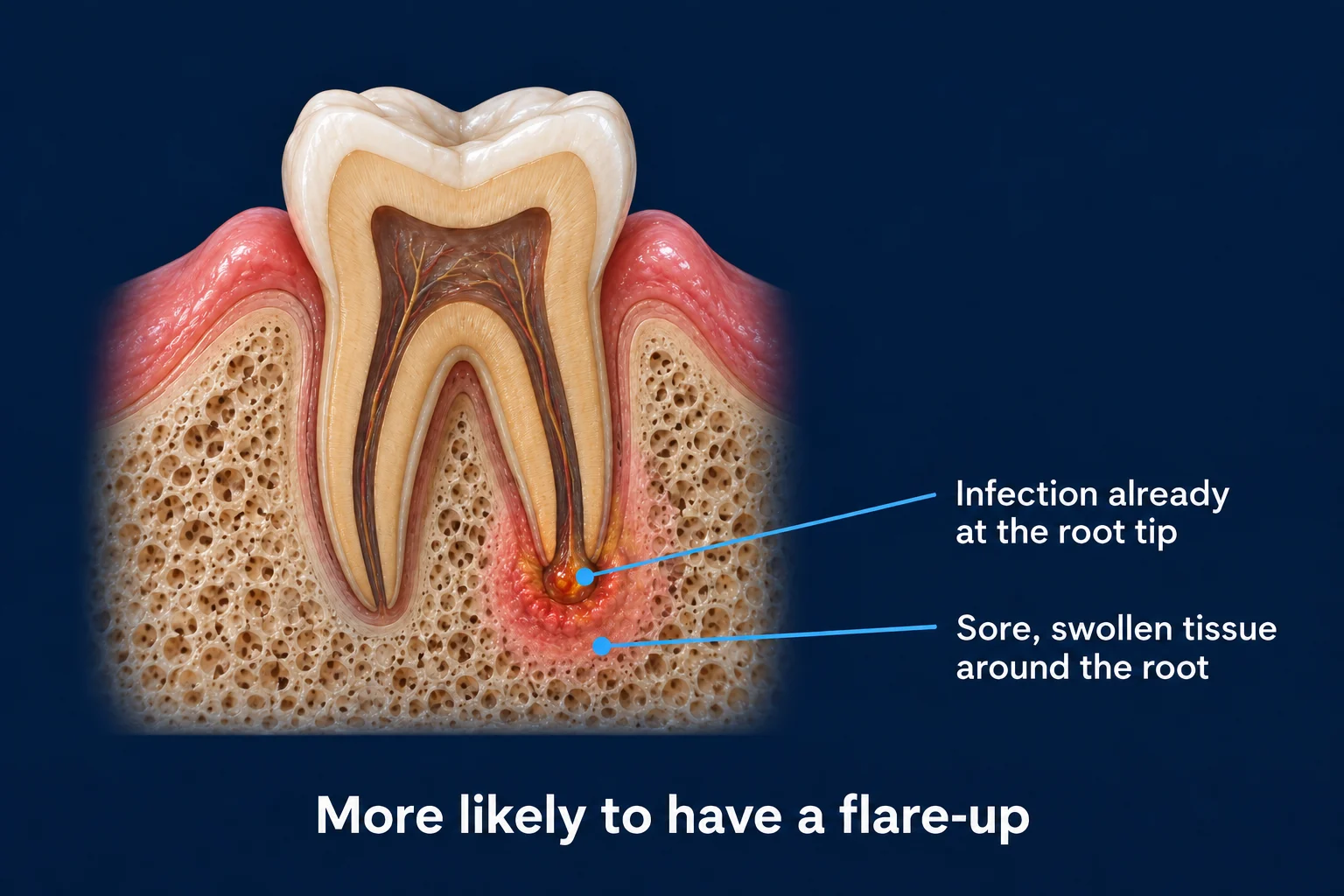
A flare-up is an acute exacerbation of symptoms, increased pain, possible swelling, after root canal treatment. It is thought to be caused by a shift in the microbial balance in the canal or a brief immune response to debris extruded beyond the root tip during instrumentation. Older clinical work links these interappointment emergencies most strongly to teeth that already carried necrotic (non-vital) pulp and pre-existing symptoms.1 Flare-ups are managed with additional antibiotics or anti-inflammatories and almost always resolve within a few days without compromising the long-term outcome of treatment. If a tooth that has already had a root canal flares up much later, that is a different situation your endodontist evaluates for retreatment.
More Likely to Have a Flare-Up
Pre-existing acute abscess · multiple previous treatment attempts · symptomatic apical periodontitis (infection and inflammation at the root tip spreading into the jawbone) before treatment · treatment requiring a second visit · anxious patients with heightened pain response
Less Likely to Have a Flare-Up
Asymptomatic necrosis (tissue death, when the living tissue inside a tooth dies due to infection or loss of blood supply) with no pre-existing abscess · straightforward single-rooted teeth · young healthy patients · teeth with no prior endodontic treatment (treatment focused on the inside of the tooth, most commonly root canal therapy)
How to Manage Post-Root Canal Pain at Home
- Take medications as prescribed or recommended by your provider your endodontist will give you specific post-operative instructions tailored to your case. Follow those first and foremost
- Ibuprofen 400-600mg every 6-8 hours with food if recommended by your provider and not contraindicated, this is effective for dental inflammatory pain. Take it proactively before the anesthesia wears off rather than waiting for pain to peak. Endodontic studies consistently show that an ibuprofen-based regimen controls post-treatment pain well for most patients.4
- Acetaminophen can be used if ibuprofen is not suitable for you medically, discuss with your provider what is appropriate for your situation. In head-to-head endodontic trials, ibuprofen alone and an ibuprofen-acetaminophen combination performed comparably, so acetaminophen is a reasonable part of your plan when guided by your provider.6
- Do not apply heat or cold compresses to the outside of your face this is a common instinct but is not advised after root canal treatment. Compresses can increase swelling, particularly when any infection was involved
- Eat soft foods and avoid chewing on the treated side
- Avoid very hot or cold foods and drinks for the first 24-48 hours
- Elevate your head when resting lying flat increases blood pressure to the area and can worsen throbbing
Post-operative pain following root canal treatment is a well-studied phenomenon. A large prospective study in the Journal of Dental Research found that pre-operative pain intensity and a diagnosis of symptomatic apical periodontitis were among the strongest predictors of more severe post-treatment pain.3 A separate systematic review and meta-analysis in the Journal of Endodontics confirmed that nonsteroidal anti-inflammatory drugs such as ibuprofen reliably reduce post-endodontic discomfort, and that adding acetaminophen was not significantly different from ibuprofen alone.4 Randomized trials tracking patients day by day show that pain ratings decline steadily over the first few days, so most patients reach satisfactory comfort with an over-the-counter regimen.6
If something feels off after your root canal, the endodontists at your nearest MFE location are available for follow-up. Find a location.
Works Cited
- Torabinejad M, Kettering JD, McGraw JC, Cummings RR, Dwyer TG, Tobias TS. Factors associated with endodontic interappointment emergencies of teeth with necrotic pulps. J Endod. 1988;14(5):261-266. doi:10.1016/S0099-2399(88)80181-X
- Gbadebo SO, Sulaiman AO, Anifowose OO. Endodontic flare up: incidence and association of possible risk factors. Afr J Med Med Sci. 2016;45(2):207-212. PMID 29465864. Prospective Study
- Law AS, Nixdorf DR, Aguirre AM, et al. Predicting severe pain after root canal therapy in the National Dental PBRN. J Dent Res. 2014;94(3 Suppl):37S-43S. doi:10.1177/0022034514555144 Prospective Study
- Smith EA, Marshall JG, Selph SS, Barker DR, Sedgley CM. Nonsteroidal Anti-inflammatory Drugs for Managing Postoperative Endodontic Pain in Patients Who Present with Preoperative Pain: A Systematic Review and Meta-analysis. J Endod. 2016;43(1):7-15. doi:10.1016/j.joen.2016.09.010 Systematic Review
- Wells LK, Drum M, Nusstein J, Reader A, Beck M. Efficacy of ibuprofen and ibuprofen/acetaminophen on postoperative pain in symptomatic patients with a pulpal diagnosis of necrosis. J Endod. 2011;37(12):1608-1612. doi:10.1016/j.joen.2011.08.026 RCT
- Stamos A, Drum M, Reader A, Nusstein J, Fowler S, Beck M. An evaluation of ibuprofen versus ibuprofen/acetaminophen for postoperative endodontic pain in patients with symptomatic irreversible pulpitis and symptomatic apical periodontitis. Anesth Prog. 2019;66(4):192-201. doi:10.2344/anpr-66-03-06 RCT