The procedure is done. You’re numb, relieved, and wondering what the next few days will look like. Recovery after a root canal is straightforward for most patients, but knowing what’s normal versus what deserves a call to your provider makes the recovery period much less stressful.
Here is a clear, honest guide to what you should and shouldn’t expect after root canal treatment at Mid-Florida Endodontics.
Hour-by-Hour and Day-by-Day Recovery Timeline
Anesthesia wearing off
The numbness gradually fades. Avoid eating until fully worn off, you may bite your cheek or tongue without realizing it. Some patients feel the first hints of soreness as sensation returns. This is expected.
Peak soreness period
Most patients report the highest level of discomfort in the first 24 hours.1 Take ibuprofen (400-600mg every 6-8 hours with food) or acetaminophen as directed by your provider, if not contraindicated, before the anesthesia fully wears off, before pain peaks. Eat soft foods on the opposite side. Rest if you can. Patients who cannot take NSAIDs due to medical conditions may find tenderness lasts a bit longer, this is expected, and healing is still happening.
Most patients feeling significantly better
Most people notice meaningful improvement by this point. Some residual soreness when biting and tenderness in the gum is still normal. Over-the-counter medication should be managing discomfort well. If you are still uncomfortable, that does not mean something is wrong, continue monitoring and expect gradual improvement.
Continued improvement, tenderness can still be present
Some patients still feel mild tenderness or bite sensitivity through the end of the first week. This is within the normal range.1 Soreness lasting up to a week, sometimes slightly longer, is not a cause for concern provided it is trending better overall. Resume normal eating, but avoid very hard or crunchy foods on the treated tooth until your final restoration is placed.

Final restoration appointment with your general dentist
Your endodontist will communicate the treatment report to your general dentist. You should schedule your final restoration appointment promptly after root canal treatment, the sooner the better. A temporary filling is protecting the tooth in the meantime, avoid chewing hard foods on that side.
Normal vs. Concerning Symptoms After a Root Canal
Normal. Expected
- Mild to moderate soreness for 2-3 days, most patients feeling significantly better
- Some soreness and tenderness for up to a week, this is within normal range
- Tenderness when biting on the treated tooth
- Gum soreness near the tooth
- Jaw achiness from keeping mouth open
- Longer tenderness if you cannot take ibuprofen due to medical conditions
- Symptoms that are gradually, overall improving
Call Your Endodontist
- No improvement whatsoever after several days
- Symptoms worsening at any point rather than improving
- Swelling of the cheek, jaw, or neck
- Fever alongside tooth pain
- Return of pre-treatment severe throbbing pain
- Temporary filling falling out completely
- Pain so severe that nothing provides any relief
Do’s and Don’ts in the First 48 Hours
What helps most
- Follow the post-operative instructions given by your endodontist, these are specific to your case
- Take medications as prescribed or recommended by your provider
- Eat soft foods: yogurt, soup, eggs, mashed potatoes
- Chew on the opposite side from the treated tooth
- Rest and avoid strenuous exercise on day one
- Keep your final restoration appointment with your general dentist
A few things to skip while you heal
- Eat until anesthesia has fully worn off
- Chew hard, crunchy, or sticky foods on the treated side
- Apply heat or cold compresses to your face, this can increase swelling
- Smoke, delays healing and increases infection risk
- Skip your final restoration appointment, the temporary filling is not permanent protection
- Ignore worsening pain, swelling, or symptoms that are not improving at all
Why Is There Any Pain at All After a Root Canal?
This is one of the most common questions patients ask. The root canal procedure itself removes the nerve tissue inside the tooth, so why does it still hurt afterward?
The answer is that the nerve inside the tooth has been removed, but the nerves and tissues surrounding the root tip are still present and alive. These tissues, the periodontal ligament (the thin layer of fibers connecting the tooth root to the jawbone, which acts as a shock absorber and contains pressure-sensitive nerve fibers) and surrounding bone, were inflamed before treatment and respond to the mechanical manipulation of the procedure with a temporary flare of soreness. This is a normal healing response, not a sign of failure or reinfection. It resolves as the periapical (relating to the area surrounding the very tip of a tooth’s root) inflammation settles, typically within 2-3 days.
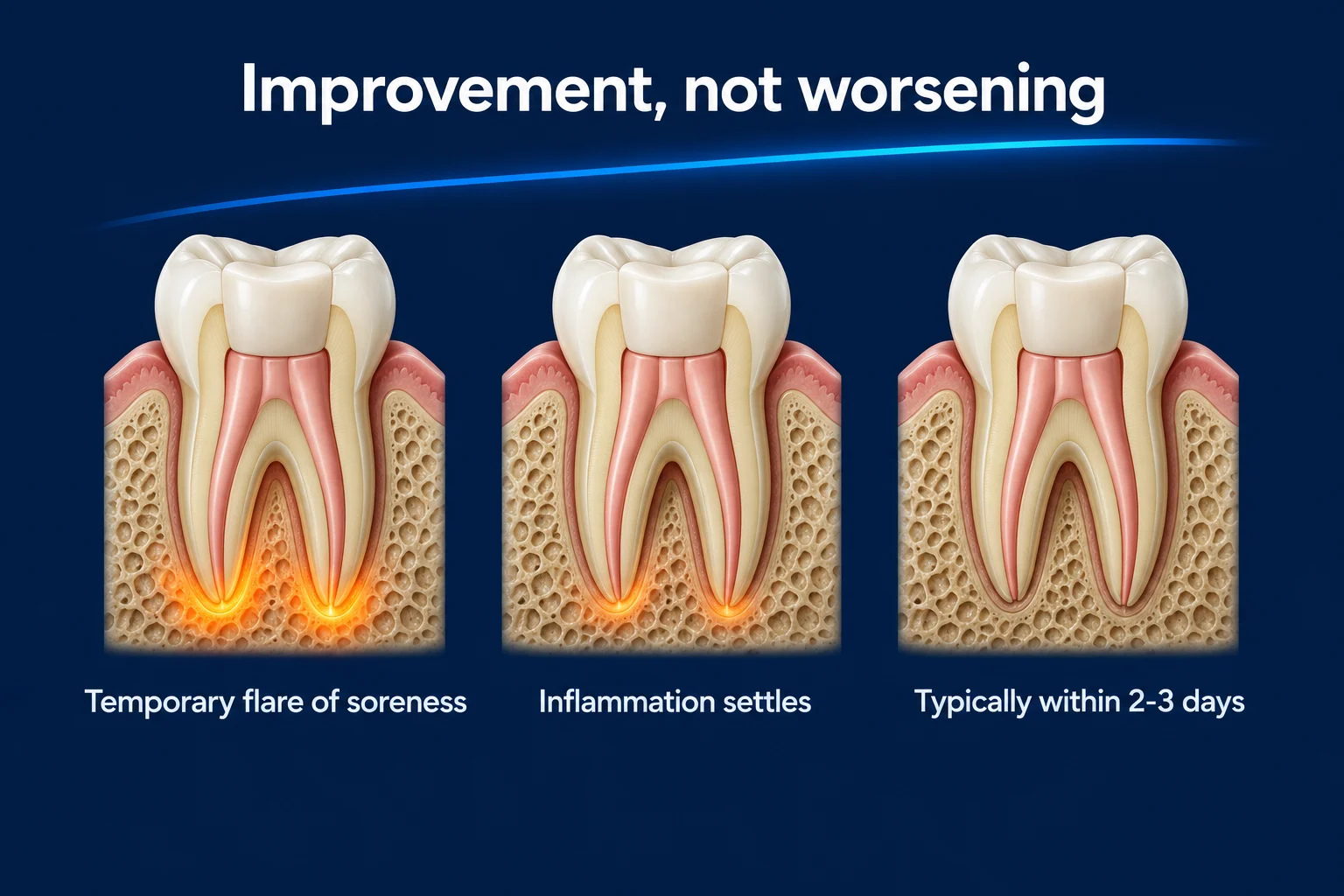
In cases where a significant pre-existing abscess or a radiographic lesion was present, this post-treatment soreness may be slightly more pronounced and last a few days longer, since pre-treatment pain and visible lesions at the root tip are linked to a higher chance of a temporary flare-up.3 The trajectory should always be improvement, not worsening.
What Happens Next: The Crown Appointment
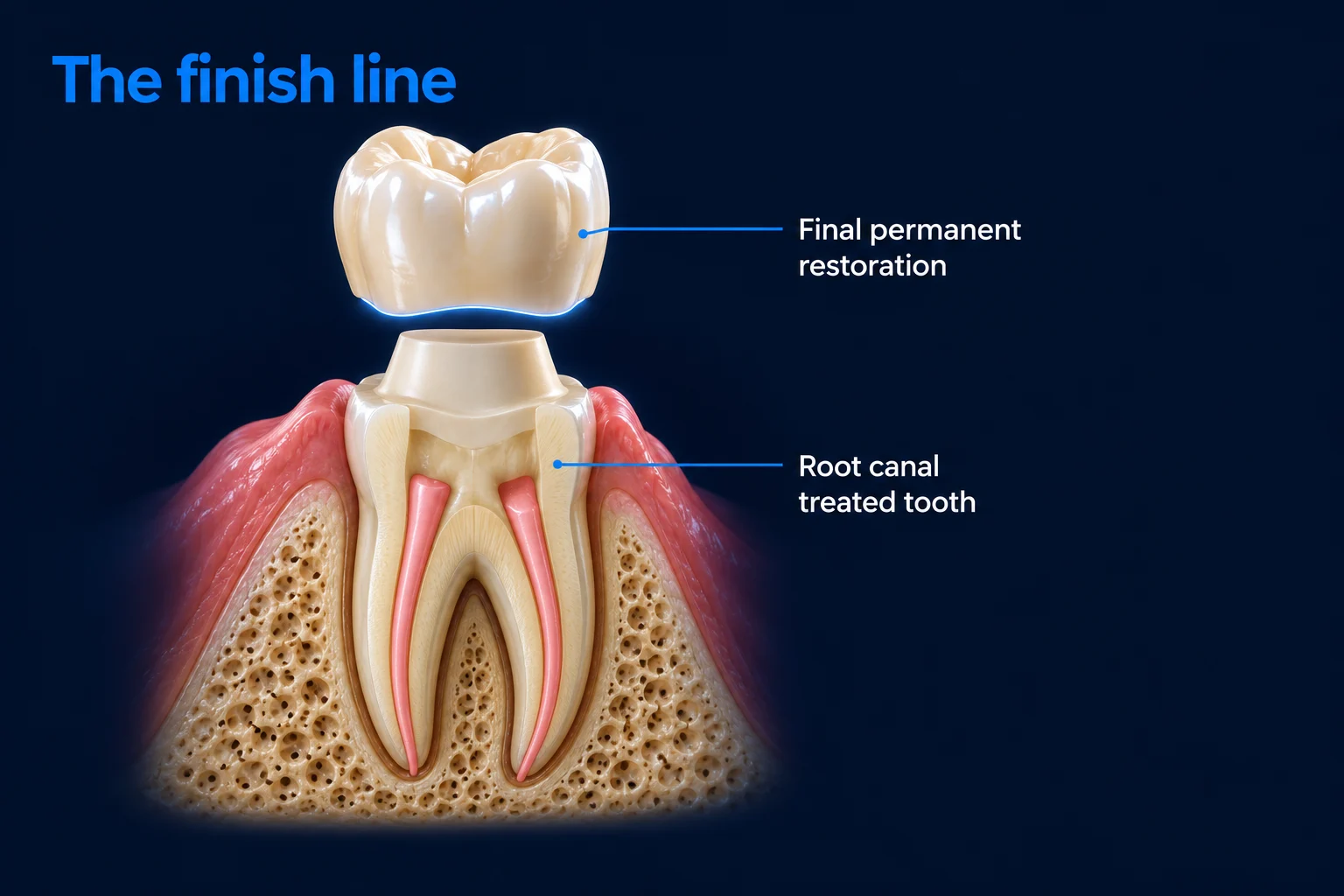
A root canal treated tooth needs a final permanent restoration placed by your general dentist, the sooner the better. This protects the tooth from fracture and restores full biting function. Think of it as the finish line, it’s what locks in all the work and keeps your tooth strong for years. Your general dentist will advise on the right restoration for your tooth, whether that’s a crown, a buildup, or another option. Scheduling it promptly is the last step in protecting everything you’ve already done.
Your endodontist will send a detailed treatment report to your general dentist including the number of canals treated, the materials used, and any specific notes about the case. You do not need to bring X-rays, they will be communicated directly.
One more practical note on the appointment plan: completing a root canal in a single visit or across multiple visits leads to comparable healing and complication rates, so let your endodontist’s recommendation for your specific tooth guide the schedule rather than worrying that one approach is safer than the other.4
Post-operative pain following root canal treatment is well-characterized in the literature. A systematic review and meta-analysis of 72 studies, published in the Journal of Endodontics, found that root canal associated pain prevalence dropped from 81% before treatment to about 40% at 24 hours and roughly 11% at one week, with pain severity falling to minimal levels by 7 days.1 Separate research has shown that pre-existing periradicular pain and a visible lesion at the root tip are among the factors linked to more pronounced post-treatment discomfort,2 which is why severe or escalating pain after treatment warrants clinical reassessment rather than waiting it out. When discomfort lingers between appointments, options such as calcium hydroxide and combination intracanal medicaments have shown a measurable benefit for inter-appointment pain in controlled trials.5
Works Cited
- Pak JG, White SN. Pain prevalence and severity before, during, and after root canal treatment: a systematic review. J Endod. 2011;37(4):429-438. doi:10.1016/j.joen.2010.12.016 Systematic Review
- Genet JM, Hart AA, Wesselink PR, Thoden van Velzen SK. Preoperative and operative factors associated with pain after the first endodontic visit. Int Endod J. 1987;20(2):53-64. doi:10.1111/j.1365-2591.1987.tb00590.x
- Imura N, Zuolo ML. Factors associated with endodontic flare-ups: a prospective study. Int Endod J. 1995;28(5):261-265. doi:10.1111/j.1365-2591.1995.tb00311.x Prospective Study
- Manfredi M, Figini L, Gagliani M, Lodi G. Single versus multiple visits for endodontic treatment of permanent teeth. Cochrane Database Syst Rev. 2016;12:CD005296. doi:10.1002/14651858.CD005296.pub3 Systematic Review
- Ahmad MZ, Sadaf D, Merdad KA, Almohaimeed A, Onakpoya IJ. Calcium hydroxide as an intracanal medication for postoperative pain during primary root canal therapy: a systematic review and meta-analysis with trial sequential analysis of randomised controlled trials. J Evid Based Dent Pract. 2022;22(1):101680. doi:10.1016/j.jebdp.2021.101680 Systematic Review