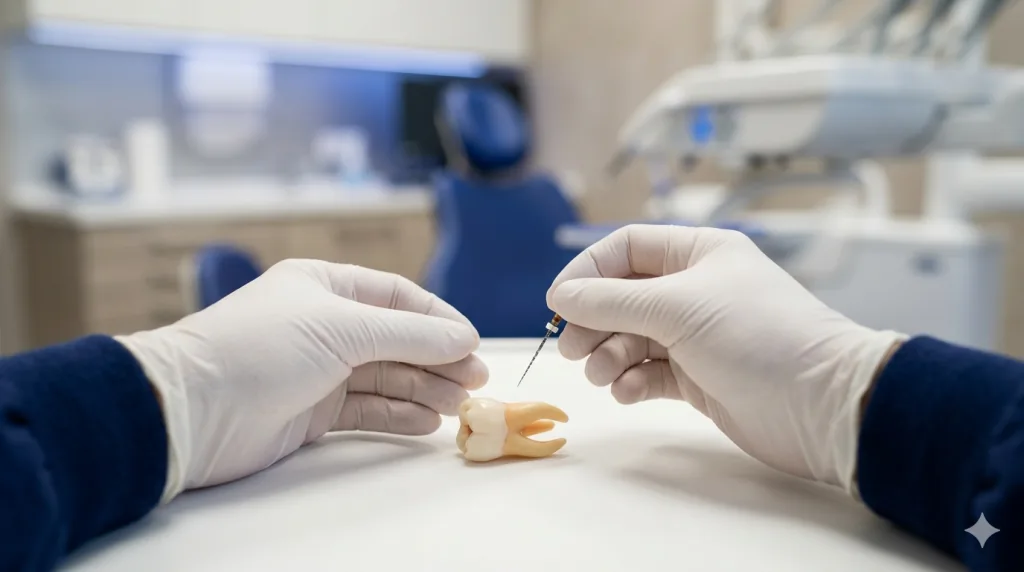
A fractured tooth is not a single diagnosis, it is a spectrum of conditions ranging from a microscopic surface crack to a completely split tooth. The treatment varies just as widely. Understanding what each type of fracture involves helps you know what to expect and why a coordinated approach between your dentist and endodontic specialist produces the best outcomes.
Treatment by Fracture Type
No Treatment Needed
Microscopic surface cracks in the enamel only. Extremely common, produce no symptoms, and require no clinical intervention. If visible and aesthetically bothersome, cosmetic bonding or a veneer can improve appearance. Read about symptoms of a cracked tooth and how they present.
Managed by: General dentist, if cosmetic treatment desired
Crown ± Root Canal
A piece of the biting surface breaks away, usually around a large filling. Often painless since the pulp is rarely directly involved. The remaining tooth structure needs to be restored and protected.
- Assessment of pulp health with testing and 3D CBCT (cone-beam CT, a low-dose 3D X-ray that lets us see the tooth and bone from every angle) imaging
- If pulp is healthy: crown placement by your general dentist
- If pulp is involved: root canal treatment by an endodontic specialist, then crown by your general dentist
Managed by: General dentist (crown) + Endodontic specialist if pulp involved
Crown ± Root Canal
A crack extending from the chewing surface downward through dentin, the most common source of cracked tooth syndrome pain. The pulp may or may not be involved depending on crack depth and duration. See whether a cracked tooth can heal on its own.
- Comprehensive evaluation: bite testing, transillumination (shining a bright light through the tooth to reveal crack lines that are otherwise invisible), 3D CBCT imaging, pulp vitality (whether the living tissue inside the tooth is still healthy and functioning) testing
- If pulp is reversibly inflamed or healthy: full-coverage crown to immobilize the crack and protect the pulp, which the evidence favors over a direct filling for a cracked tooth1
- If pulp is irreversibly inflamed or necrotic (dead, referring to tissue that has lost its blood supply and died, most commonly the pulp inside an infected tooth): root canal treatment first, then crown placement
- Follow-up to confirm pulp healing (if crown placed without root canal) or periapical healing (after root canal)
Managed by: Endodontic specialist (diagnosis + root canal if needed) + General dentist (crown)
Partial Save or Extraction
The crack has progressed to completely divide the tooth into two distinct segments. Whether any portion of the tooth can be saved depends on the position of the split relative to the bone and gum level.
- 3D CBCT imaging to assess split extent and bone involvement
- If split is coronal only and one root is intact: hemisection (removal of one root) may allow partial tooth retention
- If split extends fully through both roots: extraction is required
- After extraction: implant or bridge planning with your general dentist or prosthodontist
Managed by: Endodontic specialist + General dentist or oral surgeon for extraction and replacement
Usually Extraction
A crack originating in the root and extending upward, often in previously root canal treated teeth. Produces minimal symptoms for a long time, making it one of the most insidious dental fractures. Typically diagnosed when halo-shaped bone loss is seen on 3D CBCT imaging.
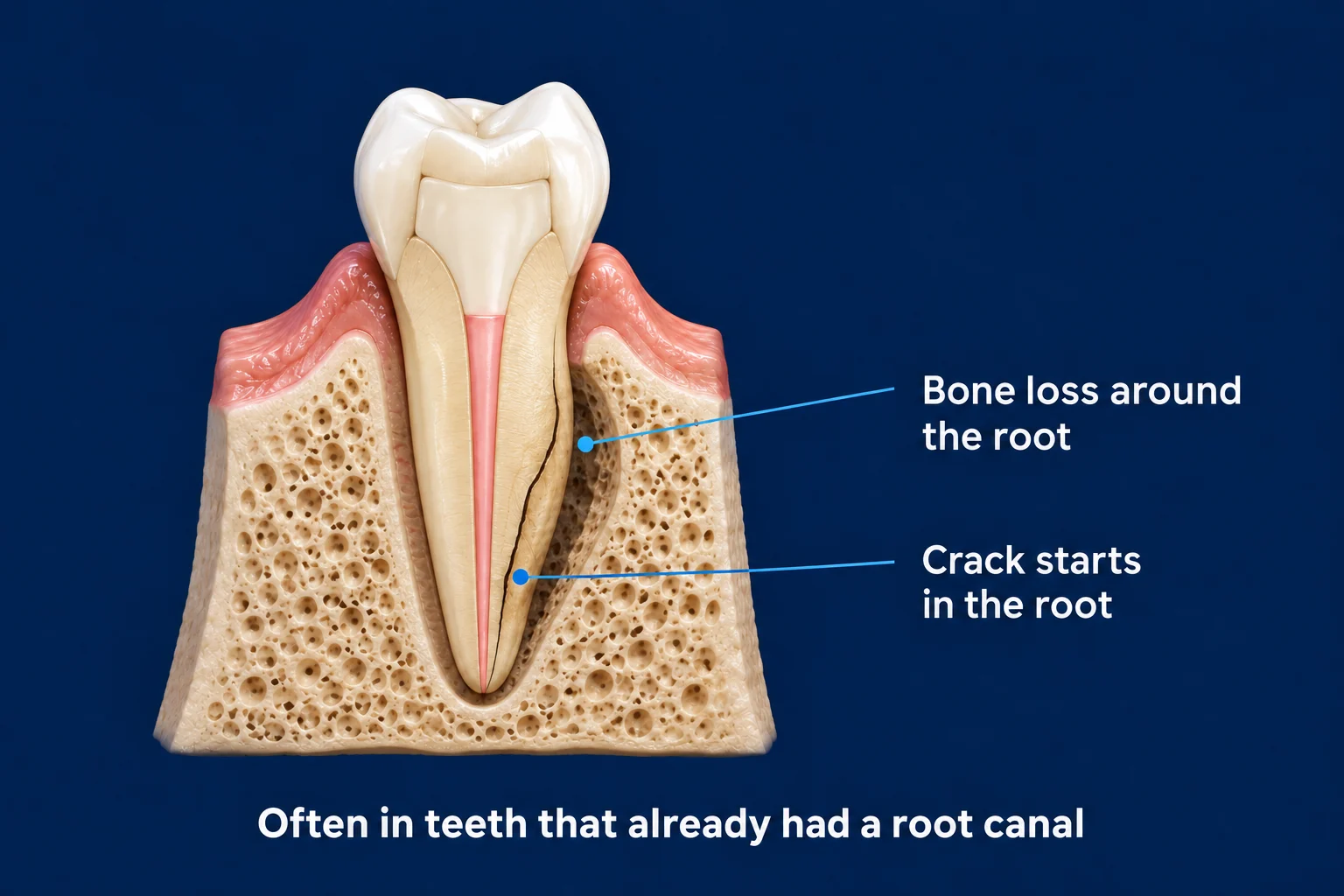
- 3D CBCT imaging confirms diagnosis
- In multi-rooted teeth: root resection (surgical removal of the fractured root only) may preserve part of the tooth
- In single-rooted teeth or when bone loss is extensive: extraction is required
- Replacement planning as above
Managed by: Endodontic specialist (diagnosis + surgery if applicable) + General dentist for extraction and replacement
Root Canal + Crown or Pulp Cap
A tooth broken by trauma, sports injury, fall, or impact, where the fracture has exposed the pulp. Requires urgent evaluation within hours, not days.2 Treatment depends on patient age, time since injury, and size of pulp exposure.2 Read what happens when dental trauma requires root canal therapy.
- Urgent evaluation, same-day preferred for pulp exposures
- In young patients with mature teeth or small exposures: pulp capping may be attempted to preserve pulp vitality
- In most adult cases: root canal treatment followed by crown or post-and-core restoration
- Regular follow-up to monitor root development in younger patients
Managed by: Endodontic specialist (urgent evaluation + treatment) + General dentist (restoration)
Why Two Providers Are Almost Always Involved
Treatment of a fractured tooth almost always requires coordinated care between an endodontic specialist and a general dentist. The endodontic specialist handles everything related to the pulp, diagnosis, root canal treatment, and in some cases surgical intervention. The general dentist handles the restorative component, the crown, buildup, or permanent restoration that protects and restores the tooth’s function after endodontic treatment (treatment focused on the inside of the tooth, most commonly root canal therapy) is complete.
Critically, your general dentist needs to confirm the tooth is restorable before endodontic treatment begins, there is no value in completing a root canal on a tooth that cannot be adequately crowned. This assessment is part of the pre-treatment planning conversation your dentist and endodontist will have on your behalf.
How a cracked tooth is restored after treatment matters for how long it lasts. A 2024 systematic review and meta-analysis in the Journal of Dentistry reported tooth survival of roughly 93 to 98 percent over one to six years for cracked teeth that kept their living pulp, and found that covering the tooth with a full crown gave clearly better results than a direct filling: cracked teeth restored without full cuspal coverage carried a higher risk of pulp complications and extraction.1 For a cracked tooth that has had root canal treatment, the review found a full crown strongly reduced the risk of later extraction, which is why the restorative plan is decided alongside the endodontic plan from the start.1
A fractured tooth gets more difficult to save the longer it goes unevaluated. An endodontist at your nearest MFE location can assess what type of fracture you have and what treatment options remain. Find a location near you.
Works Cited
- Zhang S, Xu Y, Ma Y, Zhao W, Jin X, Fu B. The treatment outcomes of cracked teeth: a systematic review and meta-analysis. J Dent. 2024;142:104843. doi:10.1016/j.jdent.2024.104843 Systematic Review
- DiAngelis AJ, Andreasen JO, Ebeleseder KA, et al. International Association of Dental Traumatology guidelines for the management of traumatic dental injuries: 1. Fractures and luxations of permanent teeth. Dent Traumatol. 2012;28(1):2-12. doi:10.1111/j.1600-9657.2011.01103.x