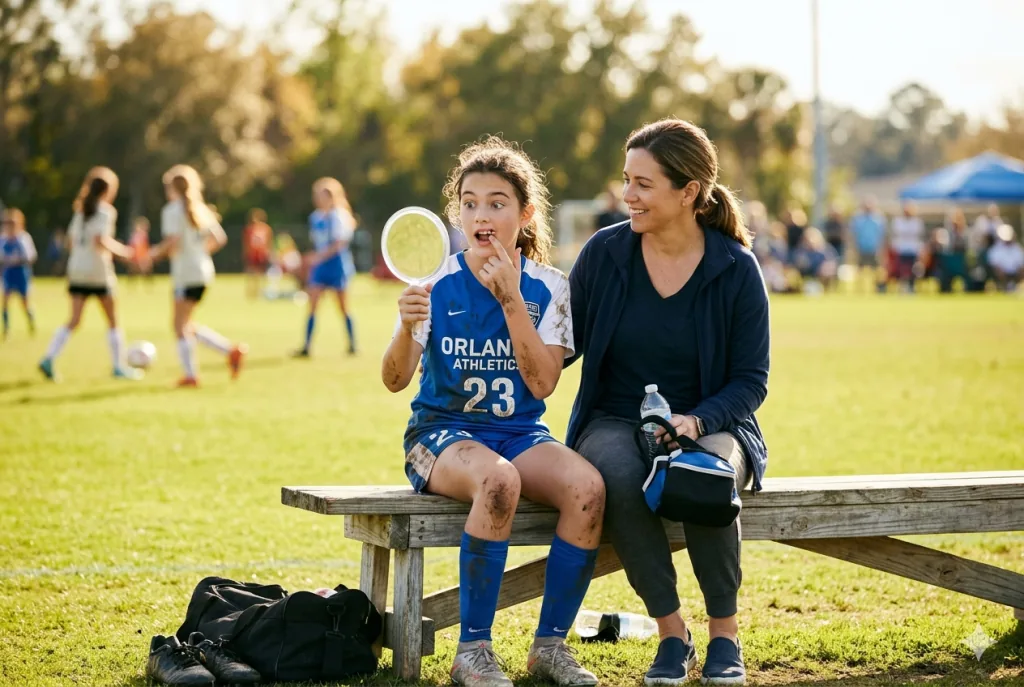
Dental injuries in sports are more common than most athletes and parents realize. Sports-related dental trauma accounts for a meaningful share of all dental injuries, and unlike many other injuries, the window for the most successful treatment is measured in minutes, not days.1 The American Association of Endodontists advises reaching a dentist or endodontist within 30 minutes4, and in a long-term study of 400 replanted teeth, the risk of the root fusing to the bone rose steadily with dry time, reaching 86% for fully formed teeth left dry more than 60 minutes, though some still healed.5
Knowing exactly what to do in the first moments after a dental sports injury can be the difference between saving a tooth and losing it permanently.
Knocked-Out Permanent Tooth. Act Quickly
Types of Sports Dental Injuries and What to Do
Avulsion (Completely Knocked-Out Tooth)
The entire tooth including root is displaced from the socket. Only occurs with permanent teeth, primary (baby) teeth are NOT replanted as this can damage developing adult teeth. Follow the emergency protocol above. Root canal treatment is almost always required after replantation.2
Intrusion (Tooth Pushed Into the Bone)
A tooth pushed upward into the socket by impact, appears shorter than neighbors. One of the most serious dental injuries. Requires urgent specialist evaluation. Depending on severity and patient age, treatment may involve allowing spontaneous re-eruption, orthodontic repositioning, or surgical repositioning, followed by root canal treatment.2
Luxation (Tooth Loosened or Displaced)
The tooth is still in the socket but has been loosened, tilted, or moved laterally. The periodontal ligament has been partially torn and the pulp (the soft living tissue inside the tooth, containing nerves and blood vessels) may be compromised. Treatment involves repositioning and splinting (bonding to adjacent teeth for stability). Root canal treatment may or may not be needed depending on pulp response over time.2
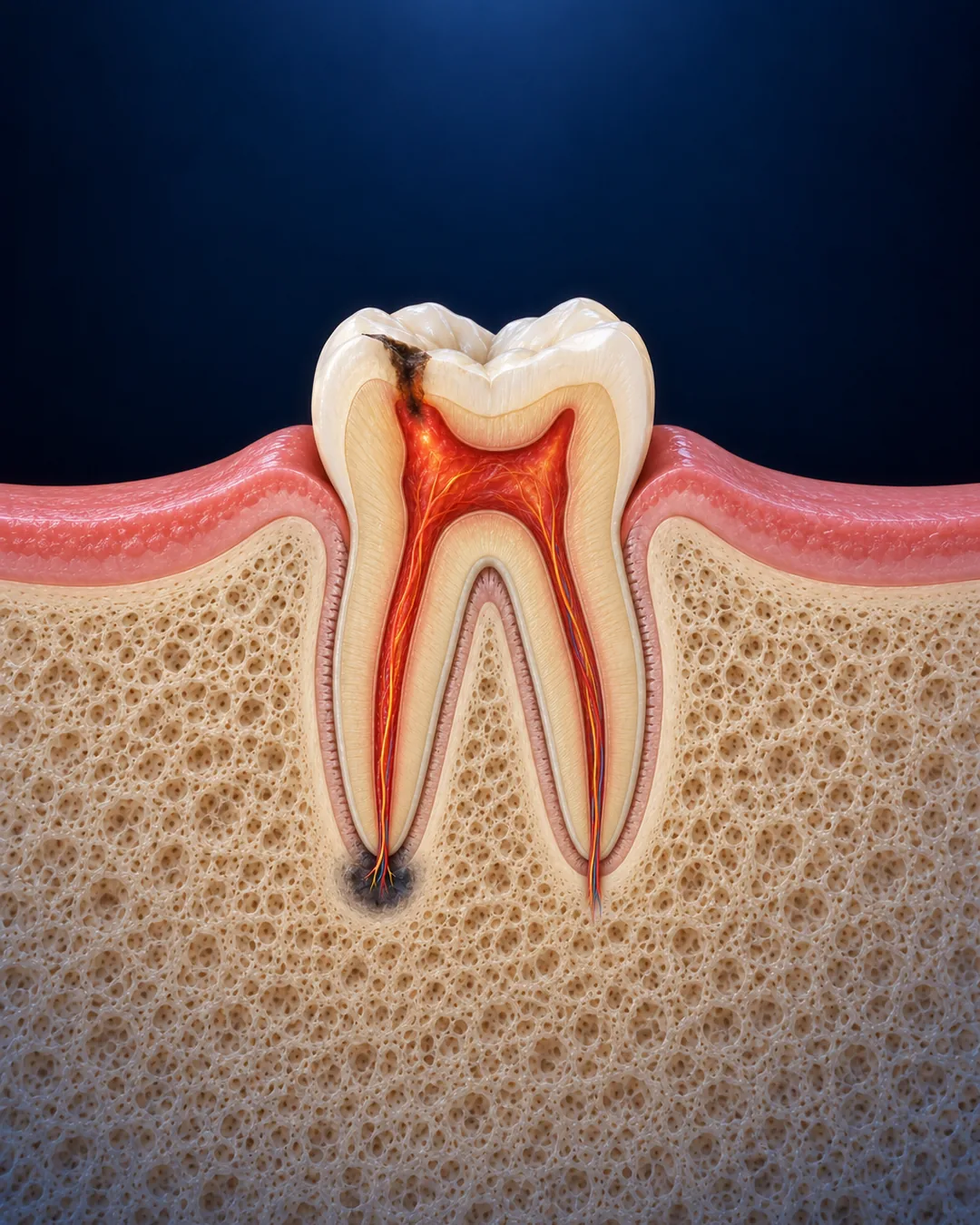
Crown Fracture with Pulp Exposure
A broken tooth where the pink pulp tissue is visible at the fracture site. Urgent evaluation is needed, the exposed pulp is vulnerable to infection. In appropriate cases, pulp capping may preserve pulp vitality (whether the living tissue inside the tooth is still healthy and functioning). Root canal treatment is often required. A permanent crown will be needed once pulp status is confirmed stable.2
Uncomplicated Crown Fracture (No Pulp Exposure)
A chip or fracture of enamel (the hard outer shell of the tooth, the hardest substance in the human body) and dentin (the layer of tooth beneath the hard enamel, softer and more sensitive, containing microscopic channels that connect to the nerve) without visible pulp exposure. Less urgent but still requires evaluation, the fracture may be deeper than it appears, and exposed dentin is sensitive and vulnerable to bacterial infiltration. Treatment typically involves bonding or a crown; root canal treatment may be needed if the pulp becomes inflamed over time.2
Concussion (No Movement, Tender to Touch)
The tooth has been jarred by impact but not displaced. It may be sore to bite or touch but is firm in the socket. No immediate intervention typically needed, but the tooth should be monitored for pulp changes over the following weeks to months, some concussed teeth develop pulp necrosis (death of the living tissue inside the tooth) gradually even without initial displacement.2
Preventing Sports Dental Injuries
Replantation timing is the strongest predictor of avulsed tooth (a tooth that has been completely knocked out of its socket) survival. In a study of 400 avulsed and replanted permanent incisors published in Endodontics & Dental Traumatology, the length of the dry extra-alveolar storage period and immediate replantation were among the factors most strongly related to healing of the periodontal ligament, and the authors recommended immediate replantation in every case.1 The current International Association of Dental Traumatology guidelines build on this evidence, advising rapid replantation when possible and storage in milk, saliva, or saline rather than water when it is not.2 These findings are why fast, calm first aid at the field matters so much: the supporting ligament cells stay viable only while the root is kept moist and out of the socket for as short a time as possible.1
Works Cited
- Andreasen JO, Borum MK, Jacobsen HL, Andreasen FM. Replantation of 400 avulsed permanent incisors. 4. Factors related to periodontal ligament healing. Endod Dent Traumatol. 1995;11(2):76-89. doi:10.1111/j.1600-9657.1995.tb00464.x Prospective Study
- DiAngelis AJ, Andreasen JO, Ebeleseder KA, et al. International Association of Dental Traumatology guidelines for the management of traumatic dental injuries: 1. Fractures and luxations of permanent teeth. Dent Traumatol. 2012;28(1):2-12. doi:10.1111/j.1600-9657.2011.01103.x
- Fernandes LM, Neto JCL, Lima TFR, et al. The use of mouthguards and prevalence of dento-alveolar trauma among athletes: a systematic review and meta-analysis. Dent Traumatol. 2019;35(1):54-72. doi:10.1111/edt.12441 Systematic Review
- American Association of Endodontists. Knocked-Out Teeth. Accessed September 28, 2026. aae.org
- Lauridsen E, Andreasen JO, Bouaziz O, Andersson L. Risk of ankylosis of 400 avulsed and replanted human teeth in relation to length of dry storage: a re-evaluation of a long-term clinical study. Dent Traumatol. 2020;36(2):108-116. doi:10.1111/edt.12520 Prospective Study