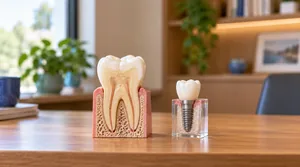
Many people put off a root canal because of cost. If that is where you are, you are not alone. The first step is a phone call to our team.
Below, we explain what goes into the cost of a root canal and crown. We cover how insurance works and how CareCredit can spread the cost. We walk you through what happens when you call us. And we explain why saving the tooth is often the better value.
How much does a root canal and crown cost?
There is no single price, and you will not find one on this page. The cost depends on the tooth, the work it needs and your insurance. A fair number for one person can be far off for the next.
Online price guides list national ranges. Those ranges are wide, and they may not match your area or your plan. The number that counts is the estimate you get from us after an exam and X-rays.
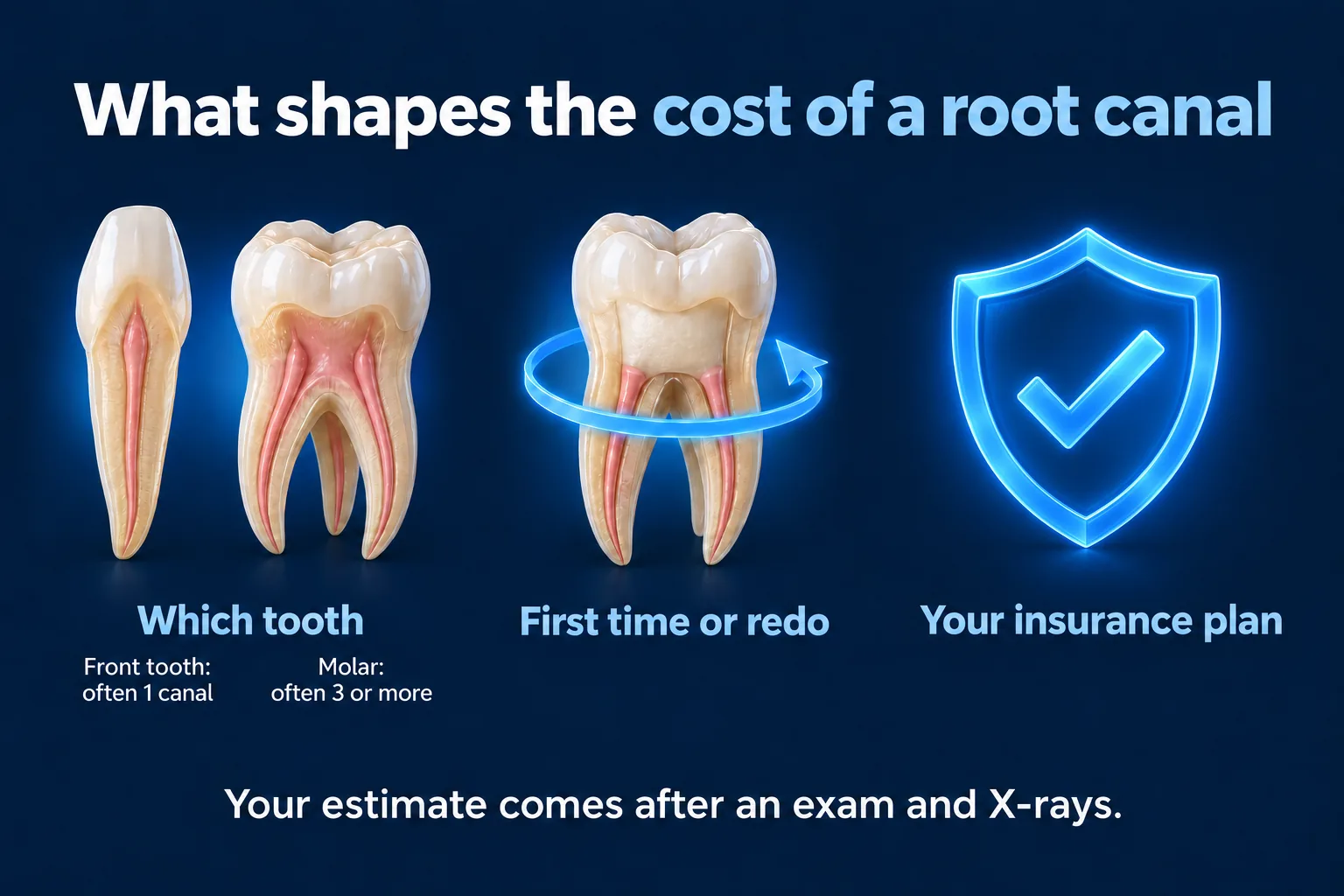
What changes the cost of the root canal?
- Which tooth it is. Front teeth most often have one canal. Molars, the large teeth in the back, often have three or more.1 More canals take more time.
- First time or redo. Treating a tooth again after an old root canal is more involved. This is called root canal retreatment, and it is priced on its own.
- Imaging. Most patients get a 3D scan at their visit, so your endodontist can see the roots clearly.
Why is the crown a separate bill?
A root canal and a crown are two steps, and they often happen in different offices. An endodontist does the root canal. In most cases, your general dentist then places the crown. So you may get one estimate from each office.
Ask for both before you start. That way you see the full cost up front. Ask your general dentist if a crown is needed for your tooth, and when it should go on.
Do you need a crown after a root canal?
For back teeth, a crown is one of the best things you can do to keep the tooth. It helps to plan for it from the start.
In one study, teeth that did not get a crown after a root canal were lost at six times the rate of teeth that did.2 In a study of more than one million treated teeth in the United States, 97% were still in place eight years later. Of the few teeth that were pulled, most had no crown.3
Timing matters too. One study of back teeth found that teeth crowned more than four months after a root canal were about three times as likely to be pulled later.4 So if cost is tight, try to budget for the crown as part of the plan, not as an extra you get to someday.
What does dental insurance cover for a root canal?
Most dental plans pay part of a root canal. What you pay depends on your plan, your deductible and how much of your yearly maximum you have used.
Here is how it works at Mid-Florida Endodontics:
- We are in-network with many PPO, DMO and HMO plans, and with Medicaid dental plans such as MCNA, DentaQuest and Liberty Dental Plan. We also accept many Medicare plans.
- Some plans need a referral from your dentist before you book. Our team will tell you if yours does.
- Before treatment, we call your plan and verify your benefits.
- You get an estimate of your share before any work begins. That way, there are no surprise charges later.
Plans and coverage change, and they can vary by office. See our insurance and fees page for the current list, or call your nearest office with your card in hand.
How can you make your benefits go further?
A few questions can help you get the most from your plan:
- How much of my yearly maximum is left? Most plans cap what they pay each year. If you have had other dental work this year, less may be left.
- Have I met my deductible? This is the amount you pay before your plan starts to pay.
- Is there a waiting period? Some plans do not cover certain care until you have been on the plan for a while.
- Is the office in-network? In-network offices have agreed fees with your plan, which often lowers your share.
You do not have to sort this out alone. When we verify your benefits, our team looks up your deductible, what is left of your yearly maximum and any referral your plan needs.
What if you don’t have dental insurance?
You are welcome at Mid-Florida Endodontics with or without insurance. We take cash, checks and all major credit cards. We also accept a number of dental discount programs, which can lower your fee.
How does CareCredit work?
CareCredit is a health care card that lets you pay for treatment over time. Many of its plans charge no interest if you pay the full balance by the end of the promo period. This applies to qualifying purchases. You can apply online from your phone and get a decision in seconds. You can also use it later for other dental, vision and medical care.
Read the terms before you sign up. If the balance is not paid in full by the end of the promo period, interest may apply. Our payment options page has the details, and your office can walk you through it.
What happens when you call us about cost?
Here is what to expect, step by step:
- Call your nearest office. Tell us your dental plan, or tell us you do not have one.
- If your plan needs a referral, we tell you how to get it.
- Before your visit, we call your plan and verify your benefits.
- At your visit, your endodontist looks at the tooth and takes X-rays. You hear honestly whether the tooth can be saved.
- You get a written estimate of your share before any treatment starts.
- If you want to spread the cost, you can apply for CareCredit from your phone.
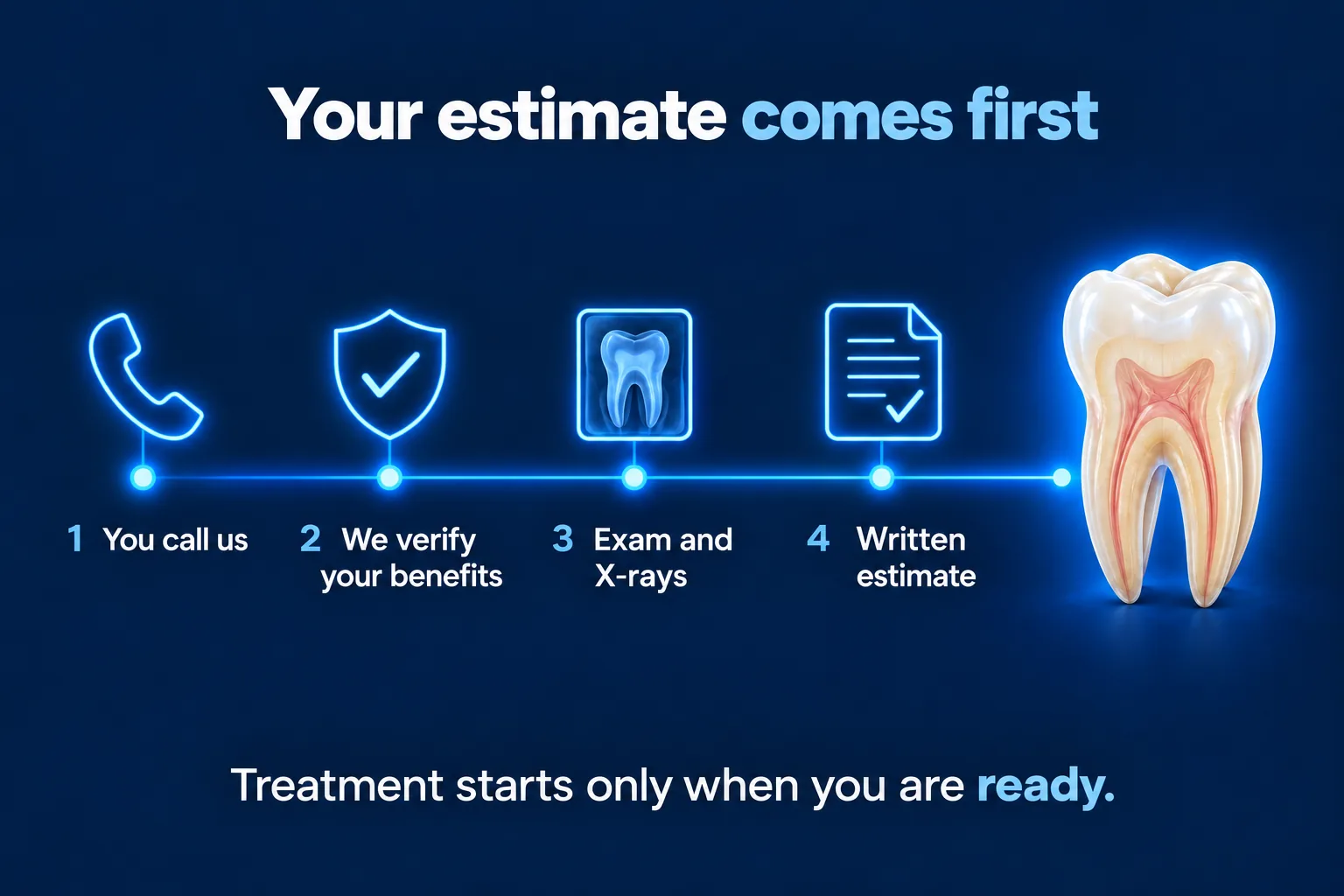
Treatment starts only when you are ready. If you have questions about the numbers, ask. Our team would rather explain twice than have you guess.
Is pulling the tooth cheaper than a root canal?
On the day of treatment, removing a tooth usually costs less. Removing the tooth is an option, and sometimes it is the right one. But the bill does not always stop there.
Once a tooth is gone, the bone where it sat starts to shrink. The fastest change happens in the first three to six months.5 To fill the gap, many people later get an implant, a bridge or a partial denture. Each of those has its own cost.
A large review found that a tooth saved with a root canal and a single implant last about the same length of time.6 Cost studies point toward saving the tooth. One from the United Kingdom modeled a front tooth over a lifetime. It found that a root canal was a good value as the first choice, ahead of replacing the tooth.7
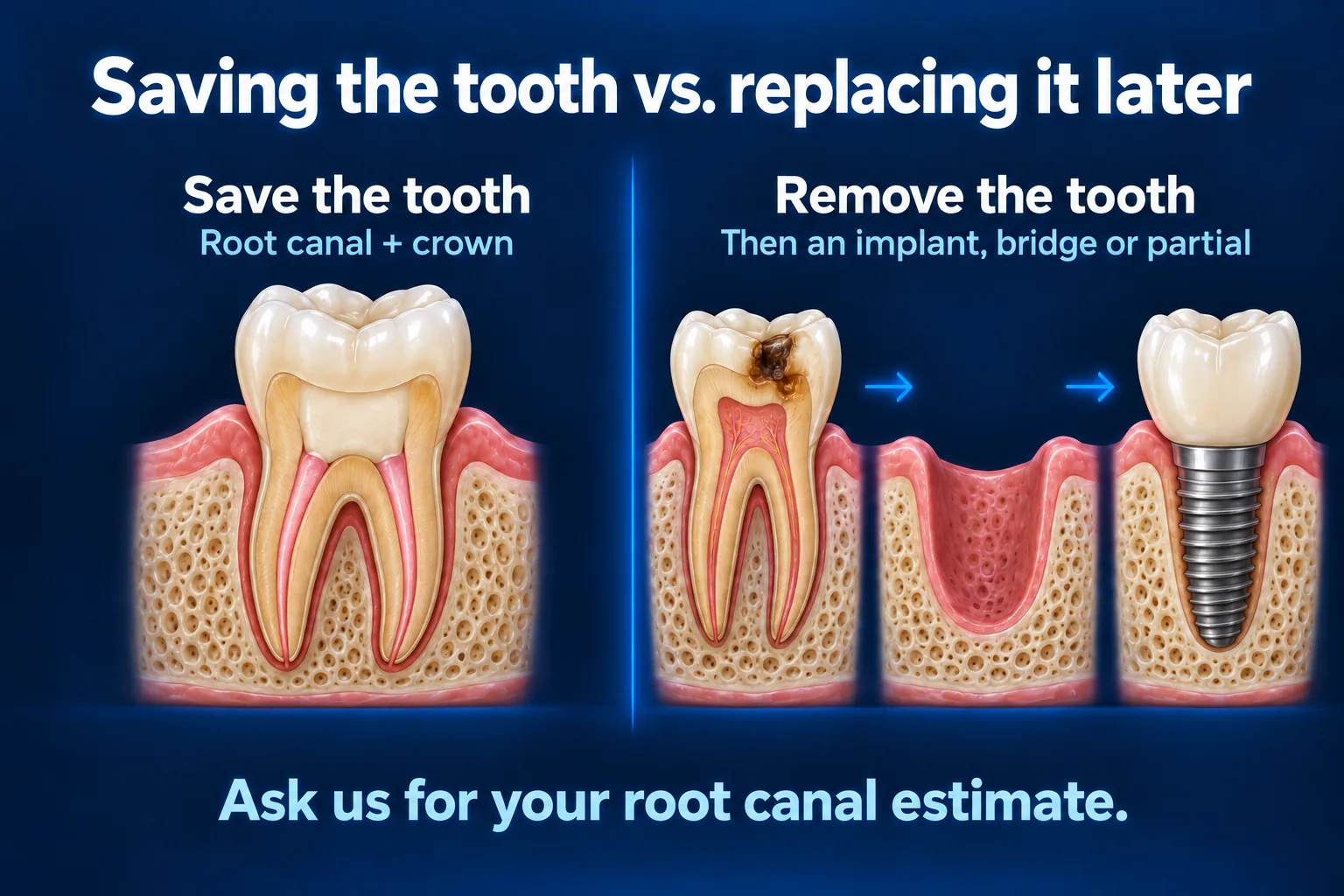
So the cheaper choice today can cost more down the road. Ask us for your root canal estimate. Your general dentist can tell you what it would take to replace the tooth. Our guides on root canal vs. extraction and why a root canal saves teeth go deeper.
What happens if you wait?
It is tempting to wait until money is less tight. The hard part is that an infected tooth does not heal on its own. A dental abscess will not go away without treatment.8
Antibiotics are not a way around it. The American Dental Association advises against them for most tooth pain and swelling, and says treating the tooth should come first.9 Pain may fade for a while, but the source stays inside the tooth.
If cost is the reason you are waiting, tell us. We would rather help you find a way to pay than see a tooth we could have saved get worse. Treating it sooner usually keeps more options open.
What should you ask before treatment?
These questions help you see the full picture before you decide:
- Can this tooth be saved?
- What is my estimate for the root canal, and what will my plan pay?
- Does my plan need a referral before my visit?
- Who will place the crown, and what will it cost?
- How soon should the crown go on?
- What would it cost to remove the tooth and replace it later?
- Can I use CareCredit to pay over time?
We will answer each one in plain words. At Mid-Florida Endodontics, your endodontist will tell you honestly if your tooth can be saved. Our team will go over the numbers with you before anything starts.
How do you book with Mid-Florida Endodontics?
Call your nearest office and have your insurance card ready. Our team can explain your plan’s coverage over the phone and find you an appointment.
Bring three things to your visit: your insurance card, a photo ID and your referral, if your plan needs one. Our what to bring page has the full list. You can also fill out your new patient forms online before you arrive, which saves time at the front desk.
If cost is on your mind, say so when you call. It is a normal question. The sooner we know, the sooner we can help you find a way to pay that works.
If you are in pain, call early in the day. Most of our offices offer same-day emergency care. For more on coverage, see our cost, insurance and financing guide.
Questions about cost? Call your nearest Mid-Florida Endodontics office. We will verify your benefits and give you an estimate before treatment. Find a location near you.
Works Cited
Sources 1 through 7 and 9 were verified against PubMed records on October 27, 2026. Source 8 is a web page read in full on October 27, 2026.
- Vertucci FJ. Root canal anatomy of the human permanent teeth. Oral Surg Oral Med Oral Pathol. 1984;58(5):589-599. doi:10.1016/0030-4220(84)90085-9
- Aquilino SA, Caplan DJ. Relationship between crown placement and the survival of endodontically treated teeth. J Prosthet Dent. 2002;87(3):256-263. doi:10.1067/mpr.2002.122014
- Salehrabi R, Rotstein I. Endodontic treatment outcomes in a large patient population in the USA: an epidemiological study. J Endod. 2004;30(12):846-850. doi:10.1097/01.don.0000145031.04236.ca
- Pratt I, Aminoshariae A, Montagnese TA, Williams KA, Khalighinejad N, Mickel A. Eight-year retrospective study of the critical time lapse between root canal completion and crown placement: its influence on the survival of endodontically treated teeth. J Endod. 2016;42(11):1598-1603. doi:10.1016/j.joen.2016.08.006
- Tan WL, Wong TL, Wong MC, Lang NP. A systematic review of post-extractional alveolar hard and soft tissue dimensional changes in humans. Clin Oral Implants Res. 2012;23(suppl 5):1-21. doi:10.1111/j.1600-0501.2011.02375.x
- Torabinejad M, Anderson P, Bader J, et al. Outcomes of root canal treatment and restoration, implant-supported single crowns, fixed partial dentures, and extraction without replacement: a systematic review. J Prosthet Dent. 2007;98(4):285-311. doi:10.1016/S0022-3913(07)60102-4
- Pennington MW, Vernazza CR, Shackley P, Armstrong NT, Whitworth JM, Steele JG. Evaluation of the cost-effectiveness of root canal treatment using conventional approaches versus replacement with an implant. Int Endod J. 2009;42(10):874-883. doi:10.1111/j.1365-2591.2009.01582.x
- Dental abscess. NHS. Page last reviewed March 18, 2026. Accessed October 27, 2026. nhs.uk/conditions/dental-abscess
- Lockhart PB, Tampi MP, Abt E, et al. Evidence-based clinical practice guideline on antibiotic use for the urgent management of pulpal- and periapical-related dental pain and intraoral swelling: a report from the American Dental Association. J Am Dent Assoc. 2019;150(11):906-921.e12. doi:10.1016/j.adaj.2019.08.020